
Month: November 2016

Immigrant community integration in world cities

Migrant and hosting communities face long-term challenges in the integration process. Immigrants must adapt to new laws and ways of life, while hosts need to adjust to multicultural societies. Integration impacts many facets of life such as access to jobs, real state and public services and can be well approximated by the extent of spatial segregation of minority group residence. Here we conduct an extensive study of immigrant integration in 53 world cities by using Twitter language detection and by introducing metrics of spatial segregation. In this way, we quantify the Power of Integration of cities (their capacity to integrate diverse cultures), and characterize the relations between cultures when they act in the role of hosts and immigrants.


Immigrant community integration in world cities

Fabio Lamanna, Maxime Lenormand, María Henar Salas-Olmedo, Gustavo Romanillos, Bruno Gonçalves, José J. Ramasco

Source: arxiv.org

Spoiler: and the most integrated city according to this study is… London!
An Information-theoretic Classification of Complex Systems

Using elementary cellular automata as an example, a novel, information-based classification of complex systems is proposed that circumvents the problems associated with isolating the complexity generated as a product of an initial state from that which is intrinsic to a dynamical rule. Transfer entropy variations processed by the system for different initial states split the 256 elementary rules into three information classes. These classes form a hierarchy such that coarse-graining transitions permitted among automata rules predominately occur within each information-based class, or much more rarely down the hierarchy.


An Information-theoretic Classification of Complex Systems

Enrico Borriello, Sara Imari Walker

Source: arxiv.org

Multiplex Modeling of the Society

The society has a multi-layered structure, where the layers represent the different contexts. To model this structure we begin with a single-layer weighted social network (WSN) model showing the Granovetterian structure. We find that when merging such WSN models, a sufficient amount of inter-layer correlation is needed to maintain the relationship between topology and link weights, while these correlations destroy the enhancement in the community overlap due to multiple layers. To resolve this, we devise a geographic multi-layer WSN model, where the indirect inter-layer correlations due to the geographic constraints of individuals enhance the overlaps between the communities and, at the same time, the Granovetterian structure is preserved. Furthermore, the network of social interactions can be considered as a multiplex from another point of view too: each layer corresponds to one communication channel and the aggregate of all them constitutes the entire social network. However, usually one has information only about one of the channels, which should be considered as a sample of the whole. Here we show by simulations and analytical methods that this sampling may lead to bias. For example, while it is expected that the degree distribution of the whole social network has a maximum at a value larger than one, we get with reasonable assumptions about the sampling process a monotonously decreasing distribution as observed in empirical studies of single channel data. We analyse the far-reaching consequences of our findings.


Multiplex Modeling of the Society

Janos Kertesz, Janos Torok, Yohsuke Murase, Hang-Hyun Jo, Kimmo Kaski

Source: arxiv.org

A Universal Rank-Size Law

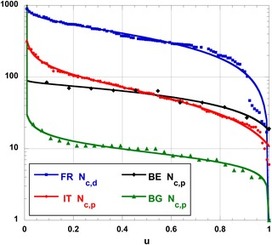
A mere hyperbolic law, like the Zipf’s law power function, is often inadequate to describe rank-size relationships. An alternative theoretical distribution is proposed based on theoretical physics arguments starting from the Yule-Simon distribution. A modeling is proposed leading to a universal form. A theoretical suggestion for the “best (or optimal) distribution”, is provided through an entropy argument. The ranking of areas through the number of cities in various countries and some sport competition ranking serves for the present illustrations.


Ausloos M, Cerqueti R (2016) A Universal Rank-Size Law. PLoS ONE 11(11): e0166011. doi:10.1371/journal.pone.0166011

Source: journals.plos.org

Traffic gridlock on a honeycomb city

As a clear signature of modern urban design concepts, urban street networks in dense populated zones are evolving nowadays towards grid-like layouts with rectangular shapes, and most studies on traffic flow assume street networks as square lattices. However, ideas from forgotten design schools bring unexplored alternatives that might improve traffic flow in many circumstances. Inspired on an old and almost in oblivion urban plan, we report the behavior of the Biham-Middleton-Levine model (BML) \– a paradigm for studying phase transitions of traffic flow \– on a hypothetical city with a perfect honeycomb street network. In contrast with the original BML model on a square lattice, the same model on a honeycomb does not show any anisotropy or intermediate states, but a single continuous phase transition between free and totally congested flow, a transition that can be completely characterized by the tools of classical percolation. Although the transition occurs at a lower density than for the conventional BML, simple modifications, like randomly stopping the cars with a very small probability or increasing the traffic light periods, drives the model to perform better on honeycomb lattices. As traffic lights and disordered perturbations are inherent to real traffic, these results question the actual role of the square grid-like designs and suggests the honeycombs as an interesting alternative for urban planning in real cities.


Traffic gridlock on a honeycomb city
L.E. Olmos, J.D. Muñoz

Source: arxiv.org