Month: November 2016

The Age of ‘Megachange’ – Why It Makes Us So Anxious

If you’re wondering why every week seems to bring some new disruption to your world, why once-solid institutions seem shaky, author Darrell West has some explanations. At the heart of them is the idea of megachange – itself rooted mostly in economics. Such periods of rapid disruption are cyclical, argues West, director of governance studies and the Center for Technology Innovation at the Brookings Institution. He explored these ideas in his new book, entitled Megachange: Economic Disruption, Political Upheaval, and Social Strife in the 21st Century.

Source: knowledge.wharton.upenn.edu

GECCO 2017

The Genetic and Evolutionary Computation Conference (GECCO) in 2017 will present the latest high-quality results in genetic and evolutionary computation. Topics include: genetic algorithms, genetic programming, ant colony optimization and swarm intelligence, complex systems (artificial life/robotics/evolvable hardware/generative and developmental systems/artificial immune systems), digital entertainment technologies and arts, evolutionary combinatorial optimization and metaheuristics, evolutionary machine learning, evolutionary multiobjective optimization, evolutionary numerical optimization, real world applications, search-based software engineering (including self-* search), theory and more.


2017 Genetic and Evolutionary Computation Conference (GECCO 2017)
July, 2017, Berlin, Germany
http://gecco-2017.sigevo.org/

Source: gecco-2017.sigevo.org

Quantifying the evolution of individual scientific impact

Are there quantifiable patterns behind a successful scientific career? Sinatra et al. analyzed the publications of 2887 physicists, as well as data on scientists publishing in a variety of fields. When productivity (which is usually greatest early in the scientist’s professional life) is accounted for, the paper with the greatest impact occurs randomly in a scientist’s career. However, the process of generating a high-impact paper is not an entirely random one. The authors developed a quantitative model of impact, based on an element of randomness, productivity, and a factor Q that is particular to each scientist and remains constant during the scientist’s career.


Quantifying the evolution of individual scientific impact
Roberta Sinatra, Dashun Wang, Pierre Deville, Chaoming Song, Albert-László Barabási

Science  04 Nov 2016:
Vol. 354, Issue 6312, 
DOI: 10.1126/science.aaf5239

Source: science.sciencemag.org

Hidden geometric correlations in real multiplex networks

Real networks often form interacting parts of larger and more complex systems. Examples can be found in different domains, ranging from the Internet to structural and functional brain networks. Here, we show that these multiplex systems are not random combinations of single network layers. Instead, they are organized in specific ways dictated by hidden geometric correlations between the layers. We find that these correlations are significant in different real multiplexes, and form a key framework for answering many important questions. Specifically, we show that these geometric correlations facilitate the definition and detection of multidimensional communities, which are sets of nodes that are simultaneously similar in multiple layers. They also enable accurate trans-layer link prediction, meaning that connections in one layer can be predicted by observing the hidden geometric space of another layer. And they allow efficient targeted navigation in the multilayer system using only local knowledge, outperforming navigation in the single layers only if the geometric correlations are sufficiently strong.


Hidden geometric correlations in real multiplex networks
Kaj-Kolja Kleineberg, Marián Boguñá, M. Ángeles Serrano & Fragkiskos Papadopoulos
Nature Physics 12, 1076–1081 (2016) doi:10.1038/nphys3812

Source: www.nature.com

Is Zika the cause of Microcephaly? Status Report November 4, 2016 | NECSI

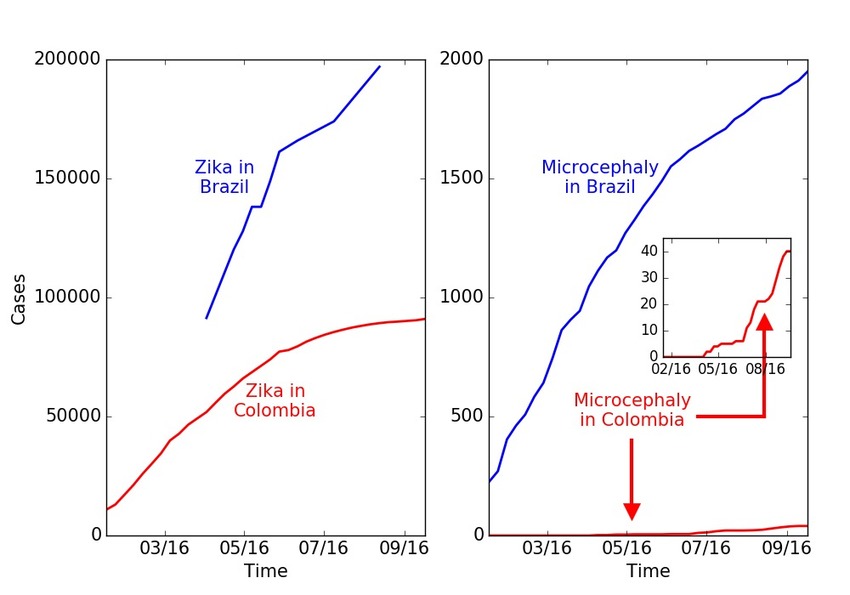
We summarize current evidence on the prevalence of Zika and microcephaly in Brazil and Colombia and conclude that the expectation of a large number of microcephaly cases outside of Brazil has not been realized. The ratio of microcephaly to Zika cases is inconsistent between Colombia and Brazil and between Brazilian states, where the majority of cases are confined to the northeast region. At the rate of microcephaly in Colombia, if all pregnancies in the Brazilian state of Pernambuco were infected by Zika, we estimate there would only be 100 cases of microcephaly in a year, whereas the number of confirmed cases is 386. Other causes and co-factors of microcephaly must be considered, including the pesticide pyriproxyfen which has been added to drinking water in some regions of Brazil since the fall of 2014 and is cross-reactive with retinoic acid which is known to cause microcephaly. Even without confirmation, the continued increase of microcephaly cases in Brazil by 100 per month warrants urgent policy action to stop the use of pyriproxyfen.


Yaneer Bar-Yam, Raphael Parens, Alfredo J. Morales, Is Zika the cause of Microcephaly? Status Report November 4, 2016, NECSI

Source: necsi.edu