

Complexity Theory is an emerging field of scientific study that seeks to offer a better framework for understanding dynamic, complex adaptive systems.
Source: www.hiddenforcespod.com
Networking the complexity community since 1999
Month: April 2017
Complexity Theory is an emerging field of scientific study that seeks to offer a better framework for understanding dynamic, complex adaptive systems.
Source: www.hiddenforcespod.com

We are delighted to welcome the 9th International Conference on Social Informatics (SocInfo 2017) to Oxford, UK, in September 2017.
SocInfo is an interdisciplinary venue for researchers from Computer Science, Informatics, Social Sciences and Management Sciences to share ideas and opinions, and present original research work on studying the interplay between socially-centric platforms and social phenomena.
The ultimate goal of Social Informatics is to create better understanding of socially-centric platforms not just as a technology, but also as a set of social phenomena. To that end, we are inviting interdisciplinary papers, on applying information technology in the study of social phenomena, on applying social concepts in the design of information systems, on applying methods from the social sciences in the study of social computing and information systems, on applying computational algorithms to facilitate the study of social systems and human social dynamics, and on designing information and communication technologies that consider social context.
Source: socinfo2017.oii.ox.ac.uk
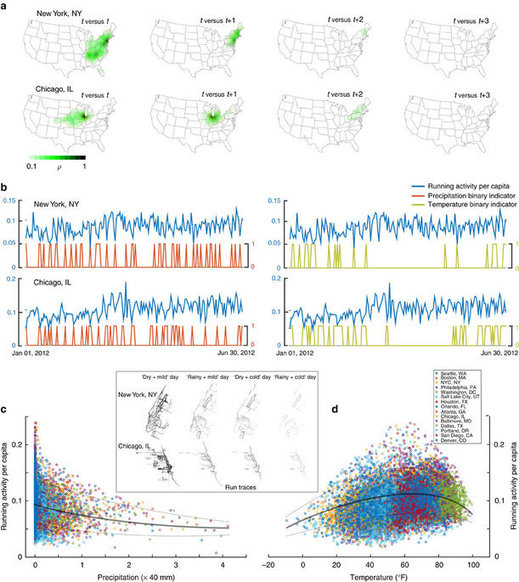
We leveraged exogenous variation in weather patterns across geographies to identify social contagion in exercise behaviours across a global social network. We estimated these contagion effects by combining daily global weather data, which creates exogenous variation in running among friends, with data on the network ties and daily exercise patterns of ∼1.1M individuals who ran over 350M km in a global social network over 5 years. Here we show that exercise is socially contagious and that its contagiousness varies with the relative activity of and gender relationships between friends. Less active runners influence more active runners, but not the reverse. Both men and women influence men, while only women influence other women. While the Embeddedness and Structural Diversity theories of social contagion explain the influence effects we observe, the Complex Contagion theory does not. These results suggest interventions that account for social contagion will spread behaviour change more effectively.
Exercise contagion in a global social network
Sinan Aral & Christos Nicolaides
Nature Communications 8, Article number: 14753 (2017)
doi:10.1038/ncomms14753
Source: www.nature.com

Government, where decisions made in a moment can affect millions of people for a lifetime, needs constant reminders of its fallibility. A big part of that has to be a proper respect for the methods of science, as well as for its substantive discoveries. Psychologists assure us that human beings have a strong desire to accept things as true because we want them to be true, not only because they are the best explanation for what we observe. In the hands of policy-makers, that natural tendency can have deadly consequences. Science has developed impressive (though not infallible) techniques for correcting for such biases; our government could stand to do a bit better.
Source: www.theatlantic.com
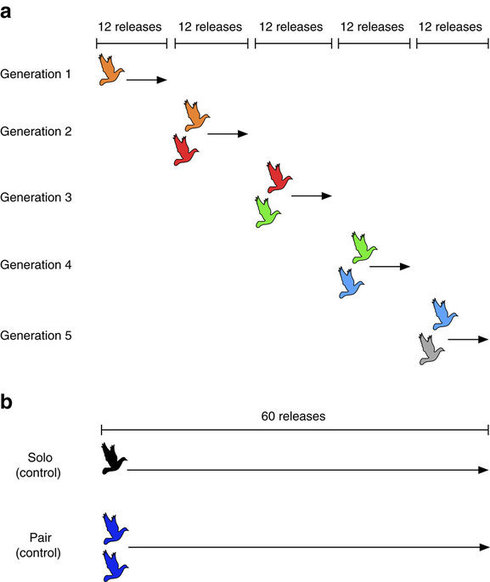
Studies of collective intelligence in animal groups typically overlook potential improvement through learning. Although knowledge accumulation is recognized as a major advantage of group living within the framework of Cumulative Cultural Evolution (CCE), the interplay between CCE and collective intelligence has remained unexplored. Here, we use homing pigeons to investigate whether the repeated removal and replacement of individuals in experimental groups (a key method in testing for CCE) alters the groups’ solution efficiency over successive generations. Homing performance improves continuously over generations, and later-generation groups eventually outperform both solo individuals and fixed-membership groups. Homing routes are more similar in consecutive generations within the same chains than between chains, indicating cross-generational knowledge transfer. Our findings thus show that collective intelligence in animal groups can accumulate progressive modifications over time. Furthermore, our results satisfy the main criteria for CCE and suggest potential mechanisms for CCE that do not rely on complex cognition.
Cumulative culture can emerge from collective intelligence in animal groups
Takao Sasaki & Dora Biro
Nature Communications 8, Article number: 15049 (2017)
doi:10.1038/ncomms15049
Source: www.nature.com
 Complexity Digest