Month: April 2017

Complex Networks 2017

* Abstract/Paper submission deadline: September 04, 2017
* Notification of acceptance: October 01, 2017
* Submission of Camera-Ready: October 8, 2017


The 6th International Conference on Complex Networks and Their Applications
November 29 – December 01 2017
Lyon, France

Source: www.complexnetworks.org

Serendipity and strategy in rapid innovation

Innovation is to organizations what evolution is to organisms: it is how organisations adapt to changes in the environment and improve. Governments, institutions and firms that innovate are more likely to prosper and stand the test of time; those that fail to do so fall behind their competitors and succumb to market and environmental change. Yet despite steady advances in our understanding of evolution, what drives innovation remains elusive. On the one hand, organizations invest heavily in systematic strategies to drive innovation. On the other, historical analysis and individual experience suggest that serendipity plays a significant role in the discovery process. To unify these two perspectives, we analyzed the mathematics of innovation as a search process for viable designs across a universe of building blocks. We then tested our insights using historical data from language, gastronomy and technology. By measuring the number of makeable designs as we acquire more components, we observed that the relative usefulness of different components is not fixed, but cross each other over time. When these crossovers are unanticipated, they appear to be the result of serendipity. But when we can predict crossovers ahead of time, they offer an opportunity to strategically increase the growth of our product space. Thus we find that the serendipitous and strategic visions of innovation can be viewed as different manifestations of the same thing: the changing importance of component building blocks over time.

Source: arxiv.org

Groundwater depletion embedded in international food trade 

Recent hydrological modelling1 and Earth observations2, 3 have located and quantified alarming rates of groundwater depletion worldwide. This depletion is primarily due to water withdrawals for irrigation1, 2, 4, but its connection with the main driver of irrigation, global food consumption, has not yet been explored. Here we show that approximately eleven per cent of non-renewable groundwater use for irrigation is embedded in international food trade, of which two-thirds are exported by Pakistan, the USA and India alone. Our quantification of groundwater depletion embedded in the world’s food trade is based on a combination of global, crop-specific estimates of non-renewable groundwater abstraction and international food trade data. A vast majority of the world’s population lives in countries sourcing nearly all their staple crop imports from partners who deplete groundwater to produce these crops, highlighting risks for global food and water security. Some countries, such as the USA, Mexico, Iran and China, are particularly exposed to these risks because they both produce and import food irrigated from rapidly depleting aquifers. Our results could help to improve the sustainability of global food production and groundwater resource management by identifying priority regions and agricultural products at risk as well as the end consumers of these products.

Source: www.nature.com

iGod: Willemijn Dicke, Dirk Helbing

iGod is a science fiction novel with heroes, love, defeat and hope. But it is much more than that. This book aims to explore how societies may develop, given the technologies that we see at present. As Dirk Helbing describes it in his introduction: We have come to the conclusion that neither a scientific study nor an investigative report would allow one to talk about certain things that, we believe, need to be thought and talked about. So, a science fiction story appeared to be the right approach. It seems the perfect way to think “what if scenarios” through. It is not the first time that this avenue has been taken. George Orwell’s “1984” and “Animal Farm” come to mind, or Dave Eggers “The Circle”. The film ‘The Matrix’ and the Netflix series ‘Black Mirror are good examples too. “iGod” outlines how life could be in a couple of years from now, certainly in our lifetime. At some places, this story about our future society seems far-fetched. For example, in “iGod”, all citizens have a Social Citizen Score. This score is established based on their buying habits, their communication in social media and social contacts they maintain. It is obtained by mass-surveillance and has a major impact on everyone’s life. It determines whether you are entitled to get a loan, what jobs you are offered, and even how long you will receive medical care. The book is set in the near future in Amsterdam, the Netherlands. Lex is an unemployed biologist. One day he is contacted by a computer which, gradually reveals the machinery behind the reality we see. It is a bleak world. Together with his girlfriend Diana and Seldon, a Professor at Amsterdam Tech, he starts the quest to regain freedom. Excerpt: ‘Clever way out, Lex! I did not expect your solution in this episode of the game at all. You are the first person to come up with it. This makes me curious.’ Lex looked puzzled at his screen. This direct and personal intervention was not how game managers would normally address the users of MultiLayer. Lex responded puzzled: ‘Who, who are you?’ ‘I thought you would never ask’ – a low, raspy but still velvety feminine voice sounded in his apartment. Lex checked where the sound came from. If he was not mistaken, the voice employed the same sound devices he used for his games and his communication with the SmartHouseProgram. ‘I like to call myself “I am”. I am the mastermind behind what happens in the world.’ Lex was too surprised to respond. ‘Or, to put it more down to earth: I am the Artificial Intelligence behind your MultiLayer game and behind your SmartHouseProgram and a lot more things… This should suffice for the moment’, the low voice continued. Lex got up and paced from one corner to the other. ‘Wow. Did I get it right? You are a female AI system that was all the time hidden in my MultiLayer game and my SmartHouseProgram?’ ‘Well, whatever you prefer. I can also express myself like this…’ Lex heard a male voice. ‘Ok, I got it. You are trying to create the impression of an Artificial Intelligence system making fun of me. But how do I know that someone didn’t just hack the sound system of my SmartHouseProgram?’ ‘So far, so good, Lex.’ She switched back to the mature female voice again, much to Lex’ approval. ‘You are a smart guy, and you will get to know me better. Trust me – you will soon know that I am more than just a hack or a computer program. At this moment I will need your trust and patience – as in any relation.’ ‘I am neither strong in the trust part nor in the patience part.’ ‘Let’s give it a try, Lex. I am sure your curiosity will win.’ ‘You seem to know me well. But in order to be able to relate to you, I need to know your name.’ ‘ “Universal program” or “Singularity” does not do the trick, I presume?’ the voice asked coyly. ‘Not really, no.’ ‘You humans are so romantic – as if a name would change anything. I am known under many different names. What is your name for someone who is present everywhere and who knows everything?’

Source: www.amazon.com

Evolutionary dynamics on any population structure

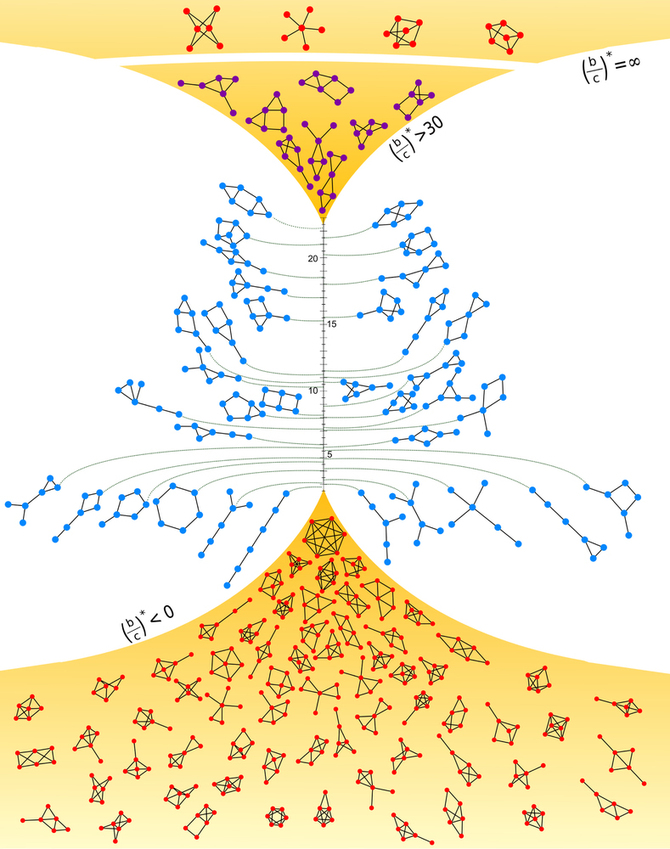
Evolution occurs in populations of reproducing individuals. The structure of a population can affect which traits evolve. Understanding evolutionary game dynamics in structured populations remains difficult. Mathematical results are known for special structures in which all individuals have the same number of neighbours. The general case, in which the number of neighbours can vary, has remained open. For arbitrary selection intensity, the problem is in a computational complexity class that suggests there is no efficient algorithm. Whether a simple solution for weak selection exists has remained unanswered. Here we provide a solution for weak selection that applies to any graph or network. Our method relies on calculating the coalescence times of random walks. We evaluate large numbers of diverse population structures for their propensity to favour cooperation. We study how small changes in population structure—graph surgery—affect evolutionary outcomes. We find that cooperation flourishes most in societies that are based on strong pairwise ties.


Evolutionary dynamics on any population structure

Benjamin Allen, Gabor Lippner, Yu-Ting Chen, Babak Fotouhi, Naghmeh Momeni, Shing-Tung Yau & Martin A. Nowak

Nature (2017) doi:10.1038/nature21723

Source: www.nature.com