Month: August 2017

Self-Organization in Traffic Lights: Evolution of Signal Control with Advances in Sensors and Communications

Traffic signals are ubiquitous devices that first appeared in 1868. Recent advances in information and communications technology (ICT) have led to unprecedented improvements in such areas as mobile handheld devices (i.e., smartphones), the electric power industry (i.e., smart grids), transportation infrastructure, and vehicle area networks. Given the trend towards interconnectivity, it is only a matter of time before vehicles communicate with one another and with infrastructure. In fact, several pilots of such vehicle-to-vehicle and vehicle-to-infrastructure (e.g. traffic lights and parking spaces) communication systems are already operational. This survey of autonomous and self-organized traffic signaling control has been undertaken with these potential developments in mind. Our research results indicate that, while many sophisticated techniques have attempted to improve the scheduling of traffic signal control, either real-time sensing of traffic patterns or a priori knowledge of traffic flow is required to optimize traffic. Once this is achieved, communication between traffic signals will serve to vastly improve overall traffic efficiency.


Self-Organization in Traffic Lights: Evolution of Signal Control with Advances in Sensors and Communications
Sanjay Goel, Stephen F. Bush, Carlos Gershenson

Source: arxiv.org
The role of city size and urban form in the surface urban heat island

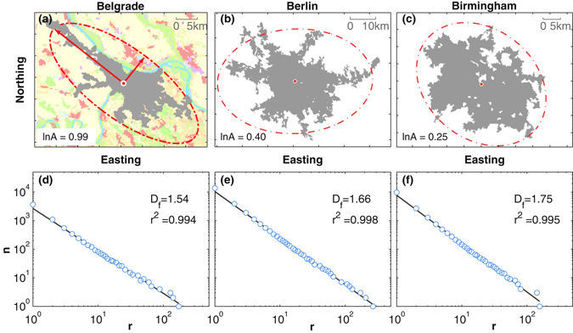
Urban climate is determined by a variety of factors, whose knowledge can help to attenuate heat stress in the context of ongoing urbanization and climate change. We study the influence of city size and urban form on the Urban Heat Island (UHI) phenomenon in Europe and find a complex interplay between UHI intensity and city size, fractality, and anisometry. Due to correlations among these urban factors, interactions in the multi-linear regression need to be taken into account. We find that among the largest 5,000 cities, the UHI intensity increases with the logarithm of the city size and with the fractal dimension, but decreases with the logarithm of the anisometry. Typically, the size has the strongest influence, followed by the compactness, and the smallest is the influence of the degree to which the cities stretch. Accordingly, from the point of view of UHI alleviation, small, disperse, and stretched cities are preferable. However, such recommendations need to be balanced against e.g. positive agglomeration effects of large cities. Therefore, trade-offs must be made regarding local and global aims.


The role of city size and urban form in the surface urban heat island
Bin Zhou, Diego Rybski & Jürgen P. Kropp
Scientific Reports 7, Article number: 4791 (2017)
doi:10.1038/s41598-017-04242-2

Source: www.nature.com

“Complexity, Criticality & Computation” (C3-2017) International Biannual Symposium

Complex systems is a new approach to science, engineering, health and management that studies how relationships between parts give rise to the collective emergent behaviours of the entire system, and how the system interacts with its environment.

What makes a system ‘complex’? A system can be thought of as complex if its dynamics cannot be easily predicted, or explained, as a linear summation of the individual dynamics of its components. In other words, the many constituent microscopic parts bring about macroscopic phenomena that cannot be understood by considering a single part alone (‘the whole is more than the sum of the parts’). There is a growing awareness that complexity is strongly related to criticality: the behaviour of dynamical spatiotemporal systems at an order/disorder phase transition where scale invariance prevails.

Complex systems can also be viewed as distributed information-processing systems, particularly in the domains of computational neuroscience, health, bioinformatics, systems biology and artificial life. Consciousness emerging from neuronal activity and interactions, cell behaviour resultant from gene regulatory networks and swarming behaviour are all examples of global system behaviour emerging as a result of the local interactions of the individuals (neurons, genes, animals). Can these interactions be seen as a generic computational process? This question shapes the third component of our symposium, linking computation to complexity and criticality.

We will consider a diverse range of systems, applications, theoretical and practical approaches to computational modelling of modern complex systems, including information theory, agent-based simulation, network theory, nonlinear dynamics, swarm intelligence, evolutionary methods, computational neuroscience, and econophysics, among others.


When: 9am – 5pm, December 11 – 13 (Mon – Wed), 2017
Where: Civil Engineering Lecture Room 1 (Rm 203), The University of Sydney
Cost: Free
Registration: Please email Mikhail Prokopenko with your name and affiliation, by 27 November 2017.

Source: sydney.edu.au

What we get wrong about technology

Blade Runner (1982) is a magnificent film, but there’s something odd about it. The heroine, Rachael, seems to be a beautiful young woman. In reality, she’s a piece of technology — an organic robot designed by the Tyrell Corporation. She has a lifelike mind, imbued with memories extracted from a human being. 

So sophisticated is Rachael that she is impossible to distinguish from a human without specialised equipment; she even believes herself to be human. Los Angeles police detective Rick Deckard knows otherwise; in Rachael, Deckard is faced with an artificial intelligence so beguiling, he finds himself falling in love. Yet when he wants to invite Rachael out for a drink, what does he do?

He calls her up from a payphone.

Source: www.ft.com

Social influence on 5-year survival in a longitudinal chemotherapy ward co-presence network

Chemotherapy is often administered in openly designed hospital wards, where the possibility of patient–patient social influence on health exists. Previous research found that social relationships influence cancer patient’s health; however, we have yet to understand social influence among patients receiving chemotherapy in the hospital. We investigate the influence of co-presence in a chemotherapy ward. We use data on 4,691 cancer patients undergoing chemotherapy in Oxfordshire, United Kingdom who average 59.8 years of age, and 44% are Male. We construct a network of patients where edges exist when patients are co-present in the ward, weighted by both patients’ time in the ward. Social influence is based on total weighted co-presence with focal patients’ immediate neighbors, considering neighbors’ 5-year mortality. Generalized estimating equations evaluated the effect of neighbors’ 5-year mortality on focal patient’s 5-year mortality. Each 1,000-unit increase in weighted co-presence with a patient who dies within 5 years increases a patient’s mortality odds by 42% (β = 0.357, CI:0.204,0.510). Each 1,000-unit increase in co-presence with a patient surviving 5 years reduces a patient’s odds of dying by 30% (β =−0.344, CI:−0.538,0.149). Our results suggest that social influence occurs in chemotherapy wards, and thus may need to be considered in chemotherapy delivery.


Social influence on 5-year survival in a longitudinal chemotherapy ward co-presence network
JEFFREY LIENERT, CHRISTOPHER STEVEN MARCUM, JOHN FINNEY, FELIX REED-TSOCHAS

Network Science
DOI: https://doi.org/10.1017/nws.2017.16

Source: www.cambridge.org