Month: March 2018

Autonomous agents modelling other agents: A comprehensive survey and open problems

Much research in artificial intelligence is concerned with the development of autonomous agents that can interact effectively with other agents. An important aspect of such agents is the ability to reason about the behaviours of other agents, by constructing models which make predictions about various properties of interest (such as actions, goals, beliefs) of the modelled agents. A variety of modelling approaches now exist which vary widely in their methodology and underlying assumptions, catering to the needs of the different sub-communities within which they were developed and reflecting the different practical uses for which they are intended. The purpose of the present article is to provide a comprehensive survey of the salient modelling methods which can be found in the literature. The article concludes with a discussion of open problems which may form the basis for fruitful future research.


Autonomous agents modelling other agents: A comprehensive survey and open problems
Stefano V.Albrecht, PeterStone

Artificial Intelligence
Volume 258, May 2018, Pages 66-95

Source: www.sciencedirect.com

Exploring Artificial Intelligence with Melanie Mitchell

What is artificial intelligence? Could unintended consequences arise from increased use of this technology? How will the role of humans change with AI? How will AI evolve in the next 10 years?

In this episode, Haley interviews leading Complex Systems Scientist, Professor of Computer Science at Portland State University, and external professor at the Santa Fe Institute, Melanie Mitchell. Professor Mitchell answers many profound questions about the field of artificial intelligence and gives specific examples of how this technology is being used today. She also provides some insights to help us navigate our relationship with AI as it becomes more popular in the coming years.

Source: www.human-current.com

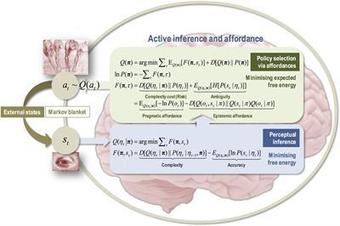
The Active Inference Approach to Ecological Perception: General Information Dynamics for Natural and Artificial Embodied Cognition

The emerging neurocomputational vision of humans as embodied, ecologically embedded, social agents—who shape and are shaped by their environment—offers a golden opportunity to revisit and revise ideas about the physical and information-theoretic underpinnings of life, mind, and consciousness itself. In particular, the active inference framework (AIF) makes it possible to bridge connections from computational neuroscience and robotics/AI to ecological psychology and phenomenology, revealing common underpinnings and overcoming key limitations. AIF opposes the mechanistic to the reductive, while staying fully grounded in a naturalistic and information-theoretic foundation, using the principle of free energy minimization. The latter provides a theoretical basis for a unified treatment of particles, organisms, and interactive machines, spanning from the inorganic to organic, non-life to life, and natural to artificial agents. We provide a brief introduction to AIF, then explore its implications for evolutionary theory, ecological psychology, embodied phenomenology, and robotics/AI research. We conclude the paper by considering implications for machine consciousness.


The Active Inference Approach to Ecological Perception: General Information Dynamics for Natural and Artificial Embodied Cognition
Adam Linson • Andy Clark • Subramanian Ramamoorthy • Karl Friston

Front. Robot. AI, 08 March 2018 | https://doi.org/10.3389/frobt.2018.00021

Source: www.frontiersin.org

The Emergence of Consensus: A Primer

The origin of population-scale coordination has puzzled philosophers and scientists for centuries. Recently, game theory, evolutionary approaches and complex systems science have provided quantitative insights on the mechanisms of social consensus. However, the literature is vast and widely scattered across fields, making it hard for the single researcher to navigate it. This short review aims to provide a compact overview of the main dimensions over which the debate has unfolded and to discuss some representative examples. It focuses on those situations in which consensus emerges ‘spontaneously’ in the absence of centralized institutions and covers topics that include the macroscopic consequences of the different microscopic rules of behavioural contagion, the role of social networks and the mechanisms that prevent the formation of a consensus or alter it after it has emerged. Special attention is devoted to the recent wave of experiments on the emergence of consensus in social systems.


The emergence of consensus: a primer
Andrea Baronchelli

RS Open Science
Published 21 February 2018.DOI: 10.1098/rsos.172189

Source: rsos.royalsocietypublishing.org