Month: April 2018

Critical diversity: Divided or united states of social coordination

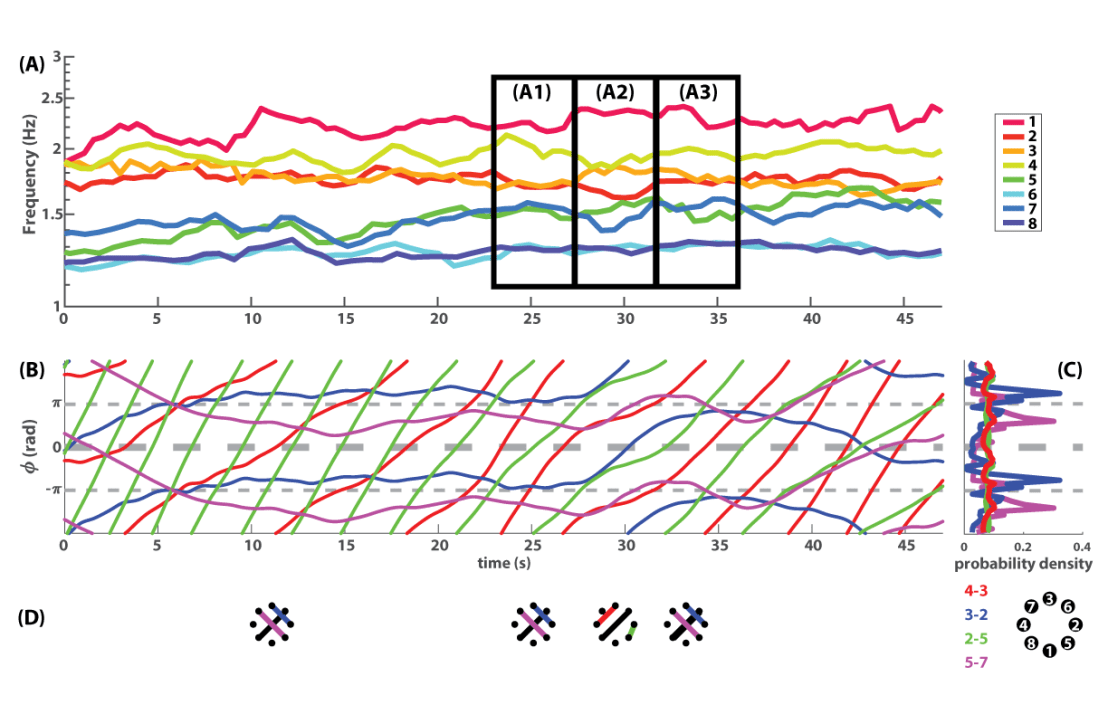
Much of our knowledge of coordination comes from studies of simple, dyadic systems or systems containing large numbers of components. The huge gap ‘in between’ is seldom addressed, empirically or theoretically. We introduce a new paradigm to study the coordination dynamics of such intermediate-sized ensembles with the goal of identifying key mechanisms of interaction. Rhythmic coordination was studied in ensembles of eight people, with differences in movement frequency (‘diversity’) manipulated within the ensemble. Quantitative change in diversity led to qualitative changes in coordination, a critical value separating régimes of integration and segregation between groups. Metastable and multifrequency coordination between participants enabled communication across segregated groups within the ensemble, without destroying overall order. These novel findings reveal key factors underlying coordination in ensemble sizes previously considered too complicated or ‘messy’ for systematic study and supply future theoretical/computational models with new empirical checkpoints.


Zhang M, Kelso JAS, Tognoli E (2018) Critical diversity: Divided or united states of social coordination. PLoS ONE 13(4): e0193843. https://doi.org/10.1371/journal.pone.0193843

Source: journals.plos.org
Self-Organization and Artificial Life: A Review

Self-organization has been an important concept within a number of disciplines, which Artificial Life (ALife) also has heavily utilized since its inception. The term and its implications, however, are often confusing or misinterpreted. In this work, we provide a mini-review of self-organization and its relationship with ALife, aiming at initiating discussions on this important topic with the interested audience. We first articulate some fundamental aspects of self-organization, outline its usage, and review its applications to ALife within its soft, hard, and wet domains. We also provide perspectives for further research.


Self-Organization and Artificial Life: A Review
Carlos Gershenson, Vito Trianni, Justin Werfel, Hiroki Sayama

Source: arxiv.org

The Integration Of Human & Artificial Intelligence

In this episode, Angie interviews Assistant Professor at the New England Complex Systems Institute (NECSI) and Visiting Scientist and the MIT Media Lab, Alfredo Morales. Professor Morales works in the areas of complex systems, AI, data science, and human behavior to develop both methods and insights that help solve complex societal problems. During his interview, he shares details from the AI and Beyond Program at NECSI, a five day certificate program where he presented alongside, Stephen Wolfram, Iyad Rahwan, and Yaneer Bar-Yam. He also discusses some unintended consequences that could arise from artificial intelligence and how complexity science can help us integrate AI systems more effectively.

Source: www.human-current.com

Multi-criteria analysis of economic complexity transition in emerging economies: The case of Paraguay

Like many emerging economies, the productive structure of the Paraguayan economy is not complex. It relies extensively on low value-added activities in the primary sector such as agriculture and cattle ranching. These activities have a lower return in terms of economic and social benefits than other potential productive activities and do not contribute to increasing capability accumulation. In this paper we present a tool to support the identification of strategic sectors and products which if taken advantage of, could leverage development through the accumulation of productive capabilities. Our guiding question is: Which productive sectors should be promoted to foster economic development in Paraguay through a transition towards a more complex economy? To answer this question, we use concepts from the Economic Complexity theory to identify new products and cluster them based on the Product Space methodology for the determination of potential products and combine it with the Analytic Hierarchy Process (AHP) for multicriteria analysis considering multiple criteria. In doing so, our proposed methodology contributes to both the Economic Complexity and the AHP literature. Through this combination, we tackle the multiplicity of juxtaposed criteria, which should be considered at the prioritization stage in the crafting of economic restructuring measures according to the country’s capabilities. Our evaluation showed that the combination of the approaches is useful, and for Paraguay’s case, it helped identify sectors, which, if promoted by policymakers, could help boost economic development through complexity and capability accumulation.


Multi-criteria analysis of economic complexity transition in emerging economies: The case of Paraguay
Arturo González, Eduardo Ortigoza, Cecilia Llamosas, GerardoBlanco, Raúl Amarilla

Socio-Economic Planning Sciences

Source: www.sciencedirect.com