
Month: June 2018

Niche emergence as an autocatalytic process in the evolution of ecosystems

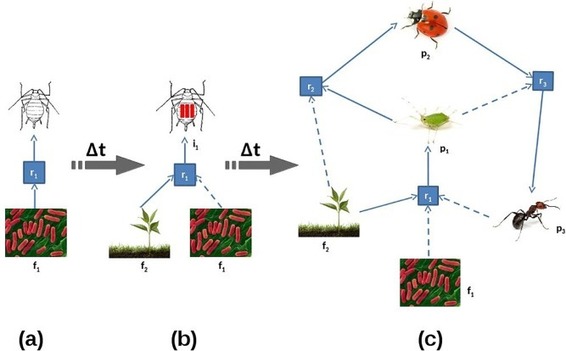
The utilisation of the ecospace and the change in diversity through time has been suggested to be due to the effect of niche partitioning, as a global long-term pattern in the fossil record. However, niche partitioning, as a way to coexist, could be a limited means to share the environmental resources and condition during evolutionary time. In fact, a physical limit impedes a high partitioning without a high restriction of the niche’s variables. Here, we propose that niche emergence, rather than niche partitioning, is what mostly drives ecological diversity. In particular, we view ecosystems in terms of autocatalytic sets: catalytically closed and self-sustaining reaction (or interaction) networks. We provide some examples of such ecological autocatalytic networks, how this can give rise to an expanding process of niche emergence (both in time and space), and how these networks have evolved over time (so-called evoRAFs). Furthermore, we use the autocatalytic set formalism to show that it can be expected to observe a power-law in the size distribution of extinction events in ecosystems. In short, we elaborate on our earlier argument that new species create new niches, and that biodiversity is therefore an autocatalytic process.


Niche emergence as an autocatalytic process in the evolution of ecosystems

Roberto Cazzolla Gatti, Brian Fath, Wim Hordijk, Stuart Kauffman, Robert Ulanowicz

Journal of Theoretical Biology

Source: www.sciencedirect.com
The Book of Why: The New Science of Cause and Effect (Judea Pearl & Dana Mackenzie)

A Turing Award-winning computer scientist and statistician shows how understanding causality has revolutionized science and will revolutionize artificial intelligence
 
"Correlation is not causation." This mantra, chanted by scientists for more than a century, has led to a virtual prohibition on causal talk. Today, that taboo is dead. The causal revolution, instigated by Judea Pearl and his colleagues, has cut through a century of confusion and established causality–the study of cause and effect–on a firm scientific basis. His work explains how we can know easy things, like whether it was rain or a sprinkler that made a sidewalk wet; and how to answer hard questions, like whether a drug cured an illness. Pearl’s work enables us to know not just whether one thing causes another: it lets us explore the world that is and the worlds that could have been. It shows us the essence of human thought and key to artificial intelligence. Anyone who wants to understand either needs The Book of Why.

Source: www.amazon.com

The Perfectionists: How Precision Engineers Created the Modern World (Simon Winchester)

The rise of manufacturing could not have happened without an attention to precision. At the dawn of the Industrial Revolution in eighteenth-century England, standards of measurement were established, giving way to the development of machine tools—machines that make machines. Eventually, the application of precision tools and methods resulted in the creation and mass production of items from guns and glass to mirrors, lenses, and cameras—and eventually gave way to further breakthroughs, including gene splicing, microchips, and the Hadron Collider.

Simon Winchester takes us back to origins of the Industrial Age, to England where he introduces the scientific minds that helped usher in modern production: John Wilkinson, Henry Maudslay, Joseph Bramah, Jesse Ramsden, and Joseph Whitworth. It was Thomas Jefferson who later exported their discoveries to the fledgling United States, setting the nation on its course to become a manufacturing titan. Winchester moves forward through time, to today’s cutting-edge developments occurring around the world, from America to Western Europe to Asia.

As he introduces the minds and methods that have changed the modern world, Winchester explores fundamental questions. Why is precision important? What are the different tools we use to measure it? Who has invented and perfected it? Has the pursuit of the ultra-precise in so many facets of human life blinded us to other things of equal value, such as an appreciation for the age-old traditions of craftsmanship, art, and high culture? Are we missing something that reflects the world as it is, rather than the world as we think we would wish it to be? And can the precise and the natural co-exist in society?

Source: www.amazon.com

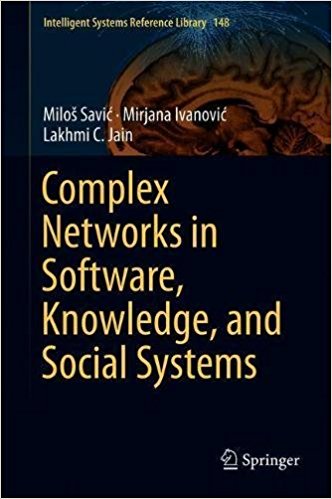
Complex Networks in Software, Knowledge, and Social Systems (Miloš Savić, Mirjana Ivanović & Lakhmi C. Jain)

This book provides a comprehensive review of complex networks from three different domains, presents novel methods for analyzing them, and highlights applications with accompanying case studies. Special emphasis is placed on three specific kinds of complex networks of high technological and scientific importance: software networks extracted from the source code of computer programs, ontology networks describing semantic web ontologies, and co-authorship networks reflecting collaboration in science. The book is primarily intended for researchers, teachers and students interested in complex networks and network data analysis. However, it will also be valuable for researchers dealing with software engineering, ontology engineering and scientometrics, as it demonstrates how complex network analysis can be used to address important research issues in these three disciplines. 

Source: www.amazon.com

Wandering Towards a Goal: How Can Mindless Mathematical Laws Give Rise to Aims and Intention? (Anthony Aguirre, Brendan Foster & Zeeya Merali)

This collection of prize-winning essays addresses the controversial question of how meaning and goals can emerge in a physical world governed by mathematical laws. What are the prerequisites for a system to have goals? What makes a physical process into a signal? Does eliminating the homunculus solve the problem? The three first-prize winners, Larissa Albantakis, Carlo Rovelli and Jochen Szangolies tackle exactly these challenges, while many other aspects (agency, the role of the observer, causality versus teleology, ghosts in the machine etc.) feature in the other award winning contributions. All contributions are accessible to non-specialists.

These seventeen stimulating and often entertaining essays are enhanced versions of the prize-winning entries to the FQXi essay competition in 2017.The Foundational Questions Institute, FQXi, catalyzes, supports, and disseminates research on questions at the foundations of physics and cosmology, particularly new frontiers and innovative ideas integral to a deep understanding of reality, but unlikely to be supported by conventional funding sources.

Source: www.amazon.com