Month: November 2018

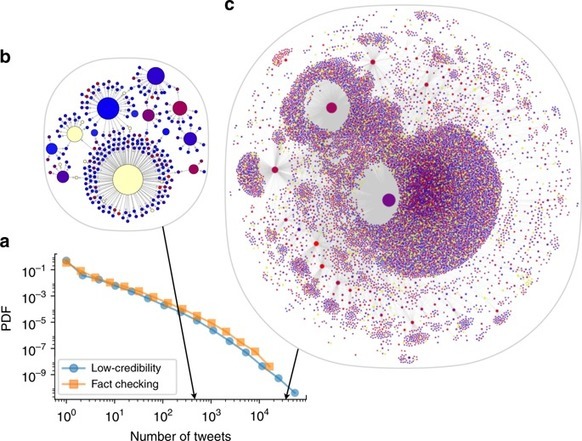
The spread of low-credibility content by social bots

Online misinformation is a threat to a well-informed electorate and undermines democracy. Here, the authors analyse the spread of articles on Twitter, find that bots play a major role in the spread of low-credibility content and suggest control measures for limiting the spread of misinformation.


The spread of low-credibility content by social bots
Chengcheng Shao, Giovanni Luca Ciampaglia, Onur Varol, Kai-Cheng Yang, Alessandro Flammini & Filippo Menczer
Nature Communications volume 9, Article number: 4787 (2018)

Source: www.nature.com

Fractional Dynamics of Individuals in Complex Networks

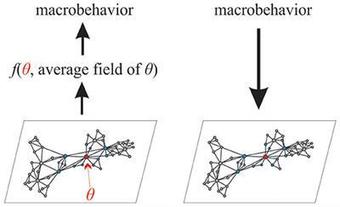
The relation between the behavior of a single element and the global dynamics of its host network is an open problem in the science of complex networks. We demonstrate that for a dynamic network that belongs to the Ising universality class, this problem can be approached analytically through a subordination procedure. The analysis leads to a linear fractional differential equation of motion for the average trajectory of the individual, whose analytic solution for the probability of changing states is a Mittag-Leffler function. Consequently, the analysis provides a linear description of the average dynamics of an individual, without linearization of the complex network dynamics.


Fractional Dynamics of Individuals in Complex Networks
Malgorzata Turalska and Bruce J. West

Front. Phys., 16 October 2018 | https://doi.org/10.3389/fphy.2018.00110

Source: www.frontiersin.org

Information Dynamics in Urban Crime

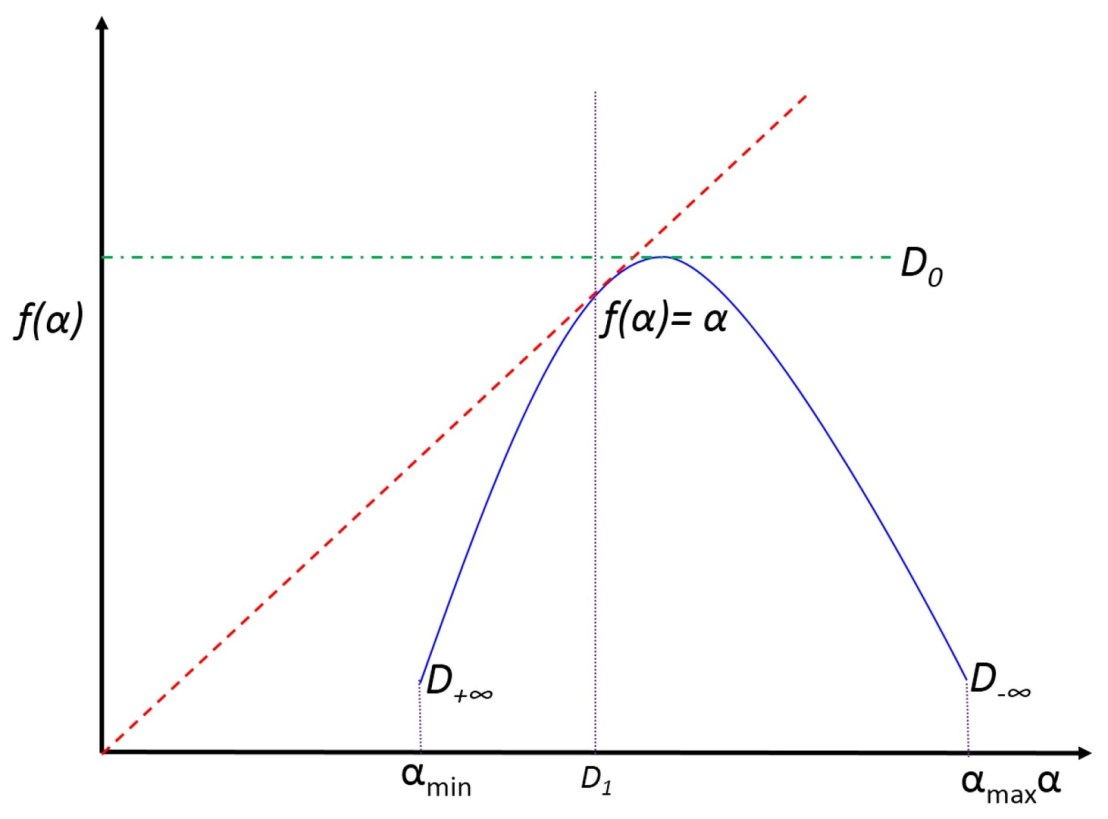
Information production in both space and time has been highlighted as one of the elements that shapes the footprint of complexity in natural and socio-technical systems. However, information production in urban crime has barely been studied. This work copes with this problem by using multifractal analysis to characterize the spatial information scaling in urban crime reports and nonlinear processing tools to study the temporal behavior of this scaling. Our results suggest that information scaling in urban crime exhibits dynamics that evolve in low-dimensional chaotic attractors, and this can be observed in several spatio-temporal scales, although some of them are more favorable than others. This evidence has practical implications in terms of defining the characteristic scales to approach urban crime from available data and supporting theoretical perspectives about the complexity of urban crime.


Information Dynamics in Urban Crime
Miguel Melgarejo and Nelson Obregon

Entropy 2018, 20(11), 874; https://doi.org/10.3390/e20110874

Source: www.mdpi.com

Charting the Next Pandemic

This book provides an introduction to the computational and complex systems modeling of the global spreading of infectious diseases. The latest developments in the area of contagion processes modeling are discussed, and readers are exposed to real world examples of data-model integration impacting the decision-making process. Recent advances in computational science and the increasing availability of real-world data are making it possible to develop realistic scenarios and real-time forecasts of the global spreading of emerging health threats.

The first part of the book guides the reader through sophisticated complex systems modeling techniques with a non-technical and visual approach, explaining and illustrating the construction of the modern framework used to project the spread of pandemics and epidemics. Models can be used to transform data to knowledge that is intuitively communicated by powerful infographics and for this reason, the second part of the book focuses on a set of charts that illustrate possible scenarios of future pandemics. The visual atlas contained allows the reader to identify commonalities and patterns in emerging health threats, as well as explore the wide range of models and data that can be used by policy makers to anticipate trends, evaluate risks and eventually manage future events.

Charting the Next Pandemic puts the reader in the position to explore different pandemic scenarios and to understand the potential impact of available containment and prevention strategies. This book emphasizes the importance of a global perspective in the assessment of emerging health threats and captures the possible evolution of the next pandemic, while at the same time providing the intelligence needed to fight it. The text will appeal to a wide range of audiences with diverse technical backgrounds.


Charting the Next Pandemic
Modeling Infectious Disease Spreading in the Data Science Age
Ana Pastore y Piontti, Nicola Perra, Luca Rossi, Nicole Samay, Alessandro Vespignani

Source: link.springer.com

Information | Special Issue : Computational Social Science

The last centuries have seen a great surge in our understanding and control of ‘simple’ physical, chemical, and biological processes through data analysis and the mathematical modelling of their underlying dynamics. Encouraged by its success, researchers have recently embarked on extending such approaches to gain qualitative and quantitative understanding of social and economic systems and the dynamics in and of them. This has become possible due to the massive amounts of data generated by information-communication technologies and the unprecedented fusion of off- and on-line human activity. However, due to the presence of adaptability, feedback loops, and strong heterogeneities of the individuals and interactions making up our modern digital societies, it is yet unclear if statistical ‘laws’ of socio-technical behaviour even exist, akin to those found for natural processes. Such continuing search has resulted in the fields of computational social science and social network science, which share the goal of first analysing social phenomena and then modelling them with enough accuracy to make reliable predictions. This Special Issue invites contributions to such fields of study, with focus on the temporal evolution and dynamics of complex social systems. As topics of interest, we propose research on more realistic models of social dynamics, the use of statistical inference, machine learning, and other cross-disciplinary techniques to complement the analysis of social dynamics, and the creation of loops between data acquisition and model analysis to increase accuracy in the prediction of social trends. We hope this Special Issue will bring together expertise from a wide range of research communities interested in similar topics, including computational social science, network science, information science, and complexity science.

Source: www.mdpi.com