
Month: November 2018

Negative Representation and Instability in Democratic Elections

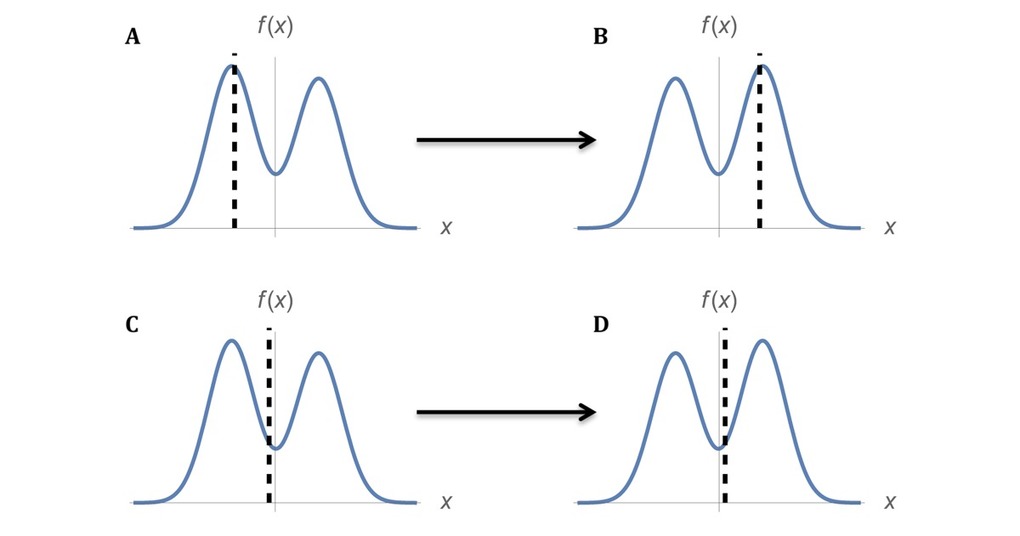
Motivated by the troubling rise of political extremism and instability throughout the democratic world, we present a novel mathematical characterization of the nature of political representation in democratic elections. We define the concepts of negative representation, in which a shift in electorate opinions produces a shift in the election outcome in the opposite direction, and electoral instability, in which an arbitrarily small change in opinion causes a large change in election outcome. Under very general conditions, we prove that unstable elections necessarily contain negatively represented opinions. Furthermore, increasing polarization of the electorate can drive elections through a transition from a stable to an unstable regime, analogous to the phase transition by which some materials become ferromagnetic below their critical temperatures. In this unstable regime, a large fraction of political opinions are negatively represented. Empirical data suggest that United States presidential elections underwent such a phase transition in the 1970s and have since become increasingly unstable.


Alexander Siegenfeld, Yaneer Bar-Yam, Negative representation and instability in democratic elections, arXiv:1810.11489 (October 29, 2018).

Source: www.necsi.edu

See also video: http://www.necsi.edu/research/social/negative-representation-video 

Linguistic Bodies

A novel theoretical framework for an embodied, non-representational approach to language that extends and deepens enactive theory, bridging the gap between sensorimotor skills and language.

Linguistic Bodies offers a fully embodied and fully social treatment of human language without positing mental representations. The authors present the first coherent, overarching theory that connects dynamical explanations of action and perception with language. Arguing from the assumption of a deep continuity between life and mind, they show that this continuity extends to language. Expanding and deepening enactive theory, they offer a constitutive account of language and the co-emergent phenomena of personhood, reflexivity, social normativity, and ideality. Language, they argue, is not something we add to a range of existing cognitive capacities but a new way of being embodied. Each of us is a linguistic body in a community of other linguistic bodies. The book describes three distinct yet entangled kinds of human embodiment, organic, sensorimotor, and intersubjective; it traces the emergence of linguistic sensitivities and introduces the novel concept of linguistic bodies; and it explores the implications of living as linguistic bodies in perpetual becoming, applying the concept of linguistic bodies to questions of language acquisition, parenting, autism, grammar, symbol, narrative, and gesture, and to such ethical concerns as microaggression, institutional speech, and pedagogy.


Linguistic Bodies
The Continuity between Life and Language
By Ezequiel A. Di Paolo, Elena Clare Cuffari and Hanne De Jaegher

Source: mitpress.mit.edu