Month: December 2018

Consciousness: The last 50 years (and the next)

The mind and brain sciences began with consciousness as a central concern. But for much of the 20th century, ideological and methodological concerns relegated its empirical study to the margins. Since the 1990s, studying consciousness has regained a legitimacy and momentum befitting its status as the primary feature of our mental lives. Nowadays, consciousness science encompasses a rich interdisciplinary mixture drawing together philosophical, theoretical, computational, experimental, and clinical perspectives, with neuroscience its central discipline. Researchers have learned a great deal about the neural mechanisms underlying global states of consciousness, distinctions between conscious and unconscious perception, and self-consciousness. Further progress will depend on specifying closer explanatory mappings between (first-person subjective) phenomenological descriptions and (third-person objective) descriptions of (embodied and embedded) neuronal mechanisms. Such progress will help reframe our understanding of our place in nature and accelerate clinical approaches to a wide range of psychiatric and neurological disorders.


Consciousness: The last 50 years (and the next)
Anil K. Seth
Brain and Neuroscience Advances

Source: journals.sagepub.com

Conference on Complex Systems 2019

The Conference on Complex Systems (CCS) is the biggest and most important annual meeting of the international complex systems community. It comes under the auspices of the Complex Systems Society. Since its inception in 2004, CCS had always been Europe-based, but in 2015 & 2017, it moved to North & Latin America respectively.

In 2019, CCS will come to Asia for the first time. Held in Singapore at Nanyang Technological University, it promises an intellectually stimulating experience to be matched by an equally exciting social programme. ​

Source: event.ntu.edu.sg

Beyond Calories: A Holistic Assessment of the Global Food System

The global food system is failing to meet nutritional needs, with growing concerns for health related to both under-, over-consumption and severe micronutrient deficiency. The 2nd Sustainable Development Goal (SDG2) targets the end of malnutrition in all forms by 2030. To address this challenge, the focus around food security and malnutrition must be broadened beyond the scope of sufficient energy intake to take full account of total nutrient supply and requirements. Here, for the first time, we have quantitatively mapped the global food system in terms of energy, protein, fat, essential amino acids, and micronutrients from “field-to-fork,” normalized to an equitable per capita availability metric. This framework allows for the evaluation of the sufficiency of nutrient supply, identifies the key hotspots within the global food supply chain which could be targeted for improved efficiency, and highlights the trade-offs which may arise in delivering a balanced nutritional system.


Beyond Calories: A Holistic Assessment of the Global Food System

Hannah Ritchie, David S. Reay and Peter Higgins

Front. Sustain. Food Syst.

Source: www.frontiersin.org

A structural transition in physical networks

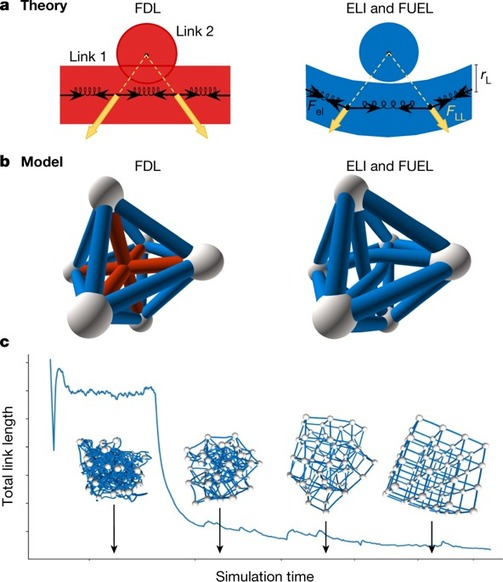
In many physical networks, including neurons in the brain1,2, three-dimensional integrated circuits3 and underground hyphal networks4, the nodes and links are physical objects that cannot intersect or overlap with each other. To take this into account, non-crossing conditions can be imposed to constrain the geometry of networks, which consequently affects how they form, evolve and function. However, these constraints are not included in the theoretical frameworks that are currently used to characterize real networks5,6,7. Most tools for laying out networks are variants of the force-directed layout algorithm8,9—which assumes dimensionless nodes and links—and are therefore unable to reveal the geometry of densely packed physical networks. Here we develop a modelling framework that accounts for the physical sizes of nodes and links, allowing us to explore how non-crossing conditions affect the geometry of a network. For small link thicknesses, we observe a weakly interacting regime in which link crossings are avoided via local link rearrangements, without altering the overall geometry of the layout compared to the force-directed layout. Once the link thickness exceeds a threshold, a strongly interacting regime emerges in which multiple geometric quantities, such as the total link length and the link curvature, scale with the link thickness. We show that the crossover between the two regimes is driven by the non-crossing condition, which allows us to derive the transition point analytically and show that networks with large numbers of nodes will ultimately exist in the strongly interacting regime. We also find that networks in the weakly interacting regime display a solid-like response to stress, whereas in the strongly interacting regime they behave in a gel-like fashion. Networks in the weakly interacting regime are amenable to 3D printing and so can be used to visualize network geometry, and the strongly interacting regime provides insights into the scaling of the sizes of densely packed mammalian brains.


A structural transition in physical networks
Nima Dehmamy, Soodabeh Milanlouei & Albert-László Barabási 
Nature volume 563, pages 676–680 (2018)

Source: www.nature.com

The Impact of Potential Crowd Behaviours on Emergency Evacuation

Crowd dynamics have important applications in evacuation management systems relevant to organizing safer large scale gatherings. For crowd safety, it is very important to study the evolution of potential crowd behaviours by simulating the crowd evacuation process. Planning crowd control tasks via studying the impact of crowd behavioural evolution towards evacuation simulation could mitigate the possibility of crowd disasters that may happen. During a typical emergency evacuation scenario, conflict among agents occurs when agents intend to move to the same location as a result of the interaction of agents within their nearest neighbours. The effect of the agent response towards their neighbourhood is vital in order to understand the effect of variation of crowd behaviours towards the whole environment. In this work, we model crowd motion subject to exit congestion under uncertainty conditions in a continuous space via computer simulations. We model best-response, risk-seeking, risk-averse and risk-neutral behaviours of agents via certain game theory notions. We perform computer simulations with heterogeneous populations in order to study the effect of the evolution of agent behaviours towards egress flow under threat conditions. Our simulation results show the relation between the local crowd pressure and the number of injured agents. We observe that when the proportion of agents in a population of risk-seeking agents is increased, the average crowd pressure, average local density and the number of injured agents get increased. Besides that, based on our simulation results, we can infer that crowd disaster could be prevented if the agent population are full of risk-averse and risk-neutral agents despite circumstances that lead to threat consequences.


The Impact of Potential Crowd Behaviours on Emergency Evacuation: An Evolutionary Game Theoretic Approach
Azhar Mohd Ibrahim , Ibrahim Venkat and De Wilde Philippe
Journal of Artificial Societies and Social Simulation 22 (1) 3
<http://jasss.soc.surrey.ac.uk/22/1/3.html>
DOI: 10.18564/jasss.3837

Source: jasss.soc.surrey.ac.uk