Month: July 2019

Embodied robots driven by self-organized environmental feedback

Which kind of complex behavior may arise from self-organizing principles? We investigate this question for the case of snake-like robots composed of passively coupled segments, with every segment containing two wheels actuated separately by a single neuron. The robot is self-organized both on the level of the individual wheels and with respect to inter-wheel coordination, which arises exclusively from the mechanical coupling of the individual wheels and segments. For the individual wheel, the generating principle proposed results in locomotive states that correspond to self-organized limit cycles of the sensorimotor loop. Our robot interacts with the environment by monitoring the state of its actuators, that is, via propriosensation. External sensors are absent. In a structured environment the robot shows complex emergent behavior that includes pushing movable blocks around, reversing direction when hitting a wall, and turning when climbing a slope. On flat grounds the robot wiggles in a snake-like manner, when moving at higher velocities. We also investigate the emergence of motor primitives, namely, the route to locomotion, which is characterized by a series of local and global bifurcations in terms of dynamical system theory.


Embodied robots driven by self-organized environmental feedback
Frederike Kubandt, Michael Nowak, Tim Koglin, Claudius Gros, Bulcsú Sándor

Adaptive Behavior

Source: journals.sagepub.com
The Internet and your inner English tea merchant | Taha Yasseri | TEDxThessaloniki

The Internet is a totally internet phenomenon. In this talk, Dr Taha Yasseri gives answers to burning internet questions. Are users biased like an English tea merchant? Why do we care more about some events and not about others? And for how long do we care? He presents research findings on collective memory on the internet, as well as on the threshold of death toll that attracts our attention and empathy when it comes to social media. Although the interned is constantly criticized as being a threat to our democracy, he reminds us that it is a place of cooperation, a land that has the power to unite us, not divide us.

Source: www.youtube.com

Alternative Approaches to Economic Theory: Complexity, Post Keynesian and Ecological Economics. Edited By Victor A. Beker

The 2007–2008 financial crisis exposed the shortcomings of mainstream economic theory with economists unprepared to deal with it. In the face of this, a major rethinking of economics seems necessary and in presenting alternative approaches to economic theory, this book contributes to the rebuilding of the discipline.

This volume brings together contributions from different perspectives and theoretical approaches that address the challenge of updating the economic theory corpus and seek to recover prestige for this discipline after the failure of neoclassical economics. It addresses a range of topics, including the complexity approach to economics, category theory, the Post-Keynesian approach to micro and macroeconomics, financialisation, multidimensional analysis and ecological economics.

The book is aimed at economics scholars, researchers, academics and practitioners, as well as upper undergraduates and graduates in this area of knowledge. It may also be of interest for people interested in methodological issues in economics and the relationship between economic theory and the real world.


Alternative Approaches to Economic Theory:
Complexity, Post Keynesian and Ecological Economics
Edited By Victor A. Beker

Source: www.taylorfrancis.com

Element-centric clustering comparison unifies overlaps and hierarchy

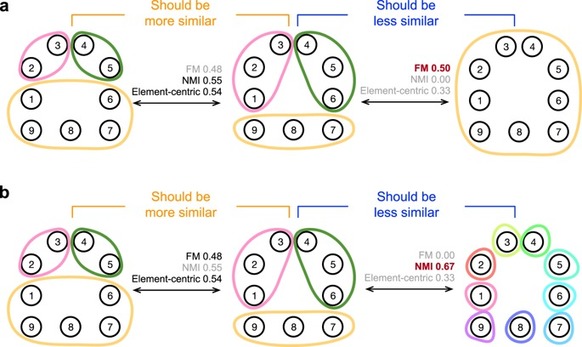
Clustering is one of the most universal approaches for understanding complex data. A pivotal aspect of clustering analysis is quantitatively comparing clusterings; clustering comparison is the basis for many tasks such as clustering evaluation, consensus clustering, and tracking the temporal evolution of clusters. In particular, the extrinsic evaluation of clustering methods requires comparing the uncovered clusterings to planted clusterings or known metadata. Yet, as we demonstrate, existing clustering comparison measures have critical biases which undermine their usefulness, and no measure accommodates both overlapping and hierarchical clusterings. Here we unify the comparison of disjoint, overlapping, and hierarchically structured clusterings by proposing a new element-centric framework: elements are compared based on the relationships induced by the cluster structure, as opposed to the traditional cluster-centric philosophy. We demonstrate that, in contrast to standard clustering similarity measures, our framework does not suffer from critical biases and naturally provides unique insights into how the clusterings differ. We illustrate the strengths of our framework by revealing new insights into the organization of clusters in two applications: the improved classification of schizophrenia based on the overlapping and hierarchical community structure of fMRI brain networks, and the disentanglement of various social homophily factors in Facebook social networks. The universality of clustering suggests far-reaching impact of our framework throughout all areas of science.


Element-centric clustering comparison unifies overlaps and hierarchy
Alexander J. Gates, Ian B. Wood, William P. Hetrick & Yong-Yeol Ahn 
Scientific Reportsvolume 9, Article number: 8574 (2019)

Source: www.nature.com

A free energy principle for a particular physics

This monograph attempts a theory of every ‘thing’ that can be distinguished from other things in a statistical sense. The ensuing statistical independencies, mediated by Markov blankets, speak to a recursive composition of ensembles (of things) at increasingly higher spatiotemporal scales. This decomposition provides a description of small things; e.g., quantum mechanics – via the Schrodinger equation, ensembles of small things – via statistical mechanics and related fluctuation theorems, through to big things – via classical mechanics. These descriptions are complemented with a Bayesian mechanics for autonomous or active things. Although this work provides a formulation of every thing, its main contribution is to examine the implications of Markov blankets for self-organisation to nonequilibrium steady-state. In brief, we recover an information geometry and accompanying free energy principle that allows one to interpret the internal states of something as representing or making inferences about its external states. The ensuing Bayesian mechanics is compatible with quantum, statistical and classical mechanics and may offer a formal description of lifelike particles.


A free energy principle for a particular physics

Karl Friston

Source: arxiv.org