
Month: January 2020

ALIFE 2020

ALife is the flagship conference of the International Society for Artificial Life, which aims to bring together leading researchers and practitioners working on problems related to simulating and synthesizing complex phenomena in computation, biology, artificial intelligence, robotics, philosophy, and cognitive science, just to name a few. The ALife conference has a long history of encouraging multi-disciplinary collaboration across research, business, arts, and design and we look forward to upholding this long-standing tradition at the ALife 2020 conference. The conference theme for ALife 2020 is New Frontiers in AI: What can ALife offer AI?

Details 

  • Dates – July 13-18, 2020
  • Location – Centre Mont-Royal, Montréal, Québec, Canada
  • Hosts – University of Vermont, Vermont Complex Systems Center 
  • Twitter –  @ALifeConf

Source: www.vermontcomplexsystems.org
Decentralization in Digital Societies — A Design Paradox

Evangelos Pournaras


Digital societies come with a design paradox: On the one hand, technologies, such as Internet of Things, pervasive and ubiquitous systems, allow a distributed local intelligence in interconnected devices of our everyday life such as smart phones, smart thermostats, self-driving cars, etc. On the other hand, Big Data collection and storage is managed in a highly centralized fashion, resulting in privacy-intrusion, surveillance actions, discriminatory and segregation social phenomena. What is the difference between a distributed and a decentralized system design? How "decentralized" is the processing of our data nowadays? Does centralized design undermine autonomy? Can the level of decentralization in the implemented technologies influence ethical and social dimensions, such as social justice? Can decentralization convey sustainability? Are there parallelisms between the decentralization of digital technology and the decentralization of urban development?

Source: arxiv.org

Efficient sentinel surveillance strategies for preventing epidemics on networks

Ewan Colman, Petter Holme, Hiroki Sayama, Carlos Gershenson


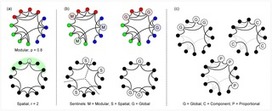
Surveillance plays a crucial role in preventing emerging infectious diseases from becoming epidemic. In circumstances where it is possible to monitor the infection status of certain people, transport hubs, or hospitals, early detection of the disease allows interventions to be implemented before most of the damage can occur, or at least its impact can be mitigated. This paper addresses the question of which nodes we should select in a network of individuals susceptible to some infectious disease in order to minimize the number of casualties. By simulating disease outbreaks on a collection of empirical and synthetic networks we show that the best strategy depends on topological characteristics of the network. For highly modular or spatially embedded networks it is better to place the sentinels on nodes distributed across different regions. However, if the degree heterogeneity is high, then a strategy that targets network hubs is preferred. We further consider the consequences of having an incomplete sample of the network and demonstrate that the value of new information diminishes as more data is collected. Finally we find further marginal improvements using two heuristics informed by known results in graph theory that exploit the fragmented structure of sparse network data.

Source: journals.plos.org

Postdoctoral fellowships at UNAM

The National Autonomous University of Mexico (UNAM) has an open call for postdoctoral fellowships to start in September, 2020. Candidates should have obtained a PhD degree within the last five years to the date of the beginning of the fellowship.


The area of interests of candidates should fall within complex systems, artificial life, information, evolution, cognition, robotics, and/or philosophy. Interested candidates should send CV and a tentative project/research interests (1 paragraph) to cgg-at-unam.mx by February 10th.

Source: complexes.blogspot.com

Networks

Network science is now a mature research field, whose growth was catalysed by the introduction of the ‘small world’ network model in 1998. Networks give mathematical descriptions of systems containing containing many interacting components, including power grids, neuronal networks and ecosystems. This collection brings together selected research, comments and review articles on how networks are structured (Layers & structure); how networks can describe healthy and disordered systems (Brain & disorders); how dynamics unfold on networks (Dynamics & spread); and community structures and resilience in networks (Community & resilience).

Source: www.nature.com