

Melanie Mitchell has worked on digital minds for decades. She says they’ll never truly be like ours until they can make analogies.
Read the full article at: www.quantamagazine.org
Networking the complexity community since 1999
Month: July 2021
Melanie Mitchell has worked on digital minds for decades. She says they’ll never truly be like ours until they can make analogies.
Read the full article at: www.quantamagazine.org
John Baez
Suppose we have n different types of self-replicating entity, with the population P_i of the ith type changing at a rate equal to P_i times the fitness f_i of that type. Suppose the fitness f_i is any continuous function of all the populations P_1, \dots, P_n. Let p_i be the fraction of replicators that are of the ith type. Then p = (p_1, \dots, p_n) is a time-dependent probability distribution, and we prove that its speed as measured by the Fisher information metric equals the variance in fitness. In rough terms, this says that the speed at which information is updated through natural selection equals the variance in fitness. This result can be seen as a modified version of Fisher’s fundamental theorem of natural selection. We compare it to Fisher’s original result as interpreted by Price, Ewens and Edwards.
Read the full article at: johncarlosbaez.wordpress.com
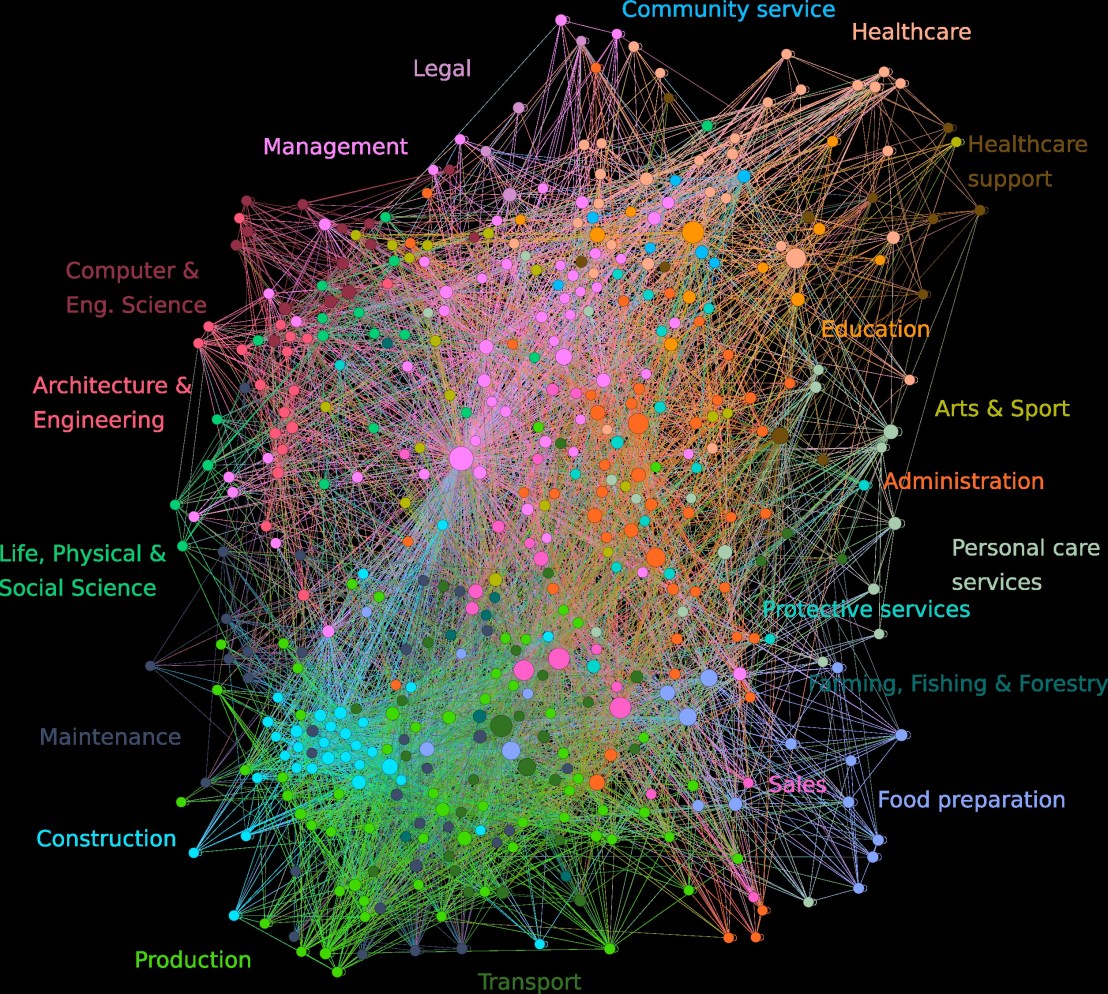
Oxford Mathematicians and Economists Maria del Rio-Chanona, Penny Mealy, Mariano Beguerisse-Díaz, François Lafond, and J. Doyne Farmer discuss their network model of labor market dynamics.
“Mathematics has explained many physical, chemical, and biological phenomena, but can it explain how the economy works? It is challenging because the economy is highly diverse, and ever-changing, with both short term fluctuations – it goes through recession and recovery periods – and long-term structural change – innovation transforms the scope and diversity of what we do.
Take the labor market, for example. Figure 1 shows what we call the occupational mobility network (1) – each node is an occupation, and the links show how likely it is that a worker in an occupation moves to another occupation. Clearly, there are many different occupations, and some occupational transitions are more likely than others. How can we model the dynamics of the labor market while taking this into account (click figure to enlarge)?
Read the full article at: www.maths.ox.ac.uk
Special issue on “Collective decision-making in living and artificial systems”
Swarm Intelligence, volume 15, issue 1–2 (2021)
Edited by A. Reina, E. Ferrante & G. Valentini
Collective decision-making is a fundamental cognitive process required for group coordination. Typically, this process requires individuals in a group to either reach a consensus on one of several available options or to distribute their workforce over different tasks. Similar collective decision-making processes can be found in a large number of systems, motivating a vast modeling effort across scientific disciplines. It can be observed across scales in a variety of animal groups, from unicellular organisms, to social insects, fish schools, and groups of mammals. In the social sciences, scientific domains such as econophysics and sociophysics emerged to investigate collective decisions in humans, deepening our understanding of the dynamics of economies and social policies. Neuroscientists also look at brains as a collection of neurons that, through numerous interactions, lead to rational decisions. Studies of collective decision-making in nature inspired the engineering of decentralized cyber-physical systems such as robot swarms and wireless sensor networks with the potential to create new emerging and disruptive technologies. Collective decision-making, ubiquitous across living and artificial collectives, can benefit from an interdisciplinary approach as apparently different systems may share similar mechanisms. With this special issue, we aim to push forward such an interdisciplinary approach by providing perspectives and insights from biology, information science, and engineering.
Read the full article at: link.springer.com
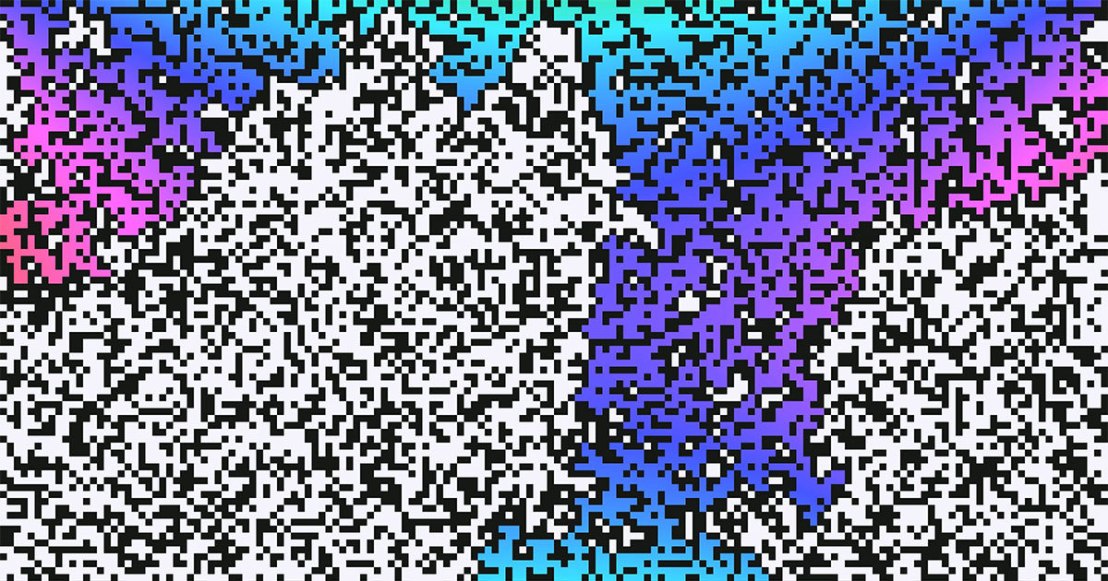
A group of mathematicians has shown that at critical moments, a symmetry called rotational invariance is a universal property across many physical systems.
Read the full article at: www.quantamagazine.org

