Month: March 2022

Coexistence in diverse communities with higher-order interactions

Theo Gibbs, Simon A. Levin, Jonathan M. Levine

A central assumption in most ecological models is that the interactions in a community operate only between pairs of species. However, the interaction between two species may be fundamentally changed by the presence of others. Although interactions among three or more species, called higher-order interactions, have the potential to modify our theoretical understanding of coexistence, ecologists lack clear expectations for how these interactions shape community structure. Here, we analytically predict and numerically confirm how the variability and strength of higher-order interactions affect species coexistence. We found that, as higher-order interaction strengths become more variable across species, fewer species coexist, echoing the behavior of pairwise models. If inter-specific higher-order interactions become too harmful relative to self-regulation, coexistence was destabilized, but coexistence was also lost when these interactions were too weak and mutualistic effects became prevalent. Last, we showed that more species rich communities structured by higher-order interactions lose species more readily than their species poor counterparts, generalizing classic results for community stability. Our work provides needed theoretical expectation for how higher-order interactions impact species coexistence in diverse communities.

Read the full article at: www.biorxiv.org

The Language Game How Improvisation Created Language and Changed the World

by Morten H. Christiansen and Nick Chater

Forget the language instinct—this is the story of how we make up language as we go

Language is perhaps humanity’s most astonishing capacity—and one that remains poorly understood. In The Language Game, cognitive scientists Morten H. Christiansen and Nick Chater show us where generations of scientists seeking the rules of language got it wrong. Language isn’t about hardwired grammars but about near-total freedom, something like a game of charades, with the only requirement being a desire to understand and be understood. From this new vantage point, Christiansen and Chater find compelling solutions to major mysteries like the origins of languages and how language learning is possible, and to long-running debates such as whether having two words for “blue” changes what we see. In the end, they show that the only real constraint on communication is our imagination.

More at: www.basicbooks.com

See Also: The Spontaneous Origins of Language

Higher-Order Systems

Edited by Federico BattistonGiovanni Petri

This book discusses its potential to model real-world systems and how considering their higher-order organization can lead to the emergence of novel dynamical behavior. Over the last decades, networks have emerged as the paradigmatic framework to model complex systems. Yet, as simple collections of nodes and links, they are intrinsically limited to pairwise interactions, limiting our ability to describe, understand, and predict complex phenomena which arise from higher-order interactions. Here we introduce the new modeling framework of higher-order systems, where hypergraphs and simplicial complexes are used to describe complex patterns of interactions among any number of agents. This book is intended both as a first introduction and an overview of the state of the art of this rapidly emerging field, serving as a reference for network scientists interested in better modeling the interconnected world we live in.

Read the full article at: link.springer.com

Recovery coupling in multilayer networks

Michael M. Danziger & Albert-László Barabási
Nature Communications volume 13, Article number: 955 (2022)

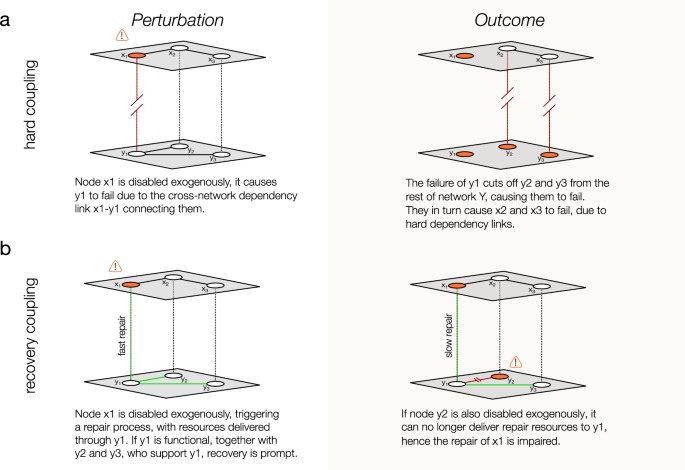
The increased complexity of infrastructure systems has resulted in critical interdependencies between multiple networks—communication systems require electricity, while the normal functioning of the power grid relies on communication systems. These interdependencies have inspired an extensive literature on coupled multilayer networks, assuming a hard interdependence, where a component failure in one network causes failures in the other network, resulting in a cascade of failures across multiple systems. While empirical evidence of such hard failures is limited, the repair and recovery of a network requires resources typically supplied by other networks, resulting in documented interdependencies induced by the recovery process. In this work, we explore recovery coupling, capturing the dependence of the recovery of one system on the instantaneous functional state of another system. If the support networks are not functional, recovery will be slowed. Here we collected data on the recovery time of millions of power grid failures, finding evidence of universal nonlinear behavior in recovery following large perturbations. We develop a theoretical framework to address recovery coupling, predicting quantitative signatures different from the multilayer cascading failures. We then rely on controlled natural experiments to separate the role of recovery coupling from other effects like resource limitations, offering direct evidence of how recovery coupling affects a system’s functionality.

Read the full article at: www.nature.com