
Month: April 2022

Quantifying changes in societal optimism from online sentiment

Calvin Isch, Marijn ten Thij, Peter M. Todd & Johan Bollen
Behavior Research Methods (2022)

Individuals can hold contrasting views about distinct times: for example, dread over tomorrow’s appointment and excitement about next summer’s vacation. Yet, psychological measures of optimism often assess only one time point or ask participants to generalize about their future. Here, we address these limitations by developing the optimism curve, a measure of societal optimism that compares positivity toward different future times that was inspired by the Treasury bond yield curve. By performing sentiment analysis on over 3.5 million tweets that reference 23 future time points (2 days to 30 years), we measured how positivity differs across short-, medium-, and longer-term future references. We found a consistent negative association between positivity and the distance into the future referenced: From August 2017 to February 2020, the long-term future was discussed less positively than the short-term future. During the COVID-19 pandemic, this relationship inverted, indicating declining near-future- but stable distant-future-optimism. Our results demonstrate that individuals hold differentiated attitudes toward the near and distant future that shift in aggregate over time in response to external events. The optimism curve uniquely captures these shifting attitudes and may serve as a useful tool that can expand existing psychometric measures of optimism.

Read the full article at: link.springer.com
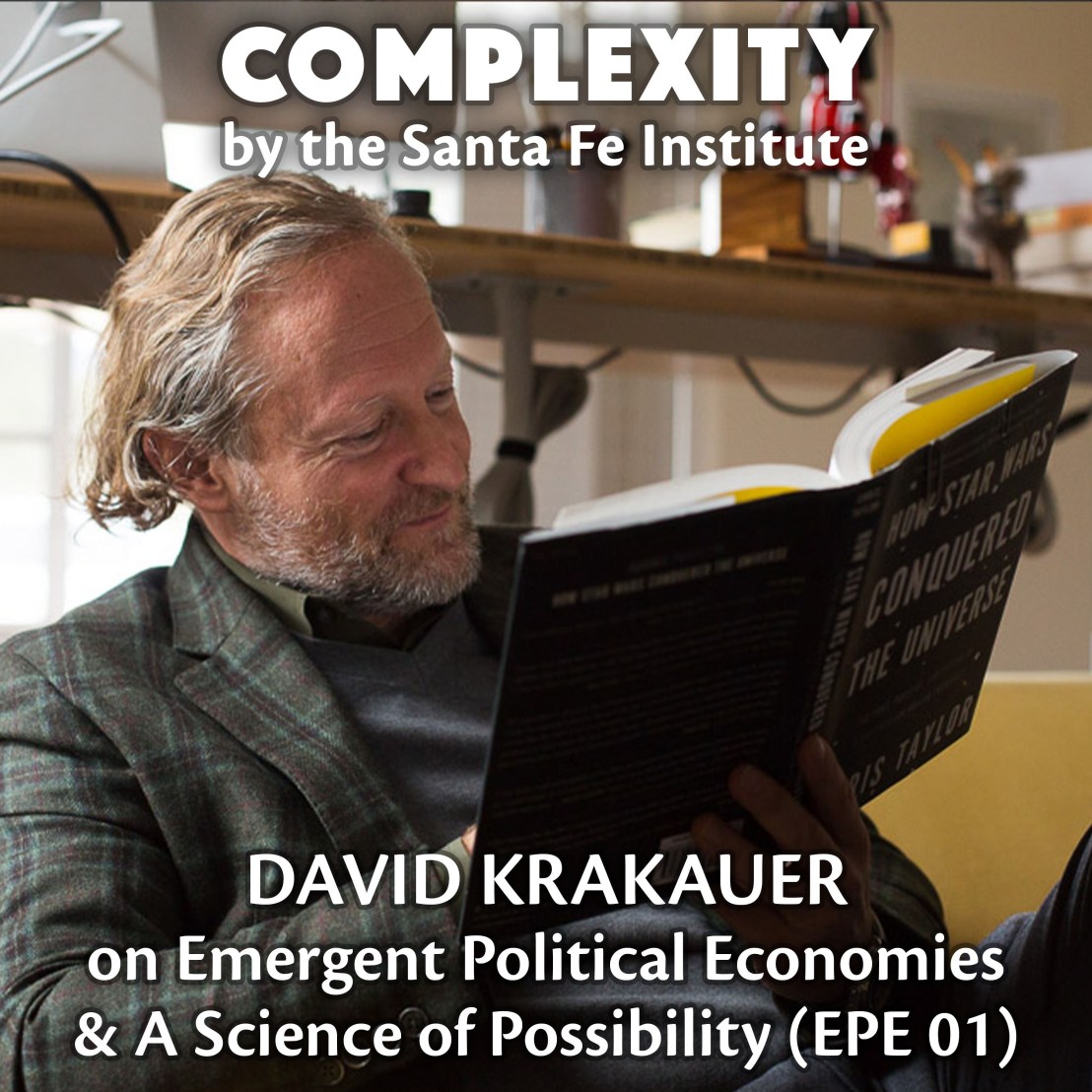
David Krakauer on Emergent Political Economies and A Science of Possibility

The world is unfair — but how much of that unfairness is inevitable, and how much is just contingency? After centuries of efforts to arrive at formal theories of history, society, and economics, most of us still believe and act on what amounts to myth. Our predecessors can’t be faulted for their lack of data, but in 2022 we have superior resources we’re only starting to appreciate and use. In honor of the Santa Fe Institute’s new role as the hub of an international research network exploring Emergent Political Economies, we dedicate this new sub-series of Complexity Podcast to conversations on money, power, governance, and justice. Subscribe for a new stream of dialogues and trialogues between SFI’s own diverse scholastic community and other acclaimed political economists, historians, and authors of speculative fiction.

Read the full article at: complexity.simplecast.com

A Short Tutorial on Mean-Field Spin Glass Techniques for Non-Physicists

Andrea Montanari, Subhabrata Sen
This tutorial is based on lecture notes written for a class taught in the Statistics Department at Stanford in the Winter Quarter of 2017. The objective was to provide a working knowledge of some of the techniques developed over the last 40 years by theoretical physicists and mathematicians to study mean field spin glasses and their applications to high-dimenensional statistics and statistical learning.

Read the full article at: arxiv.org

Scaling Beyond Cities

Rafael Prieto Curiel, Carmen Cabrera-Arnau, Steven Richard Bishop

Front. Phys.

City population size is a crucial measure when trying to understand urban life. Many socio-economic indicators scale superlinearly with city size, whilst some infrastructure indicators scale sublinearly with city size. However, the impact of size also extends beyond the city’s limits. Here, we analyse the scaling behaviour of cities beyond their boundaries by considering the emergence and growth of nearby cities. Based on an urban network from African continental cities, we construct an algorithm to create the region of influence of cities. The number of cities and the population within a region of influence are then analysed in the context of urban scaling. Our results are compared against a random permutation of the network, showing that the observed scaling power of cities to enhance the emergence and growth of cities is not the result of randomness. By altering the radius of influence of cities, we observe three regimes. Large cities tend to be surrounded by many small towns for small distances. For medium distances (above 114 km), large cities are surrounded by many other cities containing large populations. Large cities boost urban emergence and growth (even more than 190 km away), but their scaling power decays with distance.

Read the full article at: www.frontiersin.org

The biosphere computes evolution by autoencoding interacting organisms into species and decoding species into ecosystems

Irun R. Cohen, Assaf Marron
Autoencoding is a machine-learning technique for extracting a compact representation of the essential features of input data; this representation then enables a variety of applications that rely on encoding and subsequent reconstruction based on decoding of the relevant data. Here, we document our discovery that the biosphere evolves by a natural process akin to computer autoencoding. We establish the following points: (1) A species is defined by its species interaction code. The species code consists of the fundamental, core interactions of the species with its external and internal environments; core interactions are encoded by multi-scale networks including molecules-cells-organisms. (2) Evolution expresses sustainable changes in species interaction codes; these changing codes both map and construct the species environment. The survival of species is computed by what we term \textit{natural autoencoding}: arrays of input interactions generate species codes, which survive by decoding into sustained ecosystem interactions. This group process, termed survival-of-the-fitted, supplants the Darwinian struggle of individuals and survival-of-the-fittest only. DNA is only one element in natural autoencoding. (3) Natural autoencoding and artificial autoencoding techniques manifest defined similarities and differences. Biosphere autoencoding and survival-of-the-fitted sheds a new light on the mechanism of evolution. Evolutionary autoencoding renders evolution amenable to new approaches to computer modeling.

Read the full article at: arxiv.org