Month: April 2022

Funding CRISPR: Understanding the role of government and philanthropic institutions in supporting academic research within the CRISPR innovation system

David Fajardo-Ortiz, Stefan Hornbostel, Maywa Montenegro de Wit, Annie Shattuck
Quantitative Science Studies 1–21.

CRISPR/Cas has the potential to revolutionize medicine, agriculture, and biology. Understanding the trajectory of CRISPR research, how it is influenced and who pays for it, is an essential research policy question. We use a combination of methods to map, via quantitative content analysis of CRISPR papers, the research funding profile of major government agencies and organizations philanthropic, and the networks involved in supporting key stages of high-influence research, namely basic biological research and technological development. The results of the content analysis show how the research supported by the main US government agencies focus both on the study of CRISPR as a biological phenomenon and on its technological development and use as a biomedical research tool. US philanthropic organizations with the exception of HHMI, tend, by contrast, to specialize in funding CRISPR as a genome editing technology. We present a model of co-funding networks at the two most prominent institutions for CRISPR/Cas research, the University of California and the Harvard/MIT/Broad Institute, to illuminate how philanthropic organizations have articulated with government agencies to co-finance the discovery and development of CRISPR/Cas. Our results raise fundamental questions about the role of the state and the influence of philanthropy over the trajectory of transformative technologies.

Read the full article at: direct.mit.edu
Constitutions, rule of law, socioeconomics… and populism

Canova, Antonio and Martinez, Edrey and Soares, Ana Cecilia and Scolaro, Mariana and Jaffe, Klaus

Is it possible to know how institutionally stable a country is, how corrupt its rulers are, what is the expectation and standard of living of its inhabitants, how dynamic and complex is its economy, all this, just by identifying and counting certain words in its constitution? We tried to empirically measure the effect of constitutions –if any– on the institutionality and socioeconomics of a country. This study of the history of 88 countries confirms a relationship between quantitative aspects of the constitution and the institutional and socioeconomic well-being of the country; and that new constitutions, over time, tend to be more extensive, with more articles and words. We now know, from a qualitative analysis, that the number of populist words in new constitutions is also greater. We knew that there is a moderate correlation between extensive constitutions, weak rule of law, and low socioeconomic variables. And now we find a strong correlation between countries with even lower rule of law and socioeconomic indexes and constitutions with a higher percentage of populist words. In this correlational study we use 84 international indicators. We did not find a direct cause-effect relationship between a new constitution and subsequent changes in the country’s socioeconomic variables, nor in institutional aspects. We do observe that the institutional and socioeconomic conditions of a country predict certain characteristics of a new constitution. There are objective differences between the constitutions of countries with the prosperity syndrome and the dysfunctional ones. For example, the evidence shows that countries with few populist words in their constitutions enjoy a prosperity syndrome, while countries with many populist words in their constitutions suffer from a dysfunctional syndrome. These results suggest that such syndromes reflect a synergistic relationship between various factors that define the success of countries. Many things are needed for a prosperous society and only a few for it to be dysfunctional. We have seen that constitutions are a factor in this entanglement of synergies and – yes – they must be taken into consideration. Deciphering the role of constitutions in this process needs further exploration and is beyond our current rational capacities. We introduce the Pop-Con Index, an objective indicator of constitutional populism in 88 countries.

Read the full article at: papers.ssrn.com

Emergence of Autocatalytic Sets in a Simple Model of Technological Evolution

Wim Hordijk, Stuart Kauffman
Two alternative views of an economy are combined and studied. The first view is that of technological evolution as a process of combinatorial innovation. Recently a simple mathematical model (TAP) was introduced to study such a combinatorial process. The second view is that of a network of production functions forming an autocatalytic set. Autocatalytic (RAF) sets have been studied extensively in the context of chemical reaction networks.
Here, we combine the two models (TAP and RAF) and show that they are compatible. In particular, it is shown that production function networks resulting from the combinatorial TAP model have a high probability of containing autocatalytic (RAF) sets. We also study the size distribution and robustness of such “economic autocatalytic sets”, and compare our results with those from the chemical context. These initial results strongly support earlier claims that the economy can indeed be seen as an autocatalytic set.

Read the full article at: arxiv.org

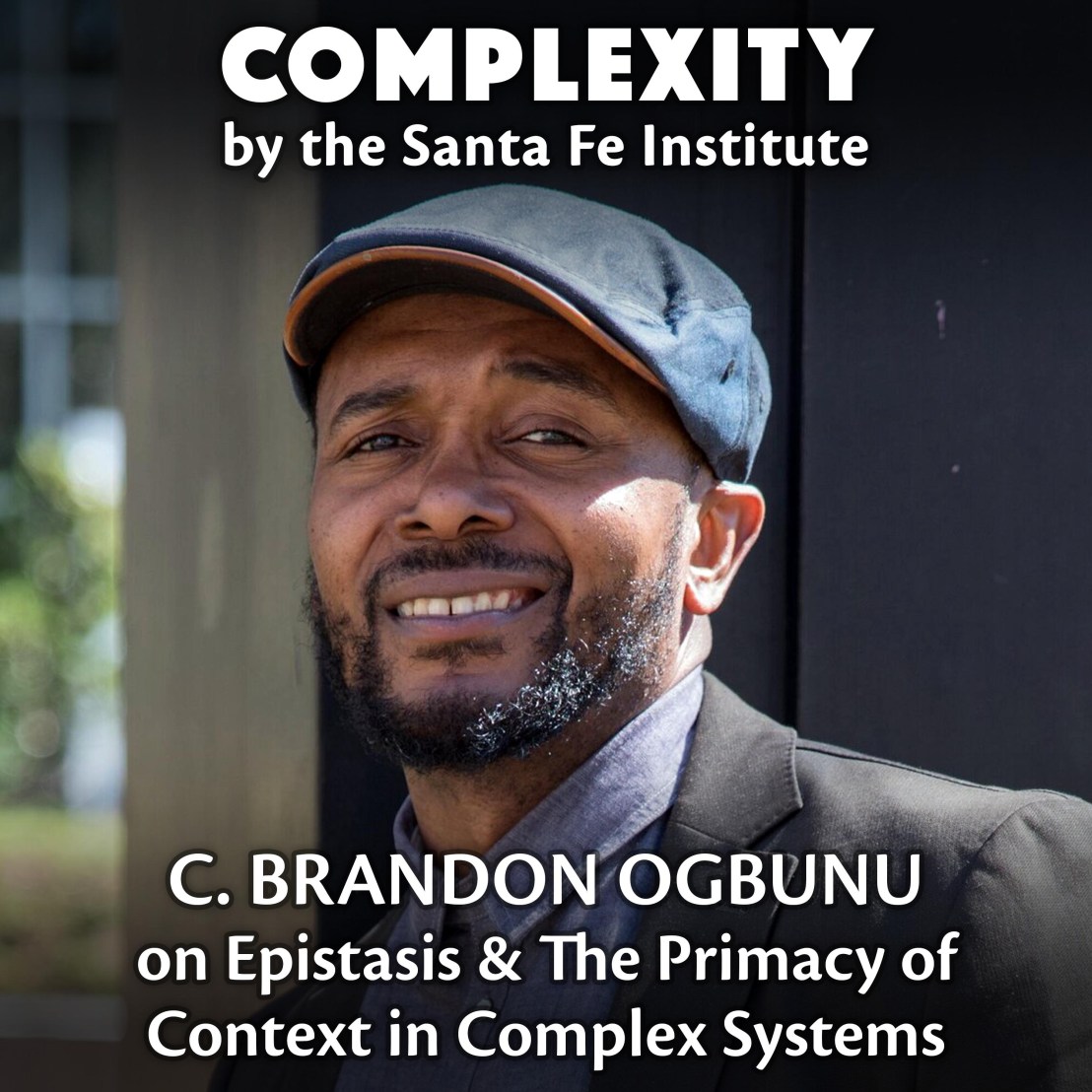
C. Brandon Ogbunu on Epistasis & The Primacy of Context in Complex Systems

Context is king: whether in language, ecology, culture, history, economics, or chemistry. One of the core teachings of complexity science is that nothing exists in isolation — especially when it comes to systems in which learning, memory, or emergent behaviors play a part. Even though this (paradoxically) limits the universality of scientific claims, it also lets us draw analogies between the context-dependency of one phenomenon and others: how protein folding shapes HIV evolution is meaningfully like the way that growing up in a specific neighborhood shapes educational and economic opportunity; the paths through a space of all possible four-letter words are constrained in ways very similar to how interactions between microbes impact gut health; how we make sense both depends on how we’ve learned and places bounds on what we’re capable of seeing.

Listen at: complexity.simplecast.com

Contrasting social and non-social sources of predictability in human mobility

Zexun Chen, Sean Kelty, Alexandre G. Evsukoff, Brooke Foucault Welles, James Bagrow, Ronaldo Menezes & Gourab Ghoshal 
Nature Communications volume 13, Article number: 1922 (2022)

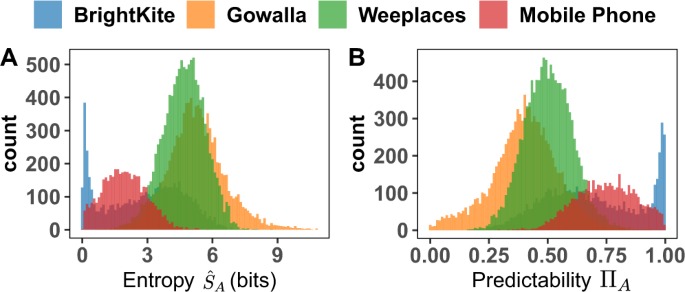
Social structures influence human behavior, including their movement patterns. Indeed, latent information about an individual’s movement can be present in the mobility patterns of both acquaintances and strangers. We develop a “colocation” network to distinguish the mobility patterns of an ego’s social ties from those not socially connected to the ego but who arrive at a location at a similar time as the ego. Using entropic measures, we analyze and bound the predictive information of an individual’s mobility pattern and its flow to both types of ties. While the former generically provide more information, replacing up to 94% of an ego’s predictability, significant information is also present in the aggregation of unknown colocators, that contain up to 85% of an ego’s predictive information. Such information flow raises privacy concerns: individuals sharing data via mobile applications may be providing actionable information on themselves as well as others whose data are absent.

Read the full article at: www.nature.com