
Month: April 2022

Entropy | Special Issue: Recent Advances in Guided Self-Organization

Examples of self-organising systems can be found practically everywhere: a heated fluid forms regular convection patterns of Bénard cells, neuronal ensembles self-organise into complex spike patterns, a swarm changes its shape in response to an approaching predator, ecosystems develop spatial structures in order to deal with diminishing resources, and so on.

Typically, self-organisation (SO) is defined as the evolution of a system into an organised form in the absence of external pressures. SO within a system brings about several attractive properties, in particular robustness, adaptability, and scalability. Consequently, a natural question to ask would be: Is it possible to guide the process of self-organisation towards some desirable patterns and outcomes? Over the last decades, it has become apparent that this question can be rigorously formalised across multiple domains, leading to the emergence of a new research field: Guided Self-Organisation (GSO). This has led to theoretical developments in information theory, network theory, dynamical systems, game theory, systems biology, and sociophysics, as well as practical applications in artificial intelligence, synthetic biology, unconventional computation, distributed robotics, and active matter.

More at: www.mdpi.com
Virtual Workshop: Is AI Extending the Mind?

April 11-15, 2022

The extended mind hypothesis suggests that cognition does not just occur in our minds, but also extends into the physical world around us. Cognition is then a process involving a system of coupled components that work together to enact intelligent processes. In this workshop, we revisit this point of view in the context of modern scientific advances. This workshop will consist largely of discussions centered around the main theme of the workshop, with daily keynotes addressing Agency, AI Ethics, and Human Augmentation.

More at: www.crosslabs.org

Self-Organization in Network Sociotechnical Systems

Svetlana Maltseva, Vasily Kornilov, Vladimir Barakhnin, and Alexander Gorbunov

Complexity Volume 2022 |Article ID 5714395

We can observe self-organization properties in various systems. However, modern networked dynamical sociotechnical systems have some features that allow for realizing the benefits of self-organization in a wide range of systems in economic and social areas. The review examines the general principles of self-organized systems, as well as the features of the implementation of self-organization in sociotechnical systems. We also delve into the production systems, in which the technical component is decisive, and social networks, in which the social component dominates; we analyze models used for modeling self-organizing networked dynamical systems. It is shown that discrete models prevail at the micro level. Furthermore, the review deals with the features of using continuous models for modeling at the macro level.

Read the full article at: www.hindawi.com

Complexity Research

Where do we come from? Where are we going? New research from the Santa Fe Institute explores key questions related to humanity, society, and the existence of life in our world.
Part 1: The Principles of Complexity: Understanding the Hidden Sources of Order by Dr. Stefani Crabtree

Part 2: Autocatalytic Sets: Complexity at the Interface of Chemistry and Biology by Dr. Wim Hordijk

Part 3: Beyond Pairwise: Higher-Order Interactions in Complex Systems

Read the full article at: www.templeton.org

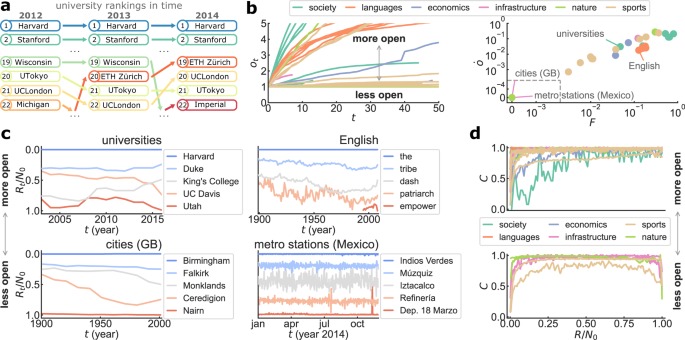
Dynamics of ranking

Gerardo Iñiguez, Carlos Pineda, Carlos Gershenson & Albert-László Barabási 

Nature Communications volume 13, Article number: 1646 (2022)

Virtually anything can be and is ranked; people, institutions, countries, words, genes. Rankings reduce complex systems to ordered lists, reflecting the ability of their elements to perform relevant functions, and are being used from socioeconomic policy to knowledge extraction. A century of research has found regularities when temporal rank data is aggregated. Far less is known, however, about how rankings change in time. Here we explore the dynamics of 30 rankings in natural, social, economic, and infrastructural systems, comprising millions of elements and timescales from minutes to centuries. We find that the flux of new elements determines the stability of a ranking: for high flux only the top of the list is stable, otherwise top and bottom are equally stable. We show that two basic mechanisms — displacement and replacement of elements — capture empirical ranking dynamics. The model uncovers two regimes of behavior; fast and large rank changes, or slow diffusion. Our results indicate that the balance between robustness and adaptability in ranked systems might be governed by simple random processes irrespective of system details.

Read the full article at: www.nature.com