Month: May 2022

Sustainability and Goal Fitness Index for the Analysis of Sustainable Development Goals: A Methodological Proposal

Sanny González, Gabriel Pereira, and Arturo González

The Sustainable Development Goals (SDGs) were adopted in September 2015 by the 193 member states of the United Nations (UN), which include 17 goals, 169 targets and 244 indicators, as an attempt to radically change the approach of the Millennium Development Goals (MDGs). Since the adoption of the 2030 Agenda, the scientific community has increased its interest in the evaluation, analysis, and evaluation of the interrelationships between the SDGs, proposing different approaches and using a diversity of methodological tools for the interactions of the SDGs. This research proposes a methodology that takes advantage of the concepts of Economic Fitness for the creation of a Sustainability Fitness Index (SFI) for the countries and a Goal Fitness Index (GFI) for each SDG. These indices are intended to provide a tool to analyze the interrelationships between the Sustainable Development Goals in such a way that they offer a new approach to address the capacities of the countries and the fulfillment of the SDGs. The results of the SFI are a first attempt to identify development priorities aligned with the SDGs in each country, based on their available productive capacities, which could help make more efficient use of their limited resources and increase the achievement of the SDGs.

Read the full article at: www.scitepress.org
Universality out of order

Petter Holme 

Nature Communications volume 13, Article number: 2355 (2022)

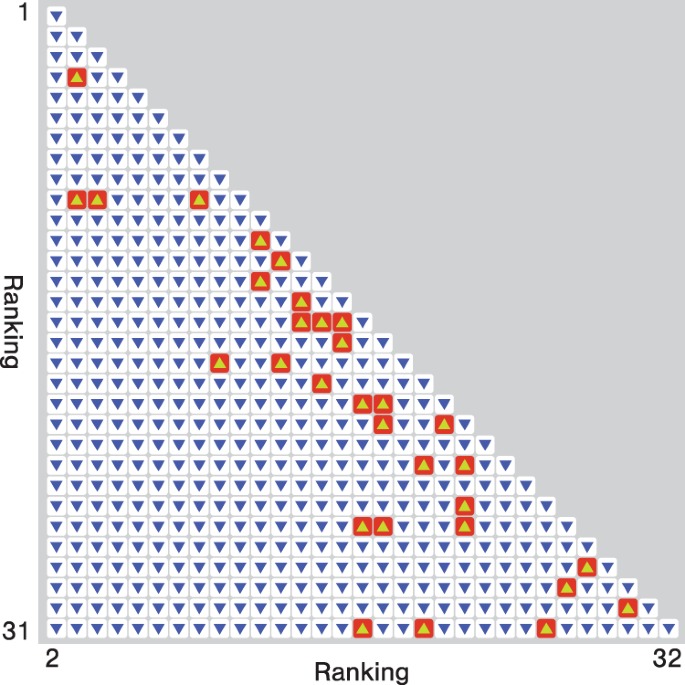
Orders, rankings, and hierarchies on one side, universal statistical laws on the other—it is rare that these core concepts of complex systems science meet. This Comment sets the scene for some recent discoveries in this too seldomly visited border zone.

Read the full article at: www.nature.com

The universality in urban commuting across and within cities

Lei Dong, Paolo Santi, Yu Liu, Siqi Zheng, Carlo Ratti
Commuting is a key mechanism that governs the dynamics of cities. Despite its importance, very little is known of the properties and mechanisms underlying this crucial urban process. Here, we capitalize on ∼ 50 million individuals’ smartphone data from 234 Chinese cities to show that urban commuting obeys remarkable regularities. These regularities can be generalized as two laws: (i) the scale-invariance of the average commuting distance across cities, which is a long-awaited validation of Marchetti’s constant conjecture, and (ii) a universal inverted U-shape of the commuting distance as a function of the distance from the city centre within cities, indicating that the city centre’s attraction is bounded. Motivated by such empirical findings, we develop a simple urban growth model that connects individual-level mobility choices with macroscopic urban spatial structure and faithfully explains both commuting laws. Our results further show that the scale-invariants of human mobility will ultimately lead to the polycentric transition in cities, which could be used to better inform urban development strategies.

Read the full article at: arxiv.org

What’s love got to do with it? From ‘survival of the fittest’ to compassionate connection [online course]

Richard A. Watson

A program for Earth Literacies

May 17th to June 7th, 2022

Why are we fighting and exploiting each other? And why are we destroying the planet’s natural resources and the balance of the global ecosystems we ourselves depend on? How do we treat each other and the biosphere with more kindness and compassion?

This course seeks to bring together the ideas of this new science and these worldviews to relieve the tension between self-interest and our impact on one another and the world around us. The focus will be both on presented material and what we can learn from each other to move into compassionate connection. The taught material will include slide presentations, with break-out room exercises, and opportunities to share reflections and to learn from one another in group discussion – and if Im feeling suitably brave and vulnerable, maybe a little guided visualisation to ‘feel into’ and invite the worldview we choose, and our role in it.

More information at: www.richardawatson.com

Instability of networks: effects of sampling frequency and extreme fluctuations in financial data

Jalshayin Bhachech, Arnab Chakrabarti, Taisei Kaizoji & Anindya S. Chakrabarti 

The European Physical Journal B volume 95, Article number: 71 (2022)

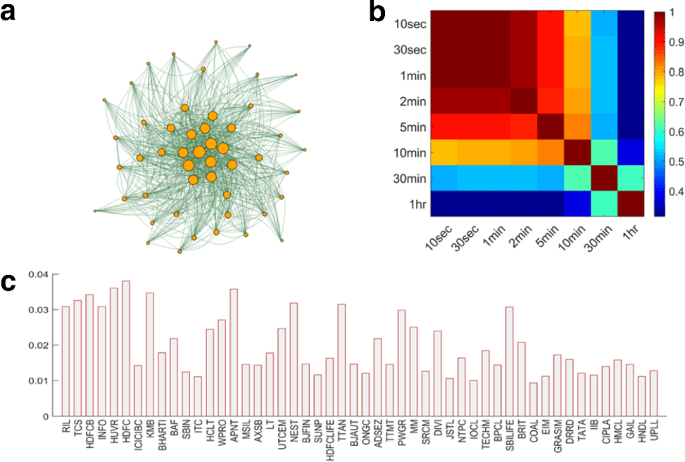
What determines the stability of networks inferred from dynamical behavior of a system? Internal and external shocks in a system can destabilize the topological properties of comovement networks. In real-world data, this creates a trade-off between identification of turbulent periods and the problem of high dimensionality. Longer time-series reduces the problem of high dimensionality, but suffers from mixing turbulent and non-turbulent periods. Shorter time-series can identify periods of turbulence more accurately, but introduces the problem of high dimensionality, so that the underlying linkages cannot be estimated precisely. In this paper, we exploit high-frequency multivariate financial data to analyze the origin of instability in the inferred networks during periods free from external disturbances. We show that the topological properties captured via centrality ordering is highly unstable even during such non-turbulent periods. Simulation results with multivariate Gaussian and fat-tailed stochastic process calibrated to financial data show that both sampling frequencies and the presence of outliers cause instability in the inferred network. We conclude that instability of network properties do not necessarily indicate systemic instability.

Read the full article at: link.springer.com