
Month: June 2023

Artificial Intelligence can facilitate selfish decisions by altering the appearance of interaction partners

Nils Köbis, Philipp Lorenz-Spreen, Tamer Ajaj, Jean-Francois Bonnefon, Ralph Hertwig, Iyad Rahwan

The increasing prevalence of image-altering filters on social media and video conferencing technologies has raised concerns about the ethical and psychological implications of using Artificial Intelligence (AI) to manipulate our perception of others. In this study, we specifically investigate the potential impact of blur filters, a type of appearance-altering technology, on individuals’ behavior towards others. Our findings consistently demonstrate a significant increase in selfish behavior directed towards individuals whose appearance is blurred, suggesting that blur filters can facilitate moral disengagement through depersonalization. These results emphasize the need for broader ethical discussions surrounding AI technologies that modify our perception of others, including issues of transparency, consent, and the awareness of being subject to appearance manipulation by others. We also emphasize the importance of anticipatory experiments in informing the development of responsible guidelines and policies prior to the widespread adoption of such technologies.

Read the full article at: arxiv.org
From autopoiesis to self-optimization: Toward an enactive model of biological regulation

Tom Froese, Natalya Weber, Ivan Shpurov, Takashi Ikegami

The theory of autopoiesis has been influential in many areas of theoretical biology, especially in the fields of artificial life and origins of life. However, it has not managed to productively connect with mainstream biology, partly for theoretical reasons, but arguably mainly because deriving specific working hypotheses has been challenging. The theory has recently undergone significant conceptual development in the enactive approach to life and mind. Hidden complexity in the original conception of autopoiesis has been explicated in the service of other operationalizable concepts related to self-individuation: precariousness, adaptivity, and agency. Here we advance these developments by highlighting the interplay of these concepts with considerations from thermodynamics: reversibility, irreversibility, and path-dependence. We interpret this interplay in terms of the self-optimization model, and present modeling results that illustrate how these minimal conditions enable a system to re-organize itself such that it tends toward coordinated constraint satisfaction at the system level. Although the model is still very abstract, these results point in a direction where the enactive approach could productively connect with cell biology.

Read the full article at: www.biorxiv.org

Sandpile Universality in Social Inequality: Gini and Kolkata Measures

Suchismita Banerjee, Soumyajyoti Biswas, Bikas K. Chakrabarti, Asim Ghosh, and Manipushpak Mitra

Entropy 2023, 25(5), 735

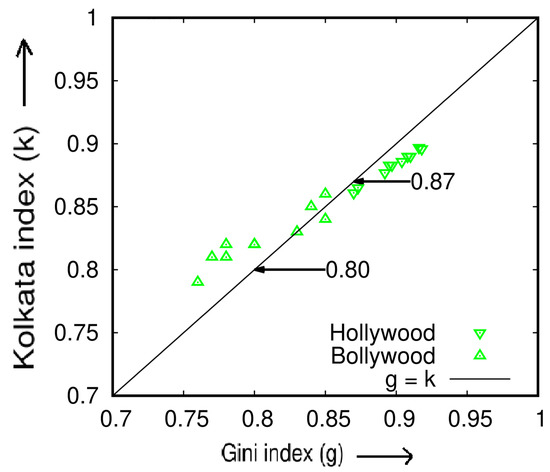
Social inequalities are ubiquitous and evolve towards a universal limit. Herein, we extensively review the values of inequality measures, namely the Gini (g) index and the Kolkata (k) index, two standard measures of inequality used in the analysis of various social sectors through data analysis. The Kolkata index, denoted as k, indicates the proportion of the ‘wealth’ owned by (1−𝑘) fraction of the ‘people’. Our findings suggest that both the Gini index and the Kolkata index tend to converge to similar values (around 𝑔=𝑘≈0.87, starting from the point of perfect equality, where 𝑔=0 and 𝑘=0.5) as competition increases in different social institutions, such as markets, movies, elections, universities, prize winning, battle fields, sports (Olympics), etc., under conditions of unrestricted competition (no social welfare or support mechanism). In this review, we present the concept of a generalized form of Pareto’s 80/20 law (𝑘=0.80), where the coincidence of inequality indices is observed. The observation of this coincidence is consistent with the precursor values of the g and k indices for the self-organized critical (SOC) state in self-tuned physical systems such as sand piles. These results provide quantitative support for the view that interacting socioeconomic systems can be understood within the framework of SOC, which has been hypothesized for many years. These findings suggest that the SOC model can be extended to capture the dynamics of complex socioeconomic systems and help us better understand their behavior.

Read the full article at: www.mdpi.com

Selection for short-term empowerment accelerates the evolution of homeostatic neural cellular automata

Caitlin Grasso, Josh Bongard

Empowerment — a domain independent, information-theoretic metric — has previously been shown to assist in the evolutionary search for neural cellular automata (NCA) capable of homeostasis when employed as a fitness function. In our previous study, we successfully extended empowerment, defined as maximum time-lagged mutual information between agents’ actions and future sensations, to a distributed sensorimotor system embodied as an NCA. However, the time-delay between actions and their corresponding sensations was arbitrarily chosen. Here, we expand upon previous work by exploring how the time scale at which empowerment operates impacts its efficacy as an auxiliary objective to accelerate the discovery of homeostatic NCAs. We show that shorter time delays result in marked improvements over empowerment with longer delays, when compared to evolutionary selection only for homeostasis. Moreover, we evaluate stability and adaptability of evolved NCAs, both hallmarks of living systems that are of interest to replicate in artificial ones. We find that short-term empowered NCA are more stable and are capable of generalizing better to unseen homeostatic challenges. Taken together, these findings motivate the use of empowerment during the evolution of other artifacts, and suggest how it should be incorporated to accelerate evolution of desired behaviors for them.

Read the full article at: arxiv.org

Self-Replicating Hierarchical Structures Emerge in a Binary Cellular Automaton

Bo Yang

We have discovered a novel transition rule for binary cellular automata (CA) that yields self-replicating structures across two spatial and temporal scales from sparsely populated random initial conditions. Lower-level, shapeshifting clusters frequently follow a transient attractor trajectory, generating new clusters, some of which periodically self-duplicate. When the initial distribution of live cells is sufficiently sparse, these clusters coalesce into larger formations that also self-replicate. These formations may further form the boundaries of an expanding complex on an even larger scale. This rule, dubbed “Outlier,” is rotationally symmetric and applies to 2D Moore neighborhoods. It was evolved through Genetic Programming during an extensive automated search for rules that foster open-ended evolution in CA. While self-replicating structures, both crafted and emergent, hav

Read the full article at: arxiv.org