
Month: June 2023

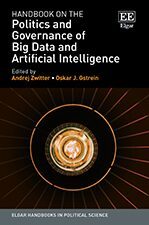
Handbook on the Politics and Governance of Big Data and Artificial Intelligence

Edited by Andrej Zwitter and Oskar Gstrein
Drawing on the theoretical debates, practical applications, and sectoral approaches in the field, this ground-breaking Handbook unpacks the political and regulatory developments in AI and big data governance. Covering the political implications of big data and AI on international relations, as well as emerging initiatives for legal regulation, it provides an accessible overview of ongoing data science discourses in politics, law and governance.

Read the full article at: www.elgaronline.com

A chiral aperiodic monotile

David Smith, Joseph Samuel Myers, Craig S. Kaplan, Chaim Goodman-Strauss

The recently discovered “hat” aperiodic monotile mixes unreflected and reflected tiles in every tiling it admits, leaving open the question of whether a single shape can tile aperiodically using translations and rotations alone. We show that a close relative of the hat — the equilateral member of the continuum to which it belongs — is a weakly chiral aperiodic monotile: it admits only non-periodic tilings if we forbid reflections by fiat. Furthermore, by modifying this polygon’s edges we obtain a family of shapes called Spectres that are strictly chiral aperiodic monotiles: they admit only chiral non-periodic tilings based on a hierarchical substitution system.

Read the full article at: arxiv.org

A revised central dogma for the 21st century:all biology is cognitive information processing

William B. Miller, František Baluška, Arthur S. Reber

Progress in Biophysics and Molecular Biology

Crick’s Central Dogma has been a foundational aspect of 20th century biology, describing an implicit relationship governing the flow of information in biological systems in biomolecular terms. Accumulating scientific discoveries support the need for a revised Central Dogma to buttress evolutionary biology’s still-fledgling migration from a Neodarwinian canon. A reformulated Central Dogma to meet contemporary biology is proposed: all biology is cognitive information processing. Central to this contention is the recognition that life is the self-referential state, instantiated within the cellular form. Self-referential cells act to sustain themselves and to do so, cells must be in consistent harmony with their environment. That consonance is achieved by the continuous assimilation of environmental cues and stresses as information to self-referential observers. All received cellular information must be analyzed to be deployed as cellular problem-solving to maintain homeorhetic equipoise. However, the effective implementation of information is definitively a function of orderly information management. Consequently, effective cellular problem-solving is information processing and management. The epicenter of that cellular information processing is its self-referential internal measurement. All further biological self-organization initiates from this obligate activity. As the internal measurement by cells of information is self-referential by definition, self-reference is biological self-organization, underpinning 21st century Cognition-Based Biology.

Read the full article at: www.sciencedirect.com

Intensive Complexity Course: Summer 2023

Gain new insights that reframe your thinking, specific tools to advance current projects, and perspectives to set new directions.
Dates: July 17-July 28, 2023

This summer, discover the science that teaches us about collected patterns of behavior, helps us understand the fluctuations of global finance, and can help us meet societal, organization and global challenges.

This course provides an introduction to essential concepts of complex systems and related mathematical methods and simulation strategies with application to physical, biological and social systems.

Concepts to be covered include: emergence, complexity, networks, self-organization, pattern formation, evolution, adaptation, fractals, chaos, cooperation, competition, attractors, interdependence, scaling, dynamic response, information and function.

Methods to be covered include: statistical methods, cellular automata, agent-based modeling, pattern recognition, system representation and informatics.

More at: necsi.edu