
Month: June 2023

Competition for popularity and interventions on a Chinese microblogging site

Hao Cui, János Kertész

PLoS ONE 18(5): e0286093.

Microblogging sites are important vehicles for the users to obtain information and shape public opinion thus they are arenas of continuous competition for popularity. Most popular topics are usually indicated on ranking lists. In this study, we investigate the public attention dynamics through the Hot Search List (HSL) of the Chinese microblog Sina Weibo, where trending hashtags are ranked based on a multi-dimensional search volume index. We characterize the rank dynamics by the time spent by hashtags on the list, the time of the day they appear there, the rank diversity, and by the ranking trajectories. We show how the circadian rhythm affects the popularity of hashtags, and observe categories of their rank trajectories by a machine learning clustering algorithm. By analyzing patterns of ranking dynamics using various measures, we identify anomalies that are likely to result from the platform provider’s intervention into the ranking, including the anchoring of hashtags to certain ranks on the HSL. We propose a simple model of ranking that explains the mechanism of this anchoring effect. We found an over-representation of hashtags related to international politics at 3 out of 4 anchoring ranks on the HSL, indicating possible manipulations of public opinion.

Read the full article at: journals.plos.org
Urban Dynamics Through the Lens of Human Mobility

Yanyan Xu, Luis E. Olmos, David Mateo, Alberto Hernando, Xiaokang Yang, Marta C. Gonzalez

The urban spatial structure represents the distribution of public and private spaces in cities and how people move within them. While it usually evolves slowly, it can change fast during large-scale emergency events, as well as due to urban renewal in rapidly developing countries. This work presents an approach to delineate such urban dynamics in quasi-real-time through a human mobility metric, the mobility centrality index ΔKS. As a case study, we tracked the urban dynamics of eleven Spanish cities during the COVID-19 pandemic. Results revealed that their structures became more monocentric during the lockdown in the first wave, but kept their regular spatial structures during the second wave. To provide a more comprehensive understanding of mobility from home, we also introduce a dimensionless metric, KSHBT, which measures the extent of home-based travel and provides statistical insights into the transmission of COVID-19. By utilizing individual mobility data, our metrics enable the detection of changes in the urban spatial structure.

Read the full article at: arxiv.org

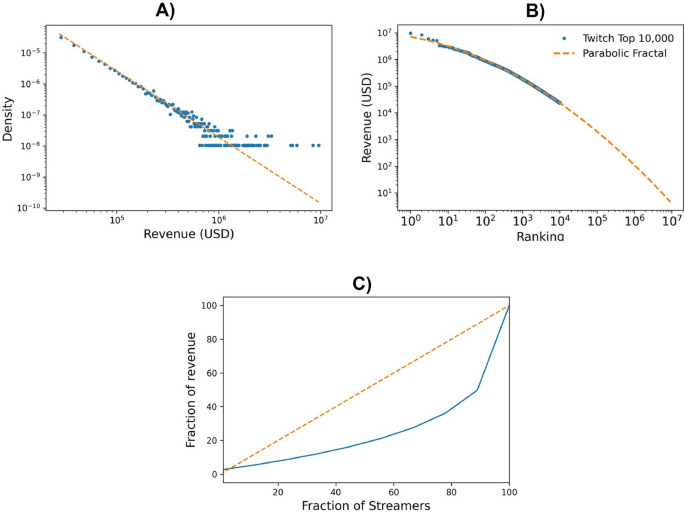
Monetization in online streaming platforms: an exploration of inequalities in Twitch.tv

A. Houssard, F. Pilati, M. Tartari, P. L. Sacco & R. Gallotti
Scientific Reports volume 13, Article number: 1103 (2023)

The live streaming platform Twitch underwent in recent years an impressive growth in terms of viewership and content diversity. The platform has been the object of several studies showcasing how streamers monetize their content via a peculiar system centered around para-sociality and community dynamics. Nonetheless, due to scarcity of data, lots is still unknown about the platform-wide relevance of this explanation as well as its effect on inequalities across streamers. In this paper, thanks to the recent availability of data showcasing the top 10,000 streamers revenue between 2019 and 2021, as well as viewership data from different sources, we characterized the popularity and audience monetization dynamics of the platform. Using methods from social physics and econometrics, we analyzed audience building and retention dynamics and linked them to observed inequalities. We found a high level of inequality across the platform, as well as an ability of top streamers to diversify their revenue sources, through audience renewal and diversification in monetization systems. Our results demonstrate that, even if the platform design and affordance favor monetization for smaller creators catering to specific niches, its non-algorithmic design still leaves room for classical choice biases allowing a few streamers to emerge, retain and renew a massive audience.

Read the full article at: www.nature.com

Implementation of Lenia as a Reaction-Diffusion System

Hiroki Kojima, Takashi Ikegami

The relationship between reaction-diffusion (RD) systems, characterized by continuous spatiotemporal states, and cellular automata (CA), marked by discrete spatiotemporal states, remains poorly understood. This paper delves into this relationship through an examination of a recently developed CA known as Lenia. We demonstrate that asymptotic Lenia, a variant of Lenia, can be comprehensively described by differential equations, and, unlike the original Lenia, it is independent of time-step ticks. Further, we establish that this formulation is mathematically equivalent to a generalization of the kernel-based Turing model (KT model). Stemming from these insights, we establish that asymptotic Lenia can be replicated by an RD system composed solely of diffusion and spatially local reaction terms, resulting in the simulated asymptotic Lenia based on an RD system, or “RD Lenia”. However, our RD Lenia cannot be construed as a chemical system since the reaction term fails to satisfy mass-action kinetics.

Read the full article at: arxiv.org

The spatiotemporal signature of cherry blossom flowering across Japan revealed via analysis of social network site images

Moataz Medhat ElQadi, Adrian G. Dyer, Carolyn Vlasveld, Alan Dorin

Flora

Volume 304, July 2023, 152311

Understanding how changing climatic conditions are impacting flowering plants typically requires intensive effort and expense to sample a local site regularly over long periods of time. The logistics of organising detailed surveys of an extensive area to provide a wider perspective are even more inhibitive. Data on flower bloom patterns across areas stretching hundreds or thousands of kilometres, and with a temporal resolution down to 1 or 2 weeks, is nevertheless very valuable, should it be feasible to collect. To understand the potential for contemporary data to record such flowering patterns, we studied Japan, a country where cherry (Sakura, 桜) flower viewing (Hanami) is a national cultural practice stretching back hundreds of years, and in which contemporary citizens and visitors commonly photograph blossoms to share on social network sites (SNS). We employed the big data this activity creates, within an iEcology framework, by collecting images from the SNS Flickr over the decade 2008–2018. We developed a custom filtering pipeline to validate this extracted data against established databases of historical flowering times. Our results reveal unprecedented detail of the spatiotemporal pattern over which cherry blossoms seasonally sweep from southern to northern Japan during a 12 week period. They also were sufficiently sensitive to reveal a subtle out of peak season bloom. This novel approach and data source therefore provides a simultaneously broad and detailed perspective that communicates the seasonal ecological phenomenon of cherry tree flowering.

Read the full article at: www.sciencedirect.com