
Month: February 2025

Pandemic monitoring with global aircraft-based wastewater surveillance networks

Guillaume St-Onge, Jessica T. Davis, Laurent Hébert-Dufresne, Antoine Allard, Alessandra Urbinati, Samuel V. Scarpino, Matteo Chinazzi & Alessandro Vespignani 
Nature Medicine (2025)

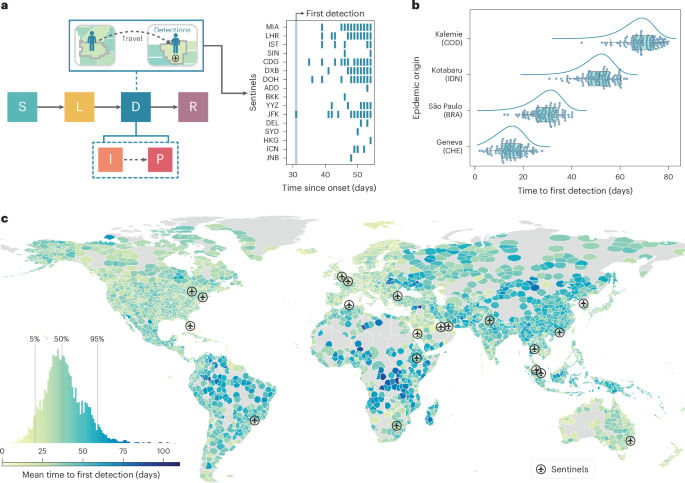
Aircraft wastewater surveillance has been proposed as a new approach to monitor the global spread of pathogens. Here we develop a computational framework providing actionable information for the design and estimation of the effectiveness of global aircraft-based wastewater surveillance networks (WWSNs). We study respiratory diseases of varying transmission potential and find that networks of 10–20 strategically placed wastewater sentinel sites can provide timely situational awareness and function effectively as an early warning system. The model identifies potential blind spots and suggests optimization strategies to increase WWSN effectiveness while minimizing resource use. Our findings indicate that increasing the number of sentinel sites beyond a critical threshold does not proportionately improve WWSN capabilities, emphasizing the importance of resource optimization. We show, through retrospective analyses, that WWSNs can notably shorten detection time for emerging pathogens. The approach presented offers a realistic analytic framework for the analysis of WWSNs at airports.

Read the full article at: www.nature.com

Grand challenges in industrial and systems engineering

Waldemar Karwowski, et al.

International Journal of Production Research

Contemporary society faces a growing set of complex issues representing significant socioeconomic, health and well-being, environmental, and sustainability challenges. The discipline of industrial and systems engineering (ISE) can play an important role in addressing these issues. This paper identifies and discusses eight grand challenges for ISE. These grand challenges are (1) Artificial Intelligence (AI) For Business and Personal Use: Decision-Making and System Design and Operations, (2) Cybersecurity and Resilience, (3) Sustainability: Environment, Energy and Infrastructure, (4) Health Issues, (5) Social Issues, (6) Logistics and Supply Chain, (7) System Integration and Operations: Humans, Automation, and AI, and (8) Industrial and Systems Engineering Education. The discussed grand challenges were derived by accomplished ISE professionals who are the authors of this paper. The implications of the ISE grand challenges for education, training, research, and implementation of ISE principles and methodologies for the benefit of global society are discussed.

Read the full article at: www.tandfonline.com

Self-similar scaling of higher order interactions in complex networks

Minze Wu, Tongfeng Weng, Zhuoming Ren, Xiaolu Chen and Chunzi Li

EPLA

Self-similarity of complex networks has been exhaustively explored but only concentrating on pairwise interactions between nodes. We restudy self-similar characteristics of networks from algebraic topological perspective. By virtue of a box covering technique, we generate consecutive renormalized networks with respect to different length scales. Interestingly, we find that the number of a specific order of clique in the renormalized networks presents a clearly scaling behavior. Moreover, we show that the growth pattern of cliques is likely to follow a universal principle for seemingly different kinds of real networks. Our work, for the first time, reveals the role of higher-order interactions in shaping self-similarity of complex networks.

Read the full article at: iopscience.iop.org

Breakdown of stochastic resonance in complex networks

Jonah E. Friederich, Everton S. Medeiros, Sabine H. L. Klapp, Anna Zakharova

In networked systems, stochastic resonance occurs as a collective phenomenon where the entire stochastic network resonates with a weak applied periodic signal. Beyond the interplay among the network coupling, the amplitude of the external periodic signal, and the intensity of stochastic fluctuations, the maintenance of stochastic resonance also crucially depends on the resonance capacity of each oscillator composing the network. This scenario raises the question: Can local defects in the ability of oscillators to resonate break down the stochastic resonance phenomenon in the entire network? Here, we investigate this possibility in complex networks of prototypical bistable oscillators in a double-well potential. We test the sustainability of stochastic resonance by considering a fraction of network oscillators with nonresonant potential landscapes. We find that the number of nonresonant oscillators depends nonlinearly on their dissimilarity from the rest of the network oscillators. In addition, we unravel the role of the network topology and coupling strength in maintaining, or suppressing, the stochastic resonance for different noise levels and number of nonresonant oscillators. Finally, we obtain a low-dimensional deterministic model confirming the results observed for the networks.

Read the full article at: arxiv.org

The Role of Science in the Climate Change Discussions on Reddit

Paolo Cornale, Michele Tizzani, Fabio Ciulla, Kyriaki Kalimeri, Elisa Omodei, Daniela Paolotti, Yelena Mejova
Collective and individual action necessary to address climate change hinges on the public’s understanding of the relevant scientific findings. In this study, we examine the use of scientific sources in the course of 14 years of public deliberation around climate change on one of the largest social media platforms, Reddit. We find that only 4.0% of the links in the Reddit posts, and 6.5% in the comments, point to domains of scientific sources, although these rates have been increasing in the past decades. These links are dwarfed, however, by the citations of mass media, newspapers, and social media, the latter of which peaked especially during 2019-2020. Further, scientific sources are more likely to be posted by users who also post links to sources having central-left political leaning, and less so by those posting more polarized sources. Unfortunately, scientific sources are not often used in response to links to unreliable sources.

Read the full article at: arxiv.org