
Month: January 2026

The software complexity of nations

Sándor Juhász, Johannes Wachs, Jermain Kaminski, César A. Hidalgo

Research Policy

Volume 55, Issue 3, April 2026, 105422

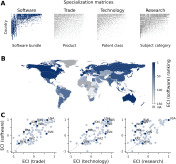
Despite the growing importance of the digital sector, research on economic complexity and its implications continues to rely mostly on administrative records—e.g. data on exports, patents, and employment—that have blind spots when it comes to the digital economy. In this paper we use data on the geography of programming languages used in open-source software to extend economic complexity ideas to the digital economy. We estimate a country’s software economic complexity index (ECIsoftware) and show that it complements the ability of measures of complexity based on trade, patents, and research to account for international differences in GDP per capita, income inequality, and emissions. We also show that open-source software follows the principle of relatedness, meaning that a country’s entries and exits in programming languages are partly explained by its current pattern of specialization. Together, these findings help extend economic complexity ideas and their policy implications to the digital economy.

Read the full article at: www.sciencedirect.com

Crossing the Functional Desert: Cascade-Driven Assembly and Feasibility Transitions in Early Life

Galen J. Wilkerson
The origin of life poses a problem of combinatorial feasibility: How can temporally supported functional organization arise in exponentially branching assembly spaces when unguided exploration behaves as a memoryless random walk? We show that nonlinear threshold-cascade dynamics in connected interaction networks provide a minimal, substrate-agnostic mechanism that can soften this obstruction. Below a critical connectivity threshold, cascades die out locally and structured input-output response mappings remain sparse and transient-a “functional desert” in which accumulation is dynamically unsupported. Near the critical percolation threshold, system-spanning cascades emerge, enabling discriminative functional responses. We illustrate this transition using a minimal toy model and generalize the argument to arbitrary networked systems. Also near criticality, cascades introduce finite-timescale structural and functional coherence, directional bias, and weak dynamical path-dependence into otherwise memoryless exploration, allowing biased accumulation. This connectivity-driven transition-functional percolation-requires only generic ingredients: interacting units, nonlinear thresholds, influence transmission, and non-zero coherence times. The mechanism does not explain specific biochemical pathways, but it identifies a necessary dynamical regime in which structured functional organization can emerge and be temporarily supported, providing a physical foundation for how combinatorial feasibility barriers can be crossed through network dynamics alone.

Read the full article at: arxiv.org

Carlos Gershenson: On the Limits of the Scientific Study of Complex Systems

Binghamton Center of Complex Systems (CoCo) Seminar

January 28, 2026

Carlos Gershenson (Systems Science and Industrial Engineering, Binghamton University)

“On the Limits of the Scientific Study of Complex Systems”

Watch  at: vimeo.com

Abundance and Economic diversity as a descriptor of cities’ economic complexity

Marco A. Rosas Pulido, Roberto Murcio, Omar R. Vázquez, Carlos Gershenson
Intricate interactions among firms, institutions, and spatial structures shape urban economic systems. In this study, we propose a framework based on three structural dimensions — abundance, diversity, and longevity (ADL) of economic units — as proxies of urban economic complexity and resilience. Using a decade of georeferenced firm-level data from Mexico City, we analyze the relationships among ADL variables using regression, spatial correlation, and time-series clustering. Our results reveal nonlinear dynamics across urban space, with powerlaw behavior in central zones and logarithmic saturation in peripheral areas, suggesting differentiated growth regimes. Notably, firm longevity modulates the relationship between abundance and diversity, particularly in periurban transition zones. These spatial patterns point to an emerging polycentric restructuring within a traditionally monocentric metropolis. By integrating economic complexity theory with spatial analysis, our approach provides a scalable method to assess the adaptive capacity of urban economies. This has implications for understanding informality, designing inclusive urban policies, and navigating structural transitions in rapidly urbanizing regions.

Read the full article at: arxiv.org

Quantifying emergent complexity

Erik Hoel

Patterns, Volume 7, Issue 1101472January 09, 2026

Complex systems can be described at myriad different scales, and their causal workings often have a multiscale structure (e.g., a computer can be described at the microscale of its hardware circuitry, the mesoscale of its machine code, and the macroscale of its operating system). While scientists study and model systems across the full hierarchy of their scales, from microphysics to macroeconomics, there is debate about what the macroscales of systems can possibly add beyond mere compression. To resolve this long-standing issue, here, a new theory of emergence is introduced that can distinguish which scales irreducibly contribute to a system’s causal workings. The theory’s application is demonstrated in coarse grains of Markov chains, revealing a novel measure of emergent complexity: how widely distributed a system’s causal contributions are across its hierarchy of scales.

Read the full article at: www.cell.com