
Month: January 2026

European Financial Ecosystems. Comparing France, Sweden, UK and Italy

Stefano Caselli, Marta Zava

The study examines the structure, functioning, and strategic implications of financial ecosystems across four European countries-France, Sweden, the United Kingdom, and Italy-to identify institutional best practices relevant to the ongoing transformation of Italy’s financial system. Building on a comparative analysis of legislation and regulation, taxation, investor bases, and financial intermediation, the report highlights how distinct historical and institutional trajectories have shaped divergent models: the French dirigiste system anchored by powerful state-backed institutions and deep asset management pools; the Swedish social-democratic ecosystem driven by broad household equity participation, taxefficient savings vehicles, and equity-oriented pension funds; and the British liberal model, characterized by deep capital markets, strong institutional investor engagement, and globally competitive listing infrastructure. In contrast, Italy remains predominantly bank-centric, with fragmented institutional investment, limited retail equity participation, underdeveloped public markets, and a structural reliance on domestic banking channels for corporate finance.

Read the full article at: papers.ssrn.com
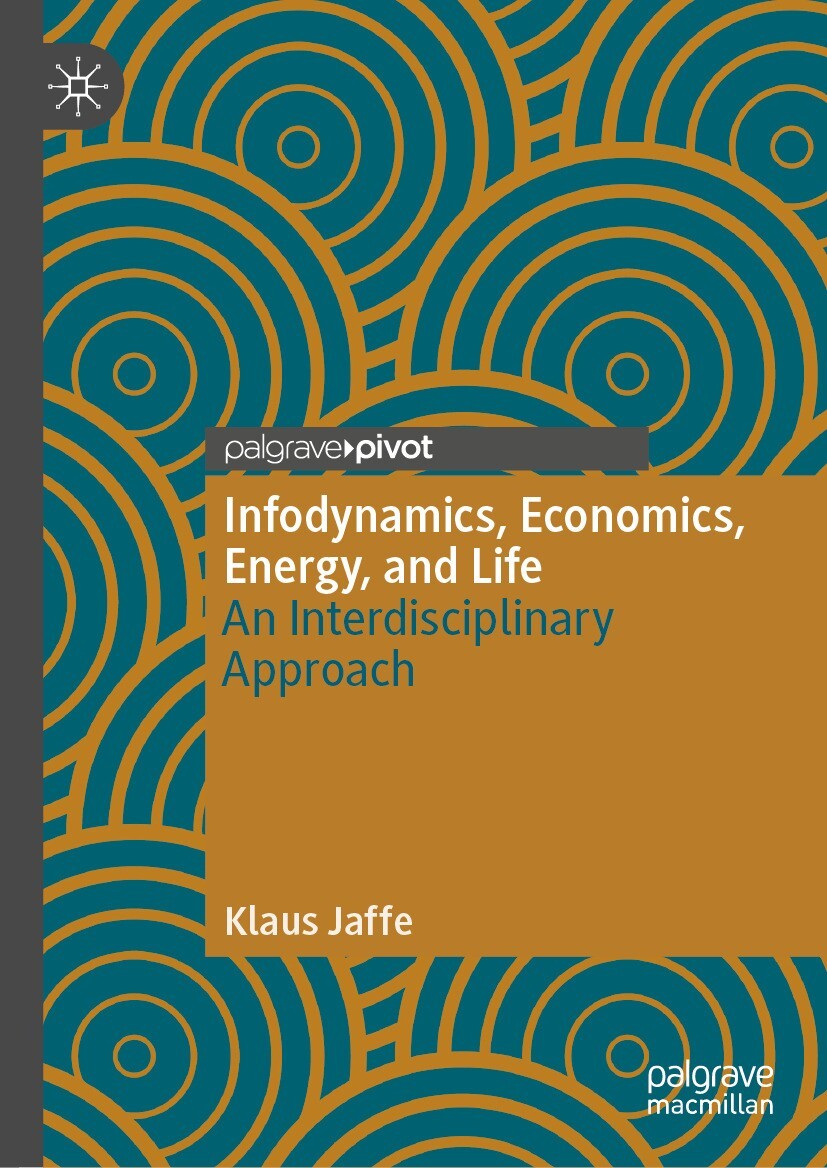
Infodynamics, Economics, Energy, and Life: An Interdisciplinary Approach, by Klaus Jaffe

The scientific understanding of energy, matter, and spacetime has advanced rapidly, whereas the study of information—its properties, behavior, and dynamics—remains underdeveloped. Despite the complexity of knowledge and information, our conceptual and empirical grasp of its evolution lags significantly behind. Progress in disciplines such as artificial intelligence, genomics, cognitive science, cyber governance, global ecology, and quantum mechanics depends critically on a more rigorous understanding of information dynamics. Absent such insight, humanity risks succumbing to entropic forces that threaten systemic stability and long-term survival.

In this book, Klaus Jaffe addresses the limitations of prior treatments of infodynamics, many of which have been incomplete, imprecise, or conceptually flawed. It offers an interdisciplinary investigation into the relationship between information and energy, drawing on theoretical and empirical contributions from economics, biology, and physics. By challenging conventional paradigms, the book constructs a conceptual framework that bridges disparate scientific domains and societal processes. The resulting synthesis opens new avenues for empirical inquiry and policy-relevant research, with implications for both academic scholarship and public discourse.

Inviting readers to explore the evolving frontier of information science, the book highlights the role of information and its impact on both natural and social systems.

More at: link.springer.com