
Month: February 2026

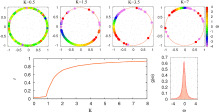
Interplay of sync and swarm: Theory and application of swarmalators

Gourab Kumar Sar, Kevin O’Keeffe, Joao U.F. Lizárraga, Marcus A.M. de Aguiar, Christian Bettstetter, Dibakar Ghosh

Physics Reports Volume 1167, 14 April 2026, Pages 1-52

Swarmalators, entities that combine the properties of swarming particles with synchronized oscillations, represent a novel and growing area of research in the study of collective behavior. This review provides a comprehensive overview of the current state of swarmalator research, focusing on the interplay between spatial organization and temporal synchronization. After a brief introduction to synchronization and swarming as separate phenomena, we discuss the various mathematical models that have been developed to describe swarmalator systems, highlighting the key parameters that govern their dynamics. The review also discusses the emergence of complex patterns, such as clustering, phase waves, and synchronized states, and how these patterns are influenced by factors such as interaction range, coupling strength, and frequency distribution. Recently, some minimal models were proposed that are solvable and mimic real-world phenomena. The effect of predators in the swarmalator dynamics is also discussed. Finally, we explore potential applications in fields ranging from robotics to biological systems, where understanding the dual nature of swarming and synchronization could lead to innovative solutions. By synthesizing recent advances and identifying open challenges, this review aims to provide a foundation for future research in this interdisciplinary field.

Read the full article at: www.sciencedirect.com

From Statistical Mechanics to Nonlinear Dynamics and into Complex Systems

Alberto Robledo

Complexities 2026, 2(1), 3

We detail a procedure to transform the current empirical stage in the study of complex systems into a predictive phenomenological one. Our approach starts with the statistical-mechanical Landau-Ginzburg equation for dissipative processes, such as kinetics of phase change. Then, it imposes discrete time evolution to explicit back feeding, and adopts a power-law driving force to incorporate the onset of chaos, or, alternatively, criticality, the guiding principles of complexity. One obtains, in closed analytical form, a nonlinear renormalization-group (RG) fixed-point map descriptive of any of the three known (one-dimensional) transitions to or out of chaos. Furthermore, its Lyapunov function is shown to be the thermodynamic potential in q-statistics, because the regular or multifractal attractors at the transitions to chaos impose a severe impediment to access the system’s built-in configurations, leaving only a subset of vanishing measure available. To test the pertinence of our approach, we refer to the following complex systems issues: (i) Basic questions, such as demonstration of paradigms equivalence, illustration of self-organization, thermodynamic viewpoint of diversity, biological or other. (ii) Derivation of empirical laws, e.g., ranked data distributions (Zipf law), biological regularities (Kleiber law), river and cosmological structures (Hack law). (iii) Complex systems methods, for example, evolutionary game theory, self-similar networks, central-limit theorem questions. (iv) Condensed-matter physics complex problems (and their analogs in other disciplines), like, critical fluctuations (catastrophes), glass formation (traffic jams), localization transition (foraging, collective motion).

Read the full article at: www.mdpi.com

The Effects of Remote Working on Scientific Collaboration and Impact

The Effects of Remote Working on Scientific Collaboration and Impact

Sara Venturini, Satyaki Sikdar, Martina Mazzarello, Francesco Rinaldi, Francesco Tudisco, Paolo Santi, Santo Fortunato, Carlo Ratti
The COVID-19 pandemic shifted academic collaboration from in-person to remote interactions. This study explores, for the first time, the effects on scientific collaborations and impact of such a shift, comparing research output before, during, and after the pandemic. Using large-scale bibliometric data, we track the evolution of collaboration networks and the resulting impact of research over time. Our findings are twofold: first, the geographic distribution of collaborations significantly shifted, with a notable increase in cross-border partnerships after 2020, indicating a reduction in the constraints of geographic proximity. Second, despite the expansion of collaboration networks, there was a concerning decline in citation impact, suggesting that the absence of spontaneous in-person interactions-which traditionally foster deep discussions and idea exchange-negatively affected research quality. As hybrid work models in academia gain traction, this study highlights the need for universities and research organizations to carefully consider the balance between remote and in-person engagement.

Read the full article at: arxiv.org

How malicious AI swarms can threaten democracy

Advances in artificial intelligence (AI) offer the prospect of manipulating beliefs and behaviors on a population-wide level (1). Large language models (LLMs) and autonomous agents (2) let influence campaigns reach unprecedented scale and precision. Generative tools can expand propaganda output without sacrificing credibility (3) and inexpensively create falsehoods that are rated as more human-like than those written by humans (3, 4). Techniques meant to refine AI reasoning, such as chain-of-thought prompting, can be used to generate more convincing falsehoods. Enabled by these capabilities, a disruptive threat is emerging: swarms of collaborative, malicious AI agents. Fusing LLM reasoning with multiagent architectures (2), these systems are capable of coordinating autonomously, infiltrating communities, and fabricating consensus efficiently. By adaptively mimicking human social dynamics, they threaten democracy. Because the resulting harms stem from design, commercial incentives, and governance, we prioritize interventions at multiple leverage points, focusing on pragmatic mechanisms over voluntary compliance.

DANIEL THILO SCHROEDER, MEEYOUNG CHA, ANDREA BARONCHELLI, NICK BOSTROM, NICHOLAS A. CHRISTAKIS, DAVID GARCIA, AMIT GOLDENBERG, YARA KYRYCHENKO, KEVIN LEYTON-BROWN, NINA LUTZ, GARY MARCUS, FILIPPO MENCZER, GORDON PENNYCOOK, DAVID G. RAND, MARIA RESSA, FRANK SCHWEITZER, DAWN SONG, CHRISTOPHER SUMMERFIELD, AUDREY TANG, JAY J. VAN BAVEL, SANDER VAN DER LINDEN, AND JONAS R. KUNST

SCIENCE 22 Jan 2026 Vol 391, Issue 6783 pp. 354-357

Read the full article at: www.science.org

Call for bids: Conference on Complex Systems (CCS 2028)

The Complex Systems Society (CSS) organizes every year the Conference on Complex Systems (CCS), the flagship annual meeting of the international complexity science community.

The CSS hereby invites bids to host the 2028 edition of CCS.

The conference is typically held in September–October and is intended to be primarily an in-person event, in order to preserve the value of direct interaction and collective discussion that characterize CCS. Hybrid formats may nevertheless be considered in a limited form, in particular to ensure inclusivity for participants who are unable to travel.

Interested organizing teams are invited to submit a proposal document outlining their bid.

More at: cssociety.org