Author: cxdig

Assistant Professor, Physics of Complex Systems, UC Davis

The Department of Physics and Astronomy at the University of California, Davis, is conducting a search for an Assistant Professor in the physics of complex systems. Complex systems is a highly interdisciplinary academic field using statistical mechanics, nonlinear dynamics, and applied mathematics to elucidate the organization and function of complex systems across a wide range of physical and applied disciplines, including: many-body physics, physics of information, computational physics, network science, machine learning, complex biological systems, nonequilibrium behavior, and complex earth systems.

The application deadline is November 27, 2023.

More at: recruit.ucdavis.edu

Up to 3 Assistant Professorships, 2 Postdocs, 3 PhD scholarships at the CoMuNe Lab, Padua, Italy

Our research, at the edge of statistical physics, applied mathematics and computer science, relies on theoretical and computational network science to cover a wide spectrum of interests, with applications to social and socio-technical systems, computational epidemiology, smart urban systems, systems biology, systems neuroscience, systems medicine.

More at: manliodedomenico.com

Boolean Networks as Predictive Models of Emergent Biological Behaviors

Jordan C. Rozum, Colin Campbell, Eli Newby, Fatemeh Sadat Fatemi Nasrollahi, Reka Albert

Interacting biological systems at all organizational levels display emergent behavior. Modeling these systems is made challenging by the number and variety of biological components and interactions (from molecules in gene regulatory networks to species in ecological networks) and the often-incomplete state of system knowledge (e.g., the unknown values of kinetic parameters for biochemical reactions). Boolean networks have emerged as a powerful tool for modeling these systems. We provide a methodological overview of Boolean network models of biological systems. After a brief introduction, we describe the process of building, analyzing, and validating a Boolean model. We then present the use of the model to make predictions about the system’s response to perturbations and about how to control (or at least influence) its behavior. We emphasize the interplay between structural and dynamical properties of Boolean networks and illustrate them in three case studies from disparate levels of biological organization.

Read the full article at: arxiv.org

Assembly theory explains and quantifies selection and evolution

Abhishek Sharma, Dániel Czégel, Michael Lachmann, Christopher P. Kempes, Sara I. Walker & Leroy Cronin 

Nature (2023)

Scientists have grappled with reconciling biological evolution1,2 with the immutable laws of the Universe defined by physics. These laws underpin life’s origin, evolution and the development of human culture and technology, yet they do not predict the emergence of these phenomena. Evolutionary theory explains why some things exist and others do not through the lens of selection. To comprehend how diverse, open-ended forms can emerge from physics without an inherent design blueprint, a new approach to understanding and quantifying selection is necessary3,4,5. We present assembly theory (AT) as a framework that does not alter the laws of physics, but redefines the concept of an ‘object’ on which these laws act. AT conceptualizes objects not as point particles, but as entities defined by their possible formation histories. This allows objects to show evidence of selection, within well-defined boundaries of individuals or selected units. We introduce a measure called assembly (A), capturing the degree of causation required to produce a given ensemble of objects. This approach enables us to incorporate novelty generation and selection into the physics of complex objects. It explains how these objects can be characterized through a forward dynamical process considering their assembly. By reimagining the concept of matter within assembly spaces, AT provides a powerful interface between physics and biology. It discloses a new aspect of physics emerging at the chemical scale, whereby history and causal contingency influence what exists.

Read the full article at: www.nature.com

Morphogenetic metasurfaces: unlocking the potential of Turing patterns

Thomas Fromenteze, Okan Yurduseven, Chidinma Uche, Eric Arnaud, David R. Smith & Cyril Decroze 
Nature Communications volume 14, Article number: 6249 (2023)

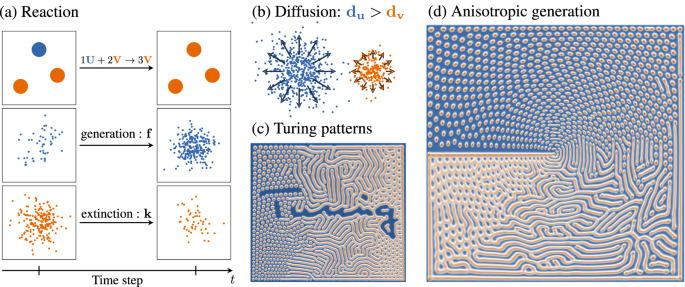
The reaction-diffusion principle imagined by Alan Turing in an attempt to explain the structuring of living organisms is leveraged in this work for the procedural synthesis of radiating metasurfaces. The adaptation of this morphogenesis technique ensures the growth of anisotropic cellular patterns automatically arranged to satisfy local electromagnetic constraints, facilitating the radiation of waves controlled in frequency, space, and polarization. Experimental validations of this method are presented, designing morphogenetic metasurfaces radiating far-field circularly polarized beams and generating a polarization-multiplexed hologram in the radiative near-field zone. The exploitation of morphogenesis-inspired models proves particularly well suited for solving generative design problems, converting global physical constraints into local interactions of simulated chemical reactants ensuring the emergence of self-organizing meta-atoms.

Read the full article at: www.nature.com