
Author: cxdig

Effective Connectivity and Bias Entropy Improve Prediction of Dynamical Regime in Automata Networks

Felipe Xavier Costa, Jordan C. Rozum, Austin M. Marcus, and Luis M. Rocha

Entropy 2023, 25(2), 374

Biomolecular network dynamics are thought to operate near the critical boundary between ordered and disordered regimes, where large perturbations to a small set of elements neither die out nor spread on average. A biomolecular automaton (e.g., gene, protein) typically has high regulatory redundancy, where small subsets of regulators determine activation via collective canalization. Previous work has shown that effective connectivity, a measure of collective canalization, leads to improved dynamical regime prediction for homogeneous automata networks. We expand this by (i) studying random Boolean networks (RBNs) with heterogeneous in-degree distributions, (ii) considering additional experimentally validated automata network models of biomolecular processes, and (iii) considering new measures of heterogeneity in automata network logic. We found that effective connectivity improves dynamical regime prediction in the models considered; in RBNs, combining effective connectivity with bias entropy further improves the prediction. Our work yields a new understanding of criticality in biomolecular networks that accounts for collective canalization, redundancy, and heterogeneity in the connectivity and logic of their automata models. The strong link we demonstrate between criticality and regulatory redundancy provides a means to modulate the dynamical regime of biochemical networks.

Read the full article at: www.mdpi.com
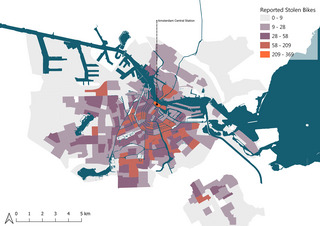
Tracking stolen bikes in Amsterdam

Venverloo T, Duarte F, Benson T, Leoni P, Hoogendoorn S, Ratti C (2023) Tracking stolen bikes in Amsterdam. PLoS ONE 18(2): e0279906.

Crime has major influences in urban life, from migration and mobility patterns, to housing prices and neighborhood liveability. However, urban crime studies still largely rely on static data reported by the various institutions and organizations dedicated to urban safety. In this paper, we demonstrate how the use of digital technologies enables the fine-grained analysis of specific crimes over time and space. This paper leverages the rise of ubiquitous sensing to investigate the issue of bike theft in Amsterdam—a city with a dominant cycling culture, where reportedly more than 80,000 bikes are stolen every year. We use active location tracking to unveil where stolen bikes travel to and what their temporal patterns are. This is the first study using tracking technologies to focus on two critical aspects of contemporary cities: active mobility and urban crime.

Read the full article at: journals.plos.org

Biology as involving laws and inconceivable without them

Richard Creath 

Theory in Biosciences volume 142, pages61–66 (2023)

There is an old attempt to divide the sciences into sciences of laws and the historical sciences. More recently, John Beatty has drawn the distinction so that biology is a historical science and urged that there are no genuinely biological laws. This paper shows that there are indeed biological laws, specifically statistical ones, notably in evolutionary theory. Moreover, all or almost all other areas of biology involve laws as well. Even history involves laws. Finally, the paper shows that this pervasiveness of laws is compatible with the most basic commitments of those who, like Beatty, would claim that biology is only historical.

Read the full article at: link.springer.com

Mediterranean School of Complex Networks 2023

Catania, Sicily 25 – 30 June 2023

In the last decade, network theory has been revealed to be a perfect instrument to model the structure of complex systems and the dynamical process they are involved into. The wide variety of applications to social sciences, technological networks, biology, transportation and economic, to cite just only some of them, showed that network theory is suitable to provide new insights into many problems.
Given the success of the Seventh Edition in 2022 of the Mediterranean School of Complex Networks, we call for applications to the Eighth Edition in 2023.

More at: mediterraneanschoolcomplex.net

Journal launched: Frontiers in Complex Systems

Frontiers in Complex Systems publishes rigorously peer-reviewed quantitative research on Complex Systems, either theoretical, experimental, mathematical, computational or data description. Field Chief Editor Maxi San Miguel at the Institute for Cross-Disciplinary Physics and Complex Systems (IFISC) in Spain is supported by an outstanding Editorial Board of international experts. This open-access journal is to become the reference and natural publication outlet for the Complex Systems community at large, and to be at the forefront of disseminating and communicating scientific knowledge and technological innovation in the field to researchers, academics, entrepreneurs, companies, policy makers and the public worldwide.

Frontiers in Complex Systems covers fundamental questions, theories and general methodologies on complex systems as well as the cross-disciplinary application of these concepts and methods, often giving rise to new disciplines. It provides a forum for cross-disciplinary communication and welcomes quantitative research from different fields including Physics, Mathematics, Computer Sciences, Artificial Intelligence, Engineering, Climate change, Economics and Finance, Social Sciences, Linguistics, Ecology, Neuroscience, Health Sciences, Epidemics, Mobility and Transport, City Science, etc. Submissions to Frontiers in Complex Systems are made to appropriate specialty sections, each of which devoted to a specific sub-field and having their own expert editorial board. Aligned with the cross-disciplinary scope of the journal, some of these sections are shared with other Frontiers journals, providing an enhanced visibility of the research in different scientific communities.

More at: www.frontiersin.org