
Author: cxdig

Toward a thermodynamic theory of evolution: a theoretical perspective on information entropy reduction and the emergence of complexity

Carlos Mendoza Montano

Front. Complex Syst., 31 July 2025

Traditional evolutionary theory explains adaptation and diversification through random mutation and natural selection. While effective in accounting for trait variation and fitness optimization, this framework provides limited insight into the physical principles underlying the spontaneous emergence of complex, ordered systems. A complementary theory is proposed: that evolution is fundamentally driven by the reduction of informational entropy. Grounded in non-equilibrium thermodynamics, systems theory, and information theory, this perspective posits that living systems emerge as self-organizing structures that reduce internal uncertainty by extracting and compressing meaningful information from environmental noise. These systems increase in complexity by dissipating energy and exporting entropy, while constructing coherent, predictive internal architectures, fully in accordance with the second law of thermodynamics. Informational entropy reduction is conceptualized as operating in synergy with Darwinian mechanisms. It generates the structural and informational complexity upon which natural selection acts, whereas mutation and selection refine and stabilize those configurations that most effectively manage energy and information. This framework extends previous thermodynamic models by identifying informational coherence, not energy efficiency, as the primary evolutionary driver. Recently formalized metrics, Information Entropy Gradient (IEG), Entropy Reduction Rate (ERR), Compression Efficiency (CE), Normalized Information Compression Ratio (NICR), and Structural Entropy Reduction (SER), provide testable tools to evaluate entropy-reducing dynamics across biological and artificial systems. Empirical support is drawn from diverse domains, including autocatalytic networks in prebiotic chemistry, genome streamlining in microbial evolution, predictive coding in neural systems, and ecosystem-level energy-information coupling. Together, these examples demonstrate that informational entropy reduction is a pervasive, measurable feature of evolving systems. While this article presents a theoretical perspective rather than empirical results, it offers a unifying explanation for major evolutionary transitions, the emergence of cognition and consciousness, the rise of artificial intelligence, and the potential universality of life. By embedding evolution within general physical laws that couple energy dissipation to informational compression, this framework provides a generative foundation for interdisciplinary research on the origin and trajectory of complexity.

Read the full article at: www.frontiersin.org

When Rivalry Backfires: How Individual Skill and Risk of Status Loss Moderate the Effects of Rivalry on Performance

Tom Grad , Christoph Riedl , Gavin J. Kilduff

Management Science

Existing rivalry research finds that people try harder and perform better when competing against their rivals. However, are there conditions under which rivalry can harm performance? We integrate rivalry theory with regulatory fit theory to propose two moderators of rivalry: individual skill and situational risk for status change. We test our predictions using data from software programming contests involving more than 4.6 million competitive encounters across 16,846 software developers (“coders”) to examine the causal effects of rivalry and the conditions under which it may backfire. We find that, on average, coders who are randomly assigned to compete against a field of competitors with whom they share a rivalrous history exhibit higher performance, above and beyond other established drivers of performance in competition. Importantly, however, this positive effect of rivalry is moderated by (1) coders’ skill level, such that rivalry is more beneficial for more skilled coders and is harmful for less skilled coders, and (2) coders’ risk of experiencing a status change, such that coders who face a possible status loss exhibit decreased performance when competing against rivals. Thus, we extend research on rivalry by revealing the conditions under which it can harm performance, which is vital to understanding its role in organizations.

https://pubsonline.informs.org/doi/abs/10.1287/mnsc.2023.00344 

Complexity Postdoctoral Fellowship – Santa Fe Institute

The Santa Fe Institute is now accepting applications for the 2026 Complexity Postdoctoral Fellowships! 
 
Complexity fellows contribute to SFI’s research and collaborate with leading researchers worldwide. If you recently completed your PhD in any scientific discipline and are interested in transdisciplinary research, consider applying. SFI offers independent research opportunities and support to explore big questions across disciplines. 
 
Deadline: October 1, 2025 Requirements & application: santafe.edu/sfifellowship

The Theory of Economic Complexity

César A. Hidalgo, Viktor Stojkoski

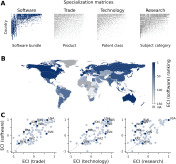
Economic complexity estimates rely on eigenvectors derived from matrices of specialization to explain differences in economic growth, inequality, and sustainability. Yet, despite their widespread use, we still lack a principled theory that can deduce these eigenvectors from first principles and place them in the context of a mechanistic model. Here, we calculate these eigenvectors analytically for a model where the output of an economy in an activity increases with the probability the economy is endowed with the factors required by the activity. We show that the eigenvector known as the Economic Complexity Index or ECI is a monotonic function of the probability that an economy is endowed with a factor, and that in a multi-factor model, it is an estimate of the average endowment across all factors. We then generalize this result to other production functions and to a short-run equilibrium framework with prices, wages, and consumption. We find that our main result does not depend on the introduction of prices or wages, and that the derived wage function is consistent with the convergence of economies with a similar level of complexity. Finally, we use this model to explain the shape of networks of related activities, such as the product space and the research space. These findings solve long standing theoretical puzzles in the economic complexity literature and validate the idea that metrics of economic complexity are estimates of an economy being endowed with multiple factors.

Read the full article at: arxiv.org

Revisiting Big Data Optimism: Risks of Data-Driven Black Box Algorithms for Society

Sachit Mahajan, Dirk Helbing

This paper critically examines the growing use of big data algorithms and AI in science, society, and public policy. While these tools are often introduced with the goal of increasing efficiency, the results do not always lead to greater empowerment or fairness for individuals or communities. Persistent issues such as bias, measurement error, and over-reliance on prediction can undermine success and produce outcomes that are neither fair nor transparent, especially when automated decisions replace human judgment. Beyond technical limitations, the widespread use of data-driven methods also shapes the distribution of power, influences public trust, and raises questions about the health of techno-socioeconomic institutions. We argue that the pursuit of optimality cannot succeed without careful evaluation of ethical risks and societal side effects. Responsible innovation demands open standards, ongoing scrutiny, and a focus on human values alongside technical performance. Our goal is to encourage a more balanced approach to big data-one that recognizes both its potentials and its limits, and one that aims for genuine social benefits rather than just efficiency alone.

Read the full article at: www.researchgate.net