Author: cxdig

Call for bids: Conference on Complex Systems (CCS 2028)

The Complex Systems Society (CSS) organizes every year the Conference on Complex Systems (CCS), the flagship annual meeting of the international complexity science community.

The CSS hereby invites bids to host the 2028 edition of CCS.

The conference is typically held in September–October and is intended to be primarily an in-person event, in order to preserve the value of direct interaction and collective discussion that characterize CCS. Hybrid formats may nevertheless be considered in a limited form, in particular to ensure inclusivity for participants who are unable to travel.

Interested organizing teams are invited to submit a proposal document outlining their bid.

More at: cssociety.org

The case against efficiency: friction in social media

Joshua Garland, Joe Bak-Coleman, Susan Benesch, Simon DeDeo, Renee DiResta, Jan Eissfeldt, Seungwoong Ha, John Irons, Chris Kempes, Juniper Lovato, Kristy Roschke, Paul E. Smaldino, Anna B. Stephenson, Thalia Wheatley & Valentina Semenova 

npj Complexity volume 3, Article number: 5 (2026)

Social media platforms frequently prioritize efficiency to maximize ad revenue and user engagement, often sacrificing deliberation, trust, and reflective, purposeful cognitive engagement in the process. This manuscript examines the potential of friction—design choices that intentionally slow user interactions—as an alternate approach. We present a case against efficiency as the dominant paradigm on social media and advocate for a complex systems approach to understanding and analyzing friction. Drawing from interdisciplinary literature, real-world examples, and industry experiments, we highlight the potential for friction to mitigate issues like polarization, disinformation, and toxic content without resorting to censorship. We propose a state space representation of friction to establish a multidimensional framework and language for analyzing the diverse forms and functions through which friction can be implemented. Additionally, we propose several experimental designs to examine the impact of friction on system dynamics, user behavior, and information ecosystems, each designed with complex systems solutions and perspectives in mind. Our case against efficiency underscores the critical role of friction in shaping digital spaces, challenging the relentless pursuit of efficiency and exploring the potential of thoughtful slowing.

Read the full article at: www.nature.com

Cognition spaces: natural, artificial, and hybrid

Ricard Solé, Luis F Seoane, Jordi Pla-Mauri, Michael Timothy Bennett, Michael E. Hochberg, Michael Levin
Cognitive processes are realized across an extraordinary range of natural, artificial, and hybrid systems, yet there is no unified framework for comparing their forms, limits, and unrealized possibilities. Here, we propose a cognition space approach that replaces narrow, substrate-dependent definitions with a comparative representation based on organizational and informational dimensions. Within this framework, cognition is treated as a graded capacity to sense, process, and act upon information, allowing systems as diverse as cells, brains, artificial agents, and human-AI collectives to be analyzed within a common conceptual landscape. We introduce and examine three cognition spaces — basal aneural, neural, and human-AI hybrid — and show that their occupation is highly uneven, with clusters of realized systems separated by large unoccupied regions. We argue that these voids are not accidental but reflect evolutionary contingencies, physical constraints, and design limitations. By focusing on the structure of cognition spaces rather than on categorical definitions, this approach clarifies the diversity of existing cognitive systems and highlights hybrid cognition as a promising frontier for exploring novel forms of complexity beyond those produced by biological evolution.

Read the full article at: arxiv.org

The software complexity of nations

Sándor Juhász, Johannes Wachs, Jermain Kaminski, César A. Hidalgo

Research Policy

Volume 55, Issue 3, April 2026, 105422

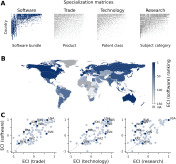
Despite the growing importance of the digital sector, research on economic complexity and its implications continues to rely mostly on administrative records—e.g. data on exports, patents, and employment—that have blind spots when it comes to the digital economy. In this paper we use data on the geography of programming languages used in open-source software to extend economic complexity ideas to the digital economy. We estimate a country’s software economic complexity index (ECIsoftware) and show that it complements the ability of measures of complexity based on trade, patents, and research to account for international differences in GDP per capita, income inequality, and emissions. We also show that open-source software follows the principle of relatedness, meaning that a country’s entries and exits in programming languages are partly explained by its current pattern of specialization. Together, these findings help extend economic complexity ideas and their policy implications to the digital economy.

Read the full article at: www.sciencedirect.com

Crossing the Functional Desert: Cascade-Driven Assembly and Feasibility Transitions in Early Life

Galen J. Wilkerson
The origin of life poses a problem of combinatorial feasibility: How can temporally supported functional organization arise in exponentially branching assembly spaces when unguided exploration behaves as a memoryless random walk? We show that nonlinear threshold-cascade dynamics in connected interaction networks provide a minimal, substrate-agnostic mechanism that can soften this obstruction. Below a critical connectivity threshold, cascades die out locally and structured input-output response mappings remain sparse and transient-a “functional desert” in which accumulation is dynamically unsupported. Near the critical percolation threshold, system-spanning cascades emerge, enabling discriminative functional responses. We illustrate this transition using a minimal toy model and generalize the argument to arbitrary networked systems. Also near criticality, cascades introduce finite-timescale structural and functional coherence, directional bias, and weak dynamical path-dependence into otherwise memoryless exploration, allowing biased accumulation. This connectivity-driven transition-functional percolation-requires only generic ingredients: interacting units, nonlinear thresholds, influence transmission, and non-zero coherence times. The mechanism does not explain specific biochemical pathways, but it identifies a necessary dynamical regime in which structured functional organization can emerge and be temporarily supported, providing a physical foundation for how combinatorial feasibility barriers can be crossed through network dynamics alone.

Read the full article at: arxiv.org