Category: Books

Conway’s Game of Life: Mathematics and Construction

Nathaniel Johnston and Dave Greene

This book provides an introduction to Conway’s Game of Life, the
interesting mathematics behind it, and the methods used to construct
many of its most interesting patterns. Lots of small “building
block”-style patterns (especially in the first four or so chapters of
this book) were found via brute-force or other computer searches, and
the book does not go into the details of how these searches were
implemented. However, from that point on it tries to guide the reader
through the thought processes and ideas that are needed to combine
those patterns into more interesting composite ones.

While the book largely follows the history of the Game of Life, that
is not its primary purpose. Rather, it is a by-product of the fact
that most recently discovered patterns build upon patterns and
techniques that were developed earlier. The goal of this book is to
demystify the Game of Life by breaking down the complex patterns that
have been developed in it into bite-size chunks that can be understood
individually.

More at: conwaylife.com

The Nature of Complex Networks – Sergey N. Dorogovtsev, José F. F. Mendes – Oxford University Press

Sergey N. Dorogovtsev and José F. F. Mendes
Provides a systematic account of the statistical mechanics of complex networks
Covers recent trends, concepts, and theoretical techniques, and emphasises interdisciplinary strands
Broad appeal to researchers in complex systems including theoretical physicists and applied mathematicians as well as epidemiologists
Extensive bibliography and appendices offer excellent reference source for students and researchers

More at: global.oup.com

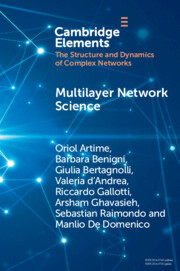
Multilayer Networks: Analysis and Visualization: Introduction to muxViz with R, by Manlio De Domenico

Provides practical recipes to use muxViz for specific purposes, bypassing theoretical obstacles
Includes dozens of examples whose R code is provided and directly linked from inside the text
Comes with, and builds on, a significant extension of the muxViz platform that can be used without needing a GUI

More at: link.springer.com

The Language Game How Improvisation Created Language and Changed the World

by Morten H. Christiansen and Nick Chater

Forget the language instinct—this is the story of how we make up language as we go

Language is perhaps humanity’s most astonishing capacity—and one that remains poorly understood. In The Language Game, cognitive scientists Morten H. Christiansen and Nick Chater show us where generations of scientists seeking the rules of language got it wrong. Language isn’t about hardwired grammars but about near-total freedom, something like a game of charades, with the only requirement being a desire to understand and be understood. From this new vantage point, Christiansen and Chater find compelling solutions to major mysteries like the origins of languages and how language learning is possible, and to long-running debates such as whether having two words for “blue” changes what we see. In the end, they show that the only real constraint on communication is our imagination.

More at: www.basicbooks.com

See Also: The Spontaneous Origins of Language

Higher-Order Systems

Edited by Federico BattistonGiovanni Petri

This book discusses its potential to model real-world systems and how considering their higher-order organization can lead to the emergence of novel dynamical behavior. Over the last decades, networks have emerged as the paradigmatic framework to model complex systems. Yet, as simple collections of nodes and links, they are intrinsically limited to pairwise interactions, limiting our ability to describe, understand, and predict complex phenomena which arise from higher-order interactions. Here we introduce the new modeling framework of higher-order systems, where hypergraphs and simplicial complexes are used to describe complex patterns of interactions among any number of agents. This book is intended both as a first introduction and an overview of the state of the art of this rapidly emerging field, serving as a reference for network scientists interested in better modeling the interconnected world we live in.

Read the full article at: link.springer.com