

Read the full book at: link.springer.com
Networking the complexity community since 1999
Category: Books
Read the full book at: link.springer.com
By Mariusz Stanowski
The book Theory and Practice of Contrast completes, corrects and integrates the foundations of science and humanities, which include: theory of art, philosophy (aesthetics, epistemology, ontology, axiology), cognitive science, theory of information, theory of complexity and physics. Through the integration of these distant disciplines, many unresolved issues in contemporary science have been clarified or better understood, among others: defining impact (contrast) and using this definition in different fields of knowledge; understanding what beauty/art is and what our aesthetic preferences depend on; deeper understanding of what complexity and information are in essence, and providing their general definitions. Complexity means integration, value and goodness – concepts that seem to be neglected today.
More at: www.routledge.com
Francis Heylighen
The present course intends to answer the question of what it means to be human. This question has traditionally been the subject of a domain known as “philosophical anthropology”. Anthropology is the science that studies humans—just as entomology studies insects, and herpetology studies reptiles. It does this by carefully observing the physical, social and cultural properties that characterize human beings. This includes the evolution of humans out of their ape-like ancestors. It also includes the behaviors that different groups of humans exhibit in their more “natural state”, for example as hunter-gatherers living in the rainforest as yet unaffected by our highly technological civilization. Philosophical anthropology complements these concrete observations and the resulting theories by studying what has been called the “human condition”. This concerns more existential questions about the meaning of human life:
Ø Who are we?
Ø What are we living for?
Ø What is our fundamental human nature?
Ø What are human values?
Ø What sets humans apart from other beings?
Read the full book at: researchportal.vub.be
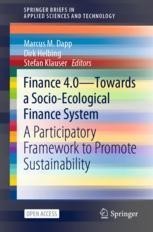
Dapp, Marcus M., Helbing, Dirk, Klauser, Stefan (Eds.)
This Open Access book outlines ideas for a novel, scalable and, above all, sustainable financial system.
We all know that today’s global markets are unsustainable and global governance is not effective enough. Given this situation, could one boost smart human coordination, sustainability and resilience by tweaking society at its core: the monetary system? A Computational Social Science team at ETH Zürich has indeed worked on a concept and little demonstrator for a new financial system, called “Finance 4.0” or just “FIN4”, which combines blockchain technology with the Internet of Things (“IoT”).
What if communities could reward sustainable actions by issuing their own money (“tokens”)? Would people behave differently, when various externalities became visible and were actionable through cryptographic tokens? Could a novel, participatory, multi-dimensional financial system be created? Could it be run by the people for the people and lead to more societal resilience than today’s financial system (which is effectively one-dimensional due to its almost frictionless exchange)? How could one manage such a system in an ethical and democratic way?
This book presents some early attempts in a nascent field, but provides a fresh view on what cryptoeconomic systems could do for us, for a circular economy, and for scalable, sustainable action.
Read the full book at: www.springer.com
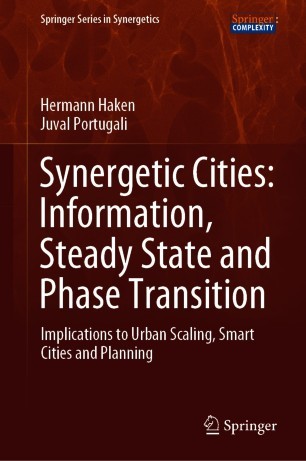
Hermann Haken, Juval Portugali
Four concepts make the title of this book: Synergetic cities which is a view on cites as complex systems from the perspective of Haken’s theory of synergetics; information, which is a view on cities as complex systems commencing from the perspective of information theory. Next come steady state and phase transition which are two central aspects of complex systems in general and of cities as complex systems. Our aim is to introduce and develop the above four notions and then to discuss their implication to three issues that stand at the core of current discourse on cities as complex systems: urban allometery (or scaling) and smart cities—both attract special attention in the discourse on cities of the last two decades, as part of the attempt to transform the study of cities into a science. The third issue, city planning, attempts to adapt the process of planning to the understanding, and reality, of cities as complex, adaptive self-organizing systems.
Book at: link.springer.com

