Category: Books

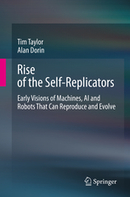
Rise of the Self-Replicators – Early Visions of Machines, AI and Robots That Can Reproduce and Evolve

Taylor, Tim, Dorin, Alan


Is it possible to design robots and other machines that can reproduce and evolve? And, if so, what are the implications: for the machines, for ourselves, for our environment, and for the future of life on Earth and elsewhere?
In this book the authors provide a chronological survey and comprehensive archive of the early history of thought about machine self-reproduction and evolution. They discuss contributions from philosophy, science fiction, science and engineering, and uncover many examples that have never been discussed in the Artificial Intelligence and Artificial Life literature before now. In the final chapter they provide a synthesis of the concepts discussed, offer their views on the field’s future directions, and call for a broad community discussion about the significant implications of intelligent evolving machines.
The book will be of interest to general readers, and a valuable resource for researchers, practitioners, and historians engaged with ideas in artificial intelligence, artificial life, robotics, and evolutionary computing.

Source: www.springer.com

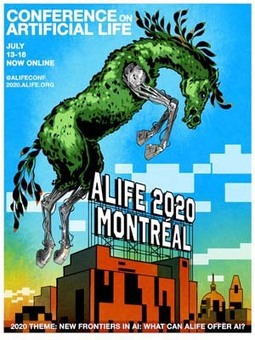
ALIFE 2020: The 2020 Conference on Artificial Life (proceedings)

Editors: Josh Bongard, Juniper Lovato, Laurent Hebert-Dufrésne, Radhakrishna Dasari and Lisa Soros


This volume presents the proceedings of the 2020 Conference on Artificial Life (ALIFE 2020) which took place online July 13-18. Originally scheduled to be held in Montreal, Canada, this was the first time our conference had been conducted in this manner. Of course, our community was not alone: just about every human community has had to adapt to the covid-19 pandemic and its repercussions. It is difficult to avoid seeing the irony in this: Artificial Life researchers have declared, since the field’s inception at a small workshop at Los Alamos in 1987, that we wish to understand how life adapts to unforeseen circumstances. Further, we wish to incorporate learned mechanisms of adaptation into our technologies and, possibly, our societies. Put simply, Artificial Life invites us to think and learn about adaptation; SARS-CoV-2 forces us to adapt. More simple yet: ALife is theory; COVID is practice. There is a long tradition in our field of peering at our computer screens or into our petri dishes, waiting with bated breath to see what new forms emerge. Likewise for the post-pandemic world. Whatever does emerge from the conference, and from the pandemic — and whether we learn from it, and whether we use that knowledge to benefit each other — it is our honor to be part of the adventure with you.

Source: www.mitpressjournals.org

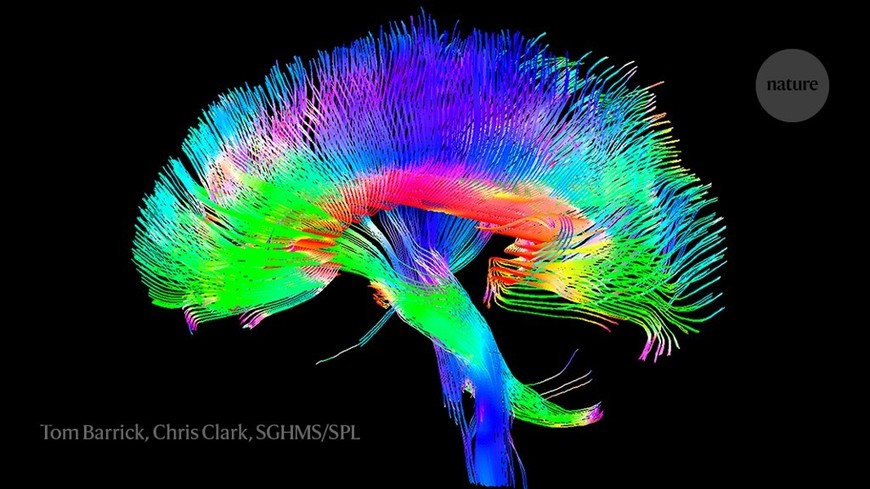
Neuroscience needs some new ideas

The Idea of the Brain: A History. Matthew Cobb. Profile (2020)


The Idea of the Brain puts our current predicament in context and synthesizes much that needs attention. It is a very good book. It could have done more in a time when science is coming to terms with the limitations of the straight, white, wealthy, Western, non-disabled, male perspective. But I hope it provokes contemplation about why certain metaphors linger, where they come from, how they persist, and in what ways they burden us with the invisible assumptions of past cultures.

Source: www.nature.com

Planning within Complex Urban Systems – 1st Edition – Shih-Kung Lai –

Imagine living in a city where people could move freely and buildings could be replaced at minimal cost. Reality cannot be further from such. Despite this imperfect world in which we live, urban planning has become integral and critical especially in the face of rapid urbanization in many developing and developed countries. This book introduces the axiomatic/experimental approach to urban planning and addresses the criticism of the lack of a theoretical foundation in urban planning.

With the rise of the complexity movement, the book is timely in its depiction of cities as complex systems and explains why planning from within is useful in the face of urban complexity. It also includes policy implications for the Chinese cities in the context of axiomatic/experimental planning theory.

Source: www.routledge.com

Building the New Economy ·

Edited by Alex Pentland, Alexander Lipton, and Thomas Hardjono

With each major crisis, be it war, pandemic, or major new technology, there has been a need to reinvent the relationships between individuals, businesses, and governments. Today’s pandemic, joined with the tsunami of data, crypto and AI technologies, is such a crisis. Consequently the critical question for today is: what sort institutions should we be creating both to help us past this crisis and to make us less vulnerable to the next crisis? This book lays out a vision of what we should build, covering not only how to reforge our societies’ social contract but also how institutions, systems, infrastructure, and law should change in support of this new order. We invite your comments and suggestions on both the ideas and the presentation, preferably by June 1, 2020 when we will move to make the book more widely available.

Source: wip.mitpress.mit.edu