Category: Books

Applied Antifragility in Technical Systems: From Principles to Applications

Cristian Axenie , Meisam Akbarzadeh , Michail A. Makridis , Matteo Saveriano , Alexandru Stancu

The book purpose is to build a foundational knowledge base by applying antifragile system design, analysis, and development in technical systems, with a focus on traffic engineering, robotics, and control engineering. The authors are interested in formalizing principles and an apparatus that turns the basic concept of antifragility into a tool for designing and building closed-loop technical systems that behave beyond robust in the face of uncertainty.

As coined in the book of Nassim Taleb, antifragility is a property of a system to gain from uncertainty, randomness, and volatility, opposite to what fragility would incur. An antifragile system’s response to external perturbations is beyond robust, such that small stressors can strengthen the future response of the system by adding a strong anticipation component. The work of the Applied Antifragility Group in traffic control and robotics, led by the authors, provides a good overview on the current research status.

Read the full article at: link.springer.com

Unifying Systems : Information, Feedback, and Self-Organization, by Aarne Mämmelä

Interdisciplinary systems thinking is complementary but does not replace conventional disciplinary analytical thinking. The book is valuable for researchers, their advisors, and other thinkers interested in deep knowledge of science. Interdisciplinary systems thinking is valuable for three reasons: The goal of all science is a unified view of the world; we cannot solve the significant problems of our time without interdisciplinary collaboration; and general theories of systems and system archetypes support the solution to those problems. System archetypes are generic system models that have stood the test of time. As specialists within a discipline, we must be able to communicate between disciplines.
Interdisciplinary generalists can offer us reliable visions and relevant research problems. The goal of interdisciplinary research is to find unified solutions to those problems. The book provides a lot of information from over a thousand sources in a structured manner to help the reader. The book includes a comprehensive chronology, vocabulary, and bibliography. The author has been a research professor in information engineering for over 25 years. During his career, he became interested in systems thinking, which is closely related to the philosophy and history of science.

More at: link.springer.com

Compendium of Urban Complexity, edited by Diego Rybski

This book brings together key findings, insights, and theories at the intersection of two disciplines – city science and complex systems. It features a curated collection of chapters contributed by emerging scholars conducting cutting-edge research in complexity science, interdisciplinary physics, and quantitative geography. The compendium is tailored to a thematically diverse audience, spanning quantitative fields such as statistical and mathematical physics, as well as socially-focused domains such as geography and urban planning. By integrating novel methods and insights from physics, economics, and geography, this book aims at an interdisciplinary spectrum of graduate students and academic researchers studying cities as complex systems.

More at: link.springer.com

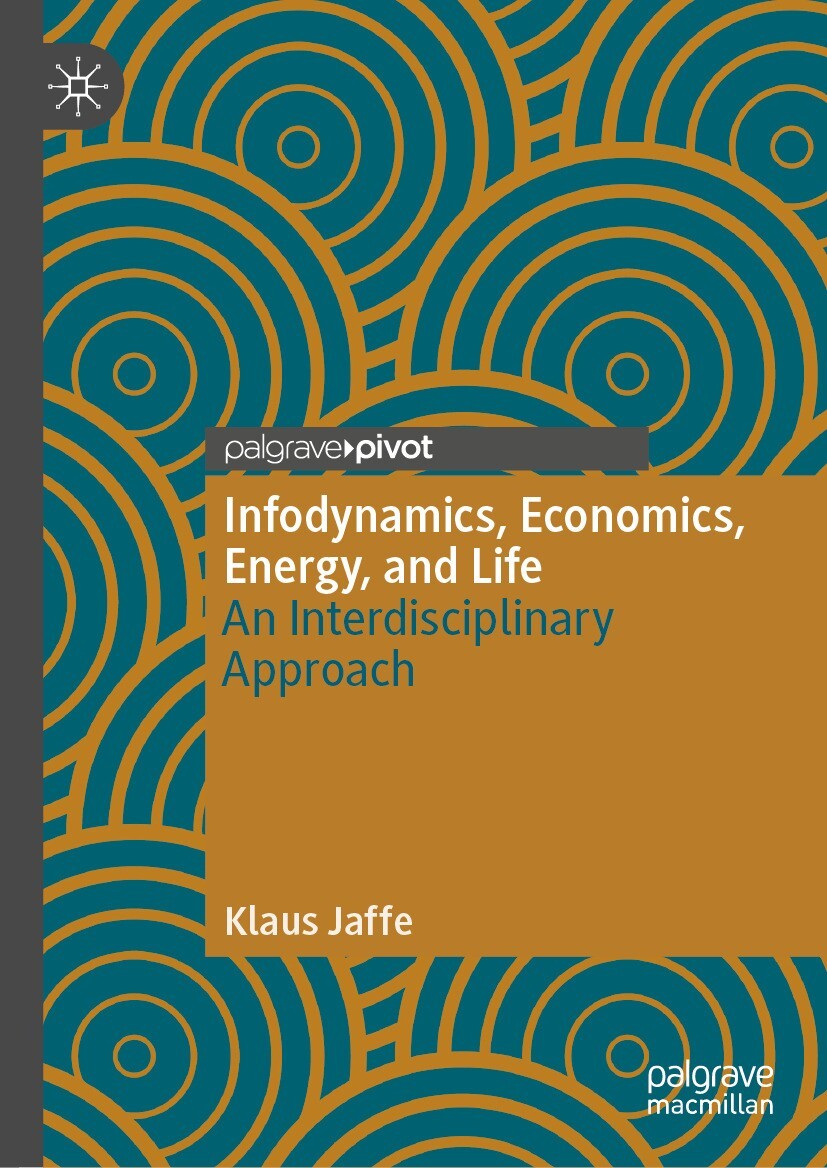
Dynamics between Energy and Information: Infodynamics and the Economics of Life by Klaus Jaffe

Information, along with energy, matter, and spacetime, is one of the fundamental elements of nature that underpins all known phenomena. While our knowledge of the universe is expanding exponentially—particularly regarding energy, spacetime, and matter—our understanding of information progresses at a much slower pace. The amount of information is increasing exponentially, but not our comprehension of its dynamics. Advancements in artificial intelligence, genetic research, natural intelligence, cyber governance, and global ecological phenomena hinge on our ability to enhance our understanding of information dynamics. Without improved access to and understanding of information, we risk succumbing to the entropic forces that threaten humanity’s survival.

Read the full book at: papers.ssrn.com

The Magic of Code How Digital Language Created and Connects Our World—and Shapes Our Future, by Samuel Arbesman

In the tradition of classics such as The Lives of a Cell, a bold reframing of our relationship with technology that is more positive and human centered.
In the digital world, code is the essential primary building block, the equivalent of the cell or DNA in the biological sphere—and almost as mysterious. Code can create entire worlds, real and virtual; it allows us to connect instantly to people and places around the globe; and it performs tasks that were once only possible in science fiction. It is a superpower, and not just in a technical sense. It is also a gateway to ideas. As vividly illustrated by Samuel Arbesman, it is the ultimate connector, providing new insight and meaning into how everything from language and mythology to biblical texts, biology, and even our patterns of thought connect with the history and nature of computing.

While the building block of code can be used for many wondrous things it can also create deeper wedges in our society and be weaponized to cause damage to our planet or our civilization. Code and computing are too important to be left to the tech community; it is essential that each of us engage with it. And we fail to understand it to our detriment.

By providing us with a framework to think about coding and its effects upon the world and placing the past, current, and future developments in computing into its broader setting we see how software and computers can work for people as opposed to against our needs. With this deeper understanding into the “why” of coding we can be masters of technology rather than its subjects.

More at: www.publicaffairsbooks.com