Category: Books

The Perfectionists: How Precision Engineers Created the Modern World (Simon Winchester)

The rise of manufacturing could not have happened without an attention to precision. At the dawn of the Industrial Revolution in eighteenth-century England, standards of measurement were established, giving way to the development of machine tools—machines that make machines. Eventually, the application of precision tools and methods resulted in the creation and mass production of items from guns and glass to mirrors, lenses, and cameras—and eventually gave way to further breakthroughs, including gene splicing, microchips, and the Hadron Collider.

Simon Winchester takes us back to origins of the Industrial Age, to England where he introduces the scientific minds that helped usher in modern production: John Wilkinson, Henry Maudslay, Joseph Bramah, Jesse Ramsden, and Joseph Whitworth. It was Thomas Jefferson who later exported their discoveries to the fledgling United States, setting the nation on its course to become a manufacturing titan. Winchester moves forward through time, to today’s cutting-edge developments occurring around the world, from America to Western Europe to Asia.

As he introduces the minds and methods that have changed the modern world, Winchester explores fundamental questions. Why is precision important? What are the different tools we use to measure it? Who has invented and perfected it? Has the pursuit of the ultra-precise in so many facets of human life blinded us to other things of equal value, such as an appreciation for the age-old traditions of craftsmanship, art, and high culture? Are we missing something that reflects the world as it is, rather than the world as we think we would wish it to be? And can the precise and the natural co-exist in society?

Source: www.amazon.com

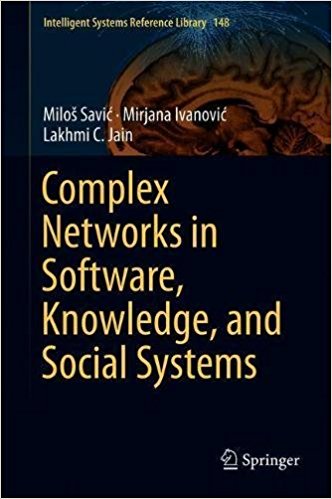
Complex Networks in Software, Knowledge, and Social Systems (Miloš Savić, Mirjana Ivanović & Lakhmi C. Jain)

This book provides a comprehensive review of complex networks from three different domains, presents novel methods for analyzing them, and highlights applications with accompanying case studies. Special emphasis is placed on three specific kinds of complex networks of high technological and scientific importance: software networks extracted from the source code of computer programs, ontology networks describing semantic web ontologies, and co-authorship networks reflecting collaboration in science. The book is primarily intended for researchers, teachers and students interested in complex networks and network data analysis. However, it will also be valuable for researchers dealing with software engineering, ontology engineering and scientometrics, as it demonstrates how complex network analysis can be used to address important research issues in these three disciplines. 

Source: www.amazon.com

Wandering Towards a Goal: How Can Mindless Mathematical Laws Give Rise to Aims and Intention? (Anthony Aguirre, Brendan Foster & Zeeya Merali)

This collection of prize-winning essays addresses the controversial question of how meaning and goals can emerge in a physical world governed by mathematical laws. What are the prerequisites for a system to have goals? What makes a physical process into a signal? Does eliminating the homunculus solve the problem? The three first-prize winners, Larissa Albantakis, Carlo Rovelli and Jochen Szangolies tackle exactly these challenges, while many other aspects (agency, the role of the observer, causality versus teleology, ghosts in the machine etc.) feature in the other award winning contributions. All contributions are accessible to non-specialists.

These seventeen stimulating and often entertaining essays are enhanced versions of the prize-winning entries to the FQXi essay competition in 2017.The Foundational Questions Institute, FQXi, catalyzes, supports, and disseminates research on questions at the foundations of physics and cosmology, particularly new frontiers and innovative ideas integral to a deep understanding of reality, but unlikely to be supported by conventional funding sources.

Source: www.amazon.com

Everything Flows Towards a Processual Philosophy of Biology Edited by Daniel J. Nicholson and John Dupre

  • A radical new conception of biology and the metaphysics of the living world
  • Offers a new kind of process philosophy with a naturalistic grounding
  • The Introduction provides a state-of-the-art survey to orient readers new to the topic

Source: global.oup.com

Download Open Access PDF

Five Principles for Organizing Collective Intelligence

Big Mind is notable for a number of reasons. One of them is that we don’t have a lot of guides for managing and optimizing collective intelligence, in contrast to the shelves and shelves of books describing how to optimize the output of individual brains. Another reason is the five fundamental principles that Mulgan offers, in the excerpt below, in a nuanced answer to the question: “What is it, at the micro and macro levels, that allows collective intelligence to flower?

Source: sloanreview.mit.edu

Featured excerpt from Big Mind: How Collective Intelligence Can Change Our World.