Category: Books

Dendrology: The community of trees

Trees are networkers. Far from the solitary splendour of the ancient old stager, it turns out that trees communicate with one another through their roots. Underground fungi — mycorrhizae associated with the root network — form a sort of subterranean internet that connects trees, passing messages and even nourishment between neighbours. Nor do trees passively tolerate the onslaught of insects on their tasty young leaves. Chemical signals carried on the breeze from infested trees cause forest fellows to crank up their own chemical armouries. It’s not a case of every tree for itself: the forest can behave as a single entity when it yields a great crop of acorns or beechnuts, or lies fallow for a year. Trees share a common response to weather and nourishment.


Dendrology: The community of trees
Richard Fortey
Nature 537, 306 (15 September 2016) doi:10.1038/537306a

Source: www.nature.com

Proceedings of the Artificial Life Conference 2016

The ALife conferences are the major meeting of the artificial life research community since 1987. For its 15th edition in 2016, it was held in Latin America for the first time, in the Mayan Riviera, Mexico, from July 4 -8. The special them of the conference: How can the synthetic study of living systems contribute to societies: scientifically, technically, and culturally? The goal of the conference theme is to better understand societies with the purpose of using this understanding for a more efficient management and development of social systems.


Proceedings of the Artificial Life Conference 2016

Edited by Carlos Gershenson, Tom Froese, Jesus M. Siqueiros, Wendy Aguilar, Eduardo J. Izquierdo and Hiroki Sayama

Source: mitpress.mit.edu

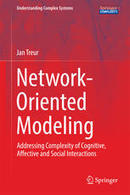
Network-Oriented Modeling – Jan Treur

This book presents a new approach that can be applied to complex, integrated individual and social human processes. It provides an alternative means of addressing complexity, better suited for its purpose than and effectively complementing traditional strategies involving isolation and separation assumptions.
Network-oriented modeling allows high-level cognitive, affective and social models in the form of (cyclic) graphs to be constructed, which can be automatically transformed into executable simulation models. The modeling format used makes it easy to take into account theories and findings about complex cognitive and social processes, which often involve dynamics based on interrelating cycles. Accordingly, it makes it possible to address complex phenomena such as the integration of emotions within cognitive processes of all kinds, of internal simulations of the mental processes of others, and of social phenomena such as shared understandings and collective actions. A variety of sample models – including those for ownership of actions, fear and dreaming, the integration of emotions in joint decision-making based on empathic understanding, and evolving social networks – illustrate the potential of the approach. Dedicated software is available to support building models in a conceptual or graphical manner, transforming them into an executable format and performing simulation experiments. The majority of the material presented has been used and positively evaluated by undergraduate and graduate students and researchers in the cognitive, social and AI domains.
Given its detailed coverage, the book is ideally suited as an introduction for graduate and undergraduate students in many different multidisciplinary fields involving cognitive, affective, social, biological, and neuroscience domains.


Network-Oriented Modeling
Addressing Complexity of Cognitive, Affective and Social Interactions
Jan Treur

Source: link.springer.com

Foundations of Data Science

While traditional areas of computer science remain highly important, increasingly re- searchers of the future will be involved with using computers to understand and extract usable information from massive data arising in applications, not just how to make com- puters useful on specific well-defined problems. With this in mind we have written this book to cover the theory likely to be useful in the next 40 years, just as an understanding of automata theory, algorithms and related topics gave students an advantage in the last 40 years. One of the major changes is the switch from discrete mathematics to more of an emphasis on probability, statistics, and numerical methods.


Foundations of Data Science
by Avrim Blum (CMU), John Hopcroft (Cornell), and Ravindran Kannan (MSR) 
June 2016
Available at https://www.cs.cornell.edu/jeh/book2016June9.pdf

Source: www.cs.cornell.edu

Infostorms

INFOSTORMS
Vincent F. Hendricks & Pelle G. Hansen
The information society is upon us. New technologies have given us back-pocket libraries, online discussion forums, blogs, crowd-based opinion aggregators, social media and breaking news wherever, whenever. But are we more enlightened and rational because of it?

With points of departure in philosophy, logic, social psychology, economics and choice and game theory, Infostorms shows how information may be used to improve the quality of personal decision and group thinking but also warns against the informational pitfalls which modern information technology may amplify, from science to reality culture and from cyberbullying to what it really is, that makes you buy a book like this.

Source: infostorms.com