Category: Conferences

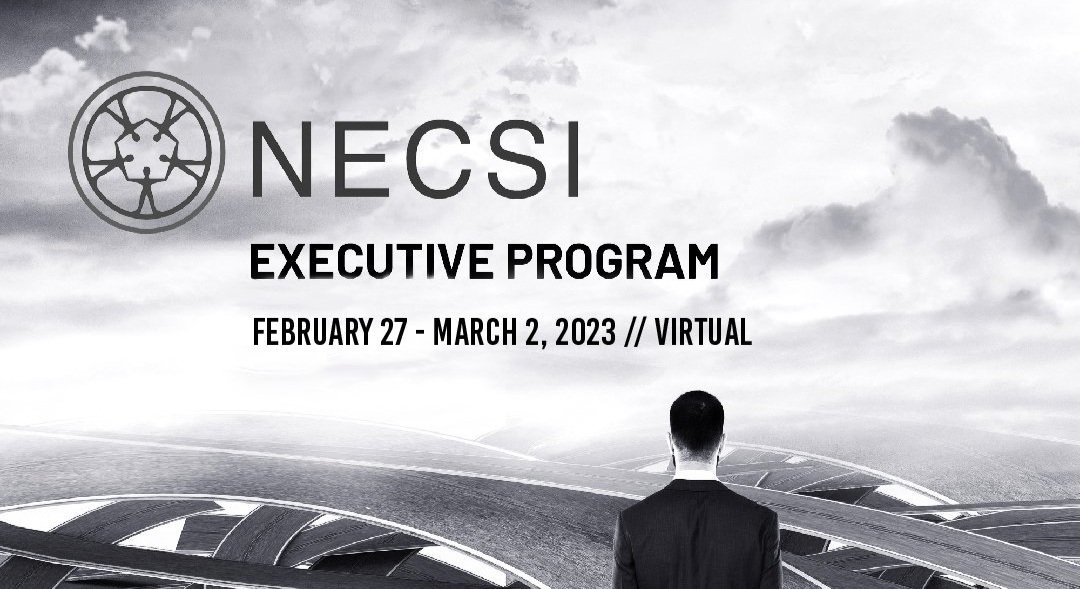
NECSI: Executive Program, Winter 2023

Certificate program preparing entrepreneurs, leaders, innovators, changemakers to anticipate, analyze and respond strategically to business problems in today’s world
The only constant in today’s world is change: change that constantly becomes more unpredictable, striking and rapid. Because of the increasing complexity of current business problems and their effects, traditional decision-making and strategy falls short.

Complex Systems Science (CSS) holds the key to success with a revolutionary framework to understand and react optimally to highly-dynamic scenarios. In two intense but enlightening days, obtain the only offered executive-focused introduction to CSS from NECSI, the leading research organization in the field.

When the unexpected occurs, you will be glad that you have Complex Systems Science and NECSI in your toolbox.

More at: necsi-exec.org

NERCCS 2023: Sixth Northeast Regional Conference on Complex Systems. MARCH 22 – 24, 2023 Clarkson University, Potsdam, NY

NERCCS 2023: The Sixth Northeast Regional Conference on Complex Systems will follow the success of the previous NERCCS conferences to promote the emerging venue of interdisciplinary scholarly exchange for complex systems researchers in the Northeast U.S. region (and beyond) to share their research outcomes through presentations and online publications, network with their peers, and promote interdisciplinary collaboration and the growth of the research community.

NERCCS will particularly focus on facilitating the professional growth of early career faculty, postdocs, and students in the region who will likely play a leading role in the field of complex systems science and engineering in the coming years.

The 2023 conference will be held as an in-person at Clarkson University in Potsdam, NY.

More at: nerccs2023.github.io

ALIFE 2023: The International Conference on Artificial Life. Sapporo – Japan, 24th-28th July 2023.

Conference Theme: Ghosts in the machine
Artificial life seeks to unravel the mysteries of life and mind, to naturalise the “ghosts in the machine”. What is life? What is the mind? Are these two concepts related?

These ghosts are however elusive, and difficult to identify or even just define at times. To try and learn more about the mind, research in artificial life and other related fields has more recently focused on studies of complexity, emergence, agency, autonomy, or information theory. As a results, this has led to major advancements in robotics, synthetic biology and artificial intelligence, among others. The main research programs in these areas however seem to be simply forgetting about the mind, rather than trying to explain it.

At the same time, with the advent of new technologies such as brain-machine interface, cyborgization, virtual/augmented reality and the metaverse, the boundaries between agents/living organisms and their environment have began fluctuating. Minds are no longer in our (living organism) shells, expanding beyond current spatial boundaries and into a new form of the “extended mind” hypothesis. At ALIFE 2023, we will bring back the focus to studies of the mind, facing the challenges and embracing the opportunities that come with studies of an often neglected but ever so important concept in both artificial life research and our daily lives.

More at: sites.google.com

Open Call – Conference Complex Systems (CCS 2024 and CCS 2025)

The Complex Systems Society (CSS) organizes every year a main conference (CCS) – the most important annual meeting for the complex systems research community.

The Complex Systems Society invites bids to host the edition for 2024 and 2025.

The conference is generally held in September/October of each year.

More at: cssociety.org

Complex Networks: Theory, Methods, and Applications – Lake Como School of Advanced Studies – 22-26 May 2023

Many real systems can be modeled as networks, where the elements of the system are nodes and interactions between elements are edges. An even larger set of systems can be modeled using dynamical processes on networks, which are in turn affected by the dynamics. Networks thus represent the backbone of many complex systems, and their theoretical and computational analysis makes it possible to gain insights into numerous applications. Networks permeate almost every conceivable discipline —including sociology, transportation, economics and finance, biology, and myriad others — and the study of “network science” has thus become a crucial component of modern scientific education.

The school “Complex Networks: Theory, Methods, and Applications” offers a succinct education in network science. It is open to all aspiring scholars in any area of science or engineering who wish to study networks of any kind (whether theoretical or applied), and it is especially addressed to doctoral students and young postdoctoral scholars. The aim of the school is to deepen into both theoretical developments and applications in targeted fields.

Read the full article at: ntmg.lakecomoschool.org