Category: Conferences

NERCCS 2018: First Northeast Regional Conference on Complex Systems

NERCCS 2018: The First Northeast Regional Conference on Complex Systems aims to establish a venue of interdisciplinary scholarly exchange for complex systems researchers in the Northeast U.S. region to share their research outcomes through presentations and post-conference online publications, network with their peers in the region, and promote inter-campus collaboration and the growth of the research community.

NERCCS will particularly focus on facilitating the professional growth of early career faculty, postdocs, and students in the region who have only limited resources but will likely play a leading role in the field of complex systems science and engineering in the coming years.

The conference will be held in the Innovative Technologies Complex at Binghamton University, which is within driving distance from all major urban areas in the U.S. Northeast region.

Source: coco.binghamton.edu

The role of city size and urban form in the surface urban heat island

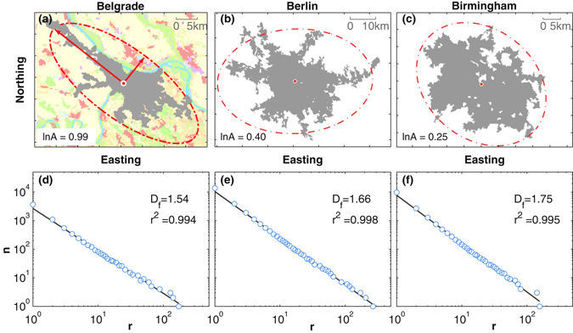
Urban climate is determined by a variety of factors, whose knowledge can help to attenuate heat stress in the context of ongoing urbanization and climate change. We study the influence of city size and urban form on the Urban Heat Island (UHI) phenomenon in Europe and find a complex interplay between UHI intensity and city size, fractality, and anisometry. Due to correlations among these urban factors, interactions in the multi-linear regression need to be taken into account. We find that among the largest 5,000 cities, the UHI intensity increases with the logarithm of the city size and with the fractal dimension, but decreases with the logarithm of the anisometry. Typically, the size has the strongest influence, followed by the compactness, and the smallest is the influence of the degree to which the cities stretch. Accordingly, from the point of view of UHI alleviation, small, disperse, and stretched cities are preferable. However, such recommendations need to be balanced against e.g. positive agglomeration effects of large cities. Therefore, trade-offs must be made regarding local and global aims.


The role of city size and urban form in the surface urban heat island
Bin Zhou, Diego Rybski & Jürgen P. Kropp
Scientific Reports 7, Article number: 4791 (2017)
doi:10.1038/s41598-017-04242-2

Source: www.nature.com

“Complexity, Criticality & Computation” (C3-2017) International Biannual Symposium

Complex systems is a new approach to science, engineering, health and management that studies how relationships between parts give rise to the collective emergent behaviours of the entire system, and how the system interacts with its environment.

What makes a system ‘complex’? A system can be thought of as complex if its dynamics cannot be easily predicted, or explained, as a linear summation of the individual dynamics of its components. In other words, the many constituent microscopic parts bring about macroscopic phenomena that cannot be understood by considering a single part alone (‘the whole is more than the sum of the parts’). There is a growing awareness that complexity is strongly related to criticality: the behaviour of dynamical spatiotemporal systems at an order/disorder phase transition where scale invariance prevails.

Complex systems can also be viewed as distributed information-processing systems, particularly in the domains of computational neuroscience, health, bioinformatics, systems biology and artificial life. Consciousness emerging from neuronal activity and interactions, cell behaviour resultant from gene regulatory networks and swarming behaviour are all examples of global system behaviour emerging as a result of the local interactions of the individuals (neurons, genes, animals). Can these interactions be seen as a generic computational process? This question shapes the third component of our symposium, linking computation to complexity and criticality.

We will consider a diverse range of systems, applications, theoretical and practical approaches to computational modelling of modern complex systems, including information theory, agent-based simulation, network theory, nonlinear dynamics, swarm intelligence, evolutionary methods, computational neuroscience, and econophysics, among others.


When: 9am – 5pm, December 11 – 13 (Mon – Wed), 2017
Where: Civil Engineering Lecture Room 1 (Rm 203), The University of Sydney
Cost: Free
Registration: Please email Mikhail Prokopenko with your name and affiliation, by 27 November 2017.

Source: sydney.edu.au

Complexities of Time

This 7th Complexity Conference, organised by Para Limes​ attempts to unravel these mysteries. It will also touches on the nature of time and change, geographical, geophysical, cultural, the personal dimensions to time; how to deal with them and what they mean for analyzing and understanding our past, sensing and exploring our future and how to manage our lives, our systems, or the world we live in. Hear them out from top-notch speakers of prominent scientists and thinkers from this field

The conference will also host parallel & poster sessions and launch of the Asian Network of Complexity Scientists by the Complexity Institute. Thus is a partnership of the Para Limes and Complexity Institute.​


Complexity Conference 2018
Theme: Complexities of Time
​Date:     19-21 March 2018
Venue:   Nanyan​g Executive Centre, Singapore​​

Source: www.complexity.ntu.edu.sg

CompleNet 2018 – 9th Conference on Complex Networks

CompleNet is an international conference that brings together researchers and practitioners from diverse disciplines—from sociology, biology, physics, and computer science—who share a passion to better understand the interdependencies within and across systems. CompleNet is a venue to discuss ideas and findings about all types networks, from biological, to technological, to informational and social. It is this interdisciplinary nature of complex networks that CompleNet aims to explore and celebrate.


CompleNet 2018 – 9th Conference on Complex Networks

Boston (MA, US)

March 5-8, 2018

www.complenet.org

Source: complenet.weebly.com