Category: Papers

Hierarchical analysis of spreading dynamics in complex systems

Aparimit Kasliwal, Abdullah Alhadlaq, Ariel Salgado, Auroop R. Ganguly, Marta C. González

Computer-Aided Civil and Infrastructure Engineering

Volume40, Issue31, 29 December 2025, Pages 6223-6241

Modeling spreading dynamics on spatial networks is crucial to addressing challenges related to traffic congestion, epidemic outbreaks, efficient information dissemination, and technology adoption. Existing approaches include domain-specific agent-based simulations, which offer detailed dynamics but often involve extensive parameterization, and simplified differential equation models, which provide analytical tractability but may abstract away spatial heterogeneity in propagation patterns. As a step toward addressing this trade-off, this work presents a hierarchical multiscale framework that approximates spreading dynamics across different spatial scales under certain simplifying assumptions. Applied to the Susceptible-Infected-Recovered (SIR) model, the approach ensures consistency in dynamics across scales through multiscale regularization, linking parameters at finer scales to those obtained at coarser scales. This approach constrains the parameter search space, and enables faster convergence of the model fitting process compared to the non-regularized model. Using hierarchical modeling, the spatial dependencies critical for understanding system-level behavior are captured while mitigating the computational challenges posed by parameter proliferation at finer scales. Considering traffic congestion and COVID-19 spread as case studies, the calibrated fine-scale model is employed to analyze the effects of perturbations and to identify critical regions and connections that disproportionately influence system dynamics. This facilitates targeted intervention strategies and provides a tool for studying and managing spreading processes in spatially distributed sociotechnical systems.

Read the full article at: onlinelibrary.wiley.com

The Physics of Causation

Leroy Cronin, Sara I. Walker

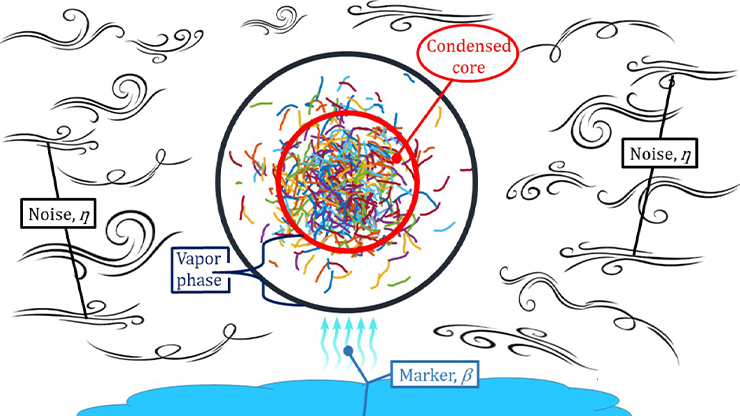
Assembly theory (AT) introduces a concept of causation as a material property, constitutive of a metrology of evolution and selection. The physical scale for causation is quantified with the assembly index, defined as the minimum number of steps necessary for a distinguishable object to exist, where steps are assembled recursively. Observing countable copies of high assembly index objects indicates that a mechanism to produce them is persistent, such that the object’s environment builds a memory that traps causation within a contingent chain. Copy number and assembly index underlie the standardized metrology for detecting causation (assembly index), and evidence of contingency (copy number). Together, these allow the precise definition of a selective threshold in assembly space, understood as the set of all causal possibilities. This threshold demarcates life (and its derivative agential, intelligent and technological forms) as structures with persistent copies beyond the threshold. In introducing a fundamental concept of material causation to explain and measure life, AT represents a departure from prior theories of causation, such as interventional ones, which have so far proven incompatible with fundamental physics. We discuss how AT’s concept of causation provides the foundation for a theory of physics where novelty, contingency and the potential for open-endedness are fundamental, and determinism is emergent along assembled lineages.

Read the full article at: arxiv.org

European Financial Ecosystems. Comparing France, Sweden, UK and Italy

Stefano Caselli, Marta Zava

The study examines the structure, functioning, and strategic implications of financial ecosystems across four European countries-France, Sweden, the United Kingdom, and Italy-to identify institutional best practices relevant to the ongoing transformation of Italy’s financial system. Building on a comparative analysis of legislation and regulation, taxation, investor bases, and financial intermediation, the report highlights how distinct historical and institutional trajectories have shaped divergent models: the French dirigiste system anchored by powerful state-backed institutions and deep asset management pools; the Swedish social-democratic ecosystem driven by broad household equity participation, taxefficient savings vehicles, and equity-oriented pension funds; and the British liberal model, characterized by deep capital markets, strong institutional investor engagement, and globally competitive listing infrastructure. In contrast, Italy remains predominantly bank-centric, with fragmented institutional investment, limited retail equity participation, underdeveloped public markets, and a structural reliance on domestic banking channels for corporate finance.

Read the full article at: papers.ssrn.com

Decoding the architecture of living systems

Manlio De Domenico

The possibility that evolutionary forces — together with a few fundamental factors such as thermodynamic constraints, specific computational features enabling information processing, and ecological processes — might constrain the logic of living systems is tantalizing. However, it is often overlooked that any practical implementation of such a logic requires complementary circuitry that, in biological systems, happens through complex networks of genetic regulation, metabolic reactions, cellular signalling, communication, social and eusocial non-trivial organization. Here, we review and discuss how circuitries are not merely passive structures, but active agents of change that, by means of hierarchical and modular organization, are able to enhance and catalyze the evolution of evolvability. By analyzing the role of non-trivial topologies in major evolutionary transitions under the lens of statistical physics and nonlinear dynamics, we show that biological innovations are strictly related to circuitry and its deviation from trivial structures and (thermo)dynamic equilibria. We argue that sparse heterogeneous networks such as hierarchical modular, which are ubiquitously observed in nature, are favored in terms of the trade-off between energetic costs for redundancy, error-correction and mantainance. We identify three main features — namely, interconnectivity, plasticity and interdependency — pointing towards a unifying framework for modeling the phenomenology, discussing them in terms of dynamical systems theory, non-equilibrium thermodynamics and evolutionary dynamics. Within this unified picture, we also show that “slow” evolutionary dynamics is an emergent phenomenon governed by the replicator-mutator equation as the direct consequence of a constrained variational nonequilibrium process. Overall, this work highlights how dynamical systems theory and nonequilibrium thermodynamics provide powerful analytical techniques to study biological complexity.

Read the full article at: iopscience.iop.org

Higher-order interactions shape collective human behaviour

Federico Battiston, Valerio Capraro, Fariba Karimi, Sune Lehmann, Andrea Bamberg Migliano, Onkar Sadekar, Angel Sánchez & Matjaž Perc
Nature Human Behaviour volume 9, pages 2441–2457 (2025

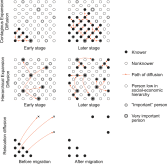
Traditional social network models focus on pairwise interactions, overlooking the complexity of group-level dynamics that shape collective human behaviour. Here we outline how the framework of higher-order social networks—using mathematical representations beyond simple graphs—can more accurately represent interactions involving multiple individuals. Drawing from empirical data including scientific collaborations and contact networks, we demonstrate how higher-order structures reveal mechanisms of group formation, social contagion, cooperation and moral behaviour that are invisible in dyadic models. By moving beyond dyads, this approach offers a transformative lens for understanding the relational architecture of human societies, opening new directions for behavioural experiments, cultural dynamics, team science and group behaviour as well as new cross-disciplinary research.

Read the full article at: www.nature.com