
Identifying and characterizing superspreaders of low-credibility content on Twitter

DeVerna MR, Aiyappa R, Pacheco D, Bryden J, Menczer F

PLoS ONE 19(5): e0302201

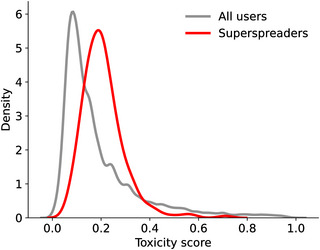
The world’s digital information ecosystem continues to struggle with the spread of misinformation. Prior work has suggested that users who consistently disseminate a disproportionate amount of low-credibility content—so-called superspreaders—are at the center of this problem. We quantitatively confirm this hypothesis and introduce simple metrics to predict the top superspreaders several months into the future. We then conduct a qualitative review to characterize the most prolific superspreaders and analyze their sharing behaviors. Superspreaders include pundits with large followings, low-credibility media outlets, personal accounts affiliated with those media outlets, and a range of influencers. They are primarily political in nature and use more toxic language than the typical user sharing misinformation. We also find concerning evidence that suggests Twitter may be overlooking prominent superspreaders. We hope this work will further public understanding of bad actors and promote steps to mitigate their negative impacts on healthy digital discourse.

Read the full article at: journals.plos.org

An Entropic Analysis of Social Demonstrations

Daniel Rico and Yérali Gandica

Entropy 2024, 26(5), 363

Social media has dramatically influenced how individuals and groups express their demands, concerns, and aspirations during social demonstrations. The study of X or Twitter hashtags during those events has revealed the presence of some temporal points characterised by high correlation among their participants. It has also been reported that the connectivity presents a modular-to-nested transition at the point of maximum correlation. The present study aims to determine whether it is possible to characterise this transition using entropic-based tools. Our results show that entropic analysis can effectively find the transition point to the nested structure, allowing researchers to know that the transition occurs without the need for a network representation. The entropic analysis also shows that the modular-to-nested transition is characterised not by the diversity in the number of hashtags users post but by how many hashtags they share.

Read the full article at: www.mdpi.com

Foundational Papers in Complexity Science for Emerging Award Winners

SFI Press launched Foundational Papers in Complexity Science this May. The four-volume collection, edited by SFI President David Krakauer, contains 88 typeset articles, each with introductions and commentaries from leading scientists.

Volumes 1 and 2, featuring papers spanning the years 1922 to 1973, are out now. The third and fourth volumes include work from the final decades of the 20th century and will be published later this summer.

The Santa Fe Institute is sponsoring a book set for each of the upcoming Emerging Award Winners, to be announced during the next Conference on Complex Systems in Exeter, UK in September.

More at: cssociety.org

Collective responses of flocking sheep to a herding dog

Vivek Jadhav, Roberto Pasqua, Christophe Zanon, Matthieu Roy, Gilles Tredan, Richard Bon, Vishwesha Guttal, Guy Theraulaz

Across taxa, group-living organisms exhibit collective escape responses to stimuli varying from mild stress to predatory pressures. How exactly does information flow among group members leading to a collective escape remains an open question. Here we study the collective responses of a flock of sheep to a shepherd dog in a driving task between well-defined target points. We collected high-resolution spatio-temporal data from 14 sheep and the dog, using Ultra Wide Band tags attached to each individual. Through the time delay analysis of velocity correlations, we identify a hierarchy among sheep in terms of directional influence. Notably, the average spatial position of a sheep along the front-back axis of the group’s velocity strongly correlates with its impact on the collective movement. Our findings demonstrate that, counter-intuitively, directional information on shorter time scales propagates from the front of the group towards the rear, and that the dog exhibits adaptive movement adjustments in response to the flock’s dynamics. Furthermore, we show that a simple shepherding model can capture key features of the collective response of the sheep flocks. In conclusion, our study reveals novel insights on how directional information propagates in escaping animal groups.

Read the full article at: www.biorxiv.org

Migration and Mobility Research in the Digital Era (MIMODE 2024)

The recent availability of massive amounts of digital data have profoundly revolutionized research on migration and mobility, enabling scientists to quantitatively study individual and collective mobility patterns at different granularities as generated by human activities in their daily life.

Read the full article at: www.demogr.mpg.de