Irruption and Absorption: A ‘Black-Box’ Framework for How Mind and Matter Make a Difference to Each Other

Tom Froese

Entropy 2024, 26(4), 288

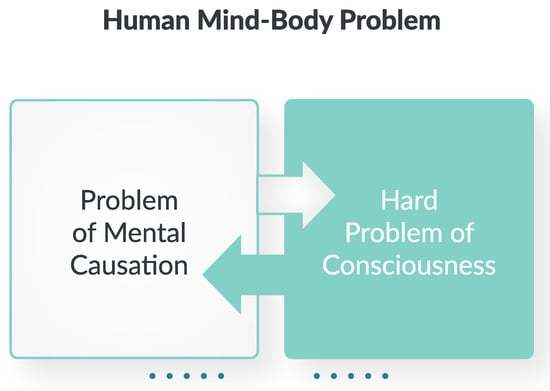
Cognitive science is confronted by several fundamental anomalies deriving from the mind–body problem. Most prominent is the problem of mental causation and the hard problem of consciousness, which can be generalized into the hard problem of agential efficacy and the hard problem of mental content. Here, it is proposed to accept these explanatory gaps at face value and to take them as positive indications of a complex relation: mind and matter are one, but they are not the same. They are related in an efficacious yet non-reducible, non-observable, and even non-intelligible manner. Natural science is well equipped to handle the effects of non-observables, and so the mind is treated as equivalent to a hidden ‘black box’ coupled to the body. Two concepts are introduced given that there are two directions of coupling influence: (1) irruption denotes the unobservable mind hiddenly making a difference to observable matter, and (2) absorption denotes observable matter hiddenly making a difference to the unobservable mind. The concepts of irruption and absorption are methodologically compatible with existing information-theoretic approaches to neuroscience, such as measuring cognitive activity and subjective qualia in terms of entropy and compression, respectively. By offering novel responses to otherwise intractable theoretical problems from first principles, and by doing so in a way that is closely connected with empirical advances, irruption theory is poised to set the agenda for the future of the mind sciences.

Read the full article at: www.mdpi.com
Intensive Summer Course in Complexity @NECSI, June 3-June 14

This June, discover the science that teaches us about collected patterns of behavior, helps us understand the fluctuations of global finance, and can help us meet societal, organization and global challenges. 

This course provides an introduction to essential concepts of complex systems and related mathematical methods and simulation strategies with application to physical, biological and social systems.

Concepts to be covered include: emergence, complexity, networks, self-organization, pattern formation, evolution, adaptation, fractals, chaos, cooperation, competition, attractors, interdependence, scaling, dynamic response, information and function.

Methods to be covered include: statistical methods, cellular automata, agent-based modeling, pattern recognition, system representation and informatics.

More  at: necsi.edu

How human history shapes scientific inquiry

In this episode, we examine how the course of human history has shaped our scientific knowledge, why the physics community prioritizes some questions over others, and why progress in complex systems research is especially difficult. Academia continues to operate within set boundaries and students are taught certain concepts as fundamental and to skirt others completely. However, the history of science demonstrates that such concepts aren’t always set in stone. It’s possible that blowing open the “shackles of reality,” such as redefining the concept of life itself, and reprioritizing the problems that scientists want to tackle, might help scientists make more progress in this very difficult world of complexity research.

Listen at: complexity.simplecast.com

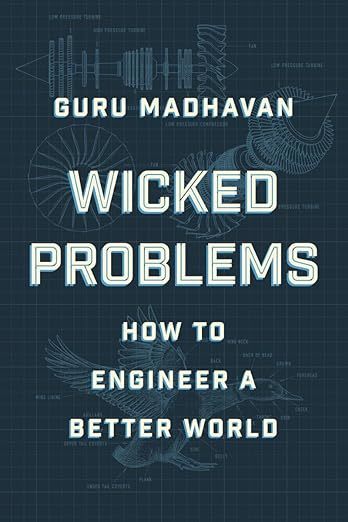
Wicked Problems: How to Engineer a Better World, by Guru Madhavan

An ode to systems engineers―whose invisible work undergirds our life―and an exploration of the wicked problems they tackle.

Our world is filled with pernicious problems. How, for example, did novice pilots learn to fly without taking to the air and risking their lives? How should cities process mountains of waste without polluting the environment? Challenges that tangle personal, public, and planetary aspects―often occurring in health care, infrastructure, business, and policy―are known as wicked problems, and they are not going away anytime soon.

In linked chapters focusing on key facets of systems engineering―efficiency, vagueness, vulnerability, safety, maintenance, and resilience―engineer Guru Madhavan illuminates how wicked problems have emerged throughout history and how best to address them in the future. He examines best-known tragedies and lesser-known tales, from the efficient design of battleships to a volcano eruption that curtailed global commerce, and how maintenance of our sanitation systems constitutes tikkun olam, or repair of our world. Braided throughout is the uplifting tale of Edwin Link, an unsung hero who revolutionized aviation with his flight trainer. In Link’s story, Madhavan uncovers a model mindset to engage with wickedness.

An homage to society’s innovators and maintainers, Wicked Problems offers a refreshing vision for readers of all backgrounds to build a better future and demonstrates how engineering is a cultural choice―one that requires us to restlessly find ways to transform society, but perhaps more critically, to care for the creations that already exist.

More at: www.amazon.com

EPS Grand Challenges: Physics for Society in the Horizon 2050, edited by Carlos Hidalgo

There are many images of science and the activities of scientists. Some would imply that science will eventually reach the limits of knowledge while others create an expectation of endless horizons. Some people would believe that science has or will provide the answers to key open questions that lie ahead, while others experience fear regarding its development. In this book, we will look at all these aspects, going from particles, via atoms, cells, stars, galaxies, our place in the universe, to explore what makes us, human beings, really unique in nature: our ability to imagine and shape the future by making use of the scientific method. The book is an EPS action designed to address the social dimension of science and the grand challenges in physics that will bring radical change to developed societies, raise standards of living at the global scale, and provide basic understanding of nature on the horizon 2050.

Read the full book at: iopscience.iop.org