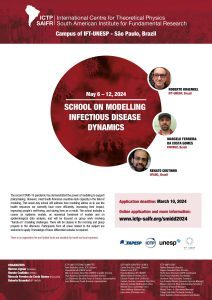
School on Modelling Infectious Disease Dynamics.  May 6 – 12, 2024.  São Paulo, Brazil

The recent COVID-19 pandemic has demonstrated the power of modeling to support policymaking. However, most South American countries lack capacity in the field of modeling. This seven-day school will address how modeling allows us to use the health resources we currently have more efficiently, increasing their impact, improving people’s well-being, and saving lives as a result. The school includes a course on epidemic models, on numerical treatment of models and on epidemiological data analysis, and will be focused on group work involving “hands-on” modeling challenges. There will be classes in the morning and group projects in the afternoon. Participants from all areas related to the subject are welcome to apply. Knowledge of basic differential calculus is required.

Apply at: www.ictp-saifr.org
Principled Limitations on Self-Representation for Generic Physical Systems

Chris Fields, James F. Glazebrook, and Michael Levin

Entropy 2024, 26(3), 194

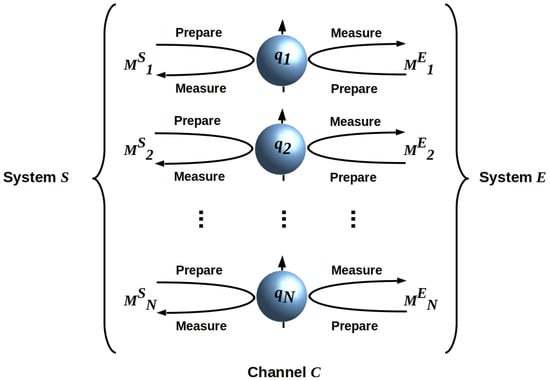
The ideas of self-observation and self-representation, and the concomitant idea of self-control, pervade both the cognitive and life sciences, arising in domains as diverse as immunology and robotics. Here, we ask in a very general way whether, and to what extent, these ideas make sense. Using a generic model of physical interactions, we prove a theorem and several corollaries that severely restrict applicable notions of self-observation, self-representation, and self-control. We show, in particular, that adding observational, representational, or control capabilities to a meta-level component of a system cannot, even in principle, lead to a complete meta-level representation of the system as a whole. We conclude that self-representation can at best be heuristic, and that self models cannot, in general, be empirically tested by the systems that implement them.

Read the full article at: www.mdpi.com

Complexity Global School | Santa Fe Institute

Application for the second Complexity Global School – to be hosted simultaneously at Universidad de los Andes, Colombia, and Santa Fe Institute, USA from July 21 to August 3 – is now open. Applicants based in Latin America and the Caribbean are eligible for the Colombia location, and applicants based in USA, Canada, and western Europe are eligible for the USA location. Supported by the Omidyar Network, the school is free for all admitted students, inclusive of tuition, room, board, and travel stipend.

Read the full article at: www.santafe.edu

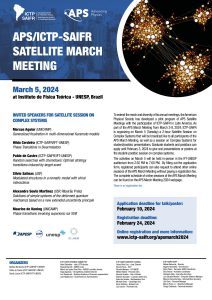
APS/ICTP-SAIFR Satellite March Meeting, Session on Complex Systems

To extend the reach and diversity of its annual meetings, the American Physical Society has developed a pilot program of APS Satellite Meetings with the participation of ICTP-SAIFR in Latin America. As part of the APS March Meeting from March 3-8, 2024, ICTP-SAIFR is organizing on March 5 (Tuesday) a 2-hour Satellite Session on Complex Systems that will be broadcast live to all participants of the APS March Meeting, as well as a session on Complex Systems for student/postdoc presentations.

Graduate students and postdocs can apply until February 10, 2024 to give oral presentations or posters at the student-postdoc session on complex systems.

More at: www.ictp-saifr.org

Faster is Slower effect for evacuation processes: a granular standpoint

F. Al Reda, S. Faure, B. Maury, E. Pinsard

Journal of Computational Physics

• Numerical investigation of the Faster is Slower effect based on a parameter free model.

• Integration of an inhibition tendency of polite pedestrians.

• Numerical evidence of the fluidizing role of an obstacle upstream the exit during evacuation.

• Numerical recovering of an experimental power law for time lapses.

Read the full article at: www.sciencedirect.com