
Selection for short-term empowerment accelerates the evolution of homeostatic neural cellular automata

Caitlin Grasso, Josh Bongard

Empowerment — a domain independent, information-theoretic metric — has previously been shown to assist in the evolutionary search for neural cellular automata (NCA) capable of homeostasis when employed as a fitness function. In our previous study, we successfully extended empowerment, defined as maximum time-lagged mutual information between agents’ actions and future sensations, to a distributed sensorimotor system embodied as an NCA. However, the time-delay between actions and their corresponding sensations was arbitrarily chosen. Here, we expand upon previous work by exploring how the time scale at which empowerment operates impacts its efficacy as an auxiliary objective to accelerate the discovery of homeostatic NCAs. We show that shorter time delays result in marked improvements over empowerment with longer delays, when compared to evolutionary selection only for homeostasis. Moreover, we evaluate stability and adaptability of evolved NCAs, both hallmarks of living systems that are of interest to replicate in artificial ones. We find that short-term empowered NCA are more stable and are capable of generalizing better to unseen homeostatic challenges. Taken together, these findings motivate the use of empowerment during the evolution of other artifacts, and suggest how it should be incorporated to accelerate evolution of desired behaviors for them.

Read the full article at: arxiv.org
Self-Replicating Hierarchical Structures Emerge in a Binary Cellular Automaton

Bo Yang

We have discovered a novel transition rule for binary cellular automata (CA) that yields self-replicating structures across two spatial and temporal scales from sparsely populated random initial conditions. Lower-level, shapeshifting clusters frequently follow a transient attractor trajectory, generating new clusters, some of which periodically self-duplicate. When the initial distribution of live cells is sufficiently sparse, these clusters coalesce into larger formations that also self-replicate. These formations may further form the boundaries of an expanding complex on an even larger scale. This rule, dubbed “Outlier,” is rotationally symmetric and applies to 2D Moore neighborhoods. It was evolved through Genetic Programming during an extensive automated search for rules that foster open-ended evolution in CA. While self-replicating structures, both crafted and emergent, hav

Read the full article at: arxiv.org

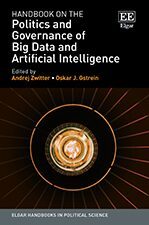
Handbook on the Politics and Governance of Big Data and Artificial Intelligence

Edited by Andrej Zwitter and Oskar Gstrein
Drawing on the theoretical debates, practical applications, and sectoral approaches in the field, this ground-breaking Handbook unpacks the political and regulatory developments in AI and big data governance. Covering the political implications of big data and AI on international relations, as well as emerging initiatives for legal regulation, it provides an accessible overview of ongoing data science discourses in politics, law and governance.

Read the full article at: www.elgaronline.com

A chiral aperiodic monotile

David Smith, Joseph Samuel Myers, Craig S. Kaplan, Chaim Goodman-Strauss

The recently discovered “hat” aperiodic monotile mixes unreflected and reflected tiles in every tiling it admits, leaving open the question of whether a single shape can tile aperiodically using translations and rotations alone. We show that a close relative of the hat — the equilateral member of the continuum to which it belongs — is a weakly chiral aperiodic monotile: it admits only non-periodic tilings if we forbid reflections by fiat. Furthermore, by modifying this polygon’s edges we obtain a family of shapes called Spectres that are strictly chiral aperiodic monotiles: they admit only chiral non-periodic tilings based on a hierarchical substitution system.

Read the full article at: arxiv.org