Foundations of Science volume 28, pages 85–107 (2023)
Quantum phenomena are notoriously difficult to grasp. The present paper first reviews the most important quantum concepts in a non-technical manner: superposition, uncertainty, collapse of the wave function, entanglement and non-locality. It then tries to clarify these concepts by examining their analogues in complex, self-organizing systems. These include bifurcations, attractors, emergent constraints, order parameters and non-local correlations. They are illustrated with concrete examples that include Rayleigh–Bénard convection, social self-organization and Gestalt perception of ambiguous figures. In both cases, quantum and self-organizing, the core process appears to be a symmetry breaking that irreversibly and unpredictably “collapses” an ambiguous state into one of a number of initially equivalent “eigenstates” or “attractors”. Some speculations are proposed about the non-linear amplification of quantum fluctuations of the vacuum being ultimately responsible for such symmetry breaking.
Tom Froese, Natalya Weber, Ivan Shpurov, Takashi Ikegami
The theory of autopoiesis has been influential in many areas of theoretical biology, especially in the fields of artificial life and origins of life. However, it has not managed to productively connect with mainstream biology, partly for theoretical reasons, but arguably mainly because deriving specific working hypotheses has been challenging. The theory has recently undergone significant conceptual development in the enactive approach to life and mind. Hidden complexity in the original conception of autopoiesis has been explicated in the service of other operationalizable concepts related to self-individuation: precariousness, adaptivity, and agency. Here we advance these developments by highlighting the interplay of these concepts with considerations from thermodynamics: reversibility, irreversibility, and path-dependence. We interpret this interplay in terms of the self-optimization model, and present modeling results that illustrate how these minimal conditions enable a system to re-organize itself such that it tends toward coordinated constraint satisfaction at the system level. Although the model is still very abstract, these results point in a direction where the enactive approach could productively connect with cell biology.
Network Science Society Colloquium – January 25, 2023
Nicholas A. Christakis Experiments with Social Network Interventions
Abstract Human beings choose their friends, and often their neighbors and co-workers, and we inherit our relatives; and each of the people to whom we are connected also does the same, such that, in the end, we assemble ourselves into face-to-face social networks that obey particular mathematical and sociological rules. Why do we do this? And how might a deep understanding of human social network structure and function be used to intervene in the world to make it better? Here, I will review recent research from our lab describing three classes of interventions involving both offline and online networks: (1) interventions that rewire the connections between people; (2) interventions that manipulate social contagion, modifying the flow of desirable or undesirable properties; and (3) interventions that manipulate the positions of people within network structures. I will illustrate what can be done using a variety of experiments in settings as diverse as fostering cooperation or the diffusion of innovation in networked groups online, to fostering health behavior change in developing world villages and towns. I will also discuss recent experiments with “hybrid systems” comprised of both humans and artificial intelligence (AI) agents interacting in small groups. Overall, by taking account of people’s structural embeddedness in social networks, and by understanding social influence, it is possible to intervene in social systems to enhance desirable population-level properties as diverse as health, wealth, cooperation, coordination, and learning.
About the Speaker Nicholas A. Christakis, MD, PhD, MPH, is a social scientist and physician at Yale University who conducts research in the fields of network science, biosocial science, and behavior genetics. His current work focuses on how human biology and health affect, and are affected by, social interactions and social networks. He directs the Human Nature Lab and is the Co-Director of the Yale Institute for Network Science. He is the Sterling Professor of Social and Natural Science at Yale University, appointed in the Departments of Sociology; Medicine; Ecology and Evolutionary Biology; Biomedical Engineering; and the School of Management.
Martin Arvidsson, Niclas Lovsjö & Marc Keuschnigg Nature Human Behaviour (2023)
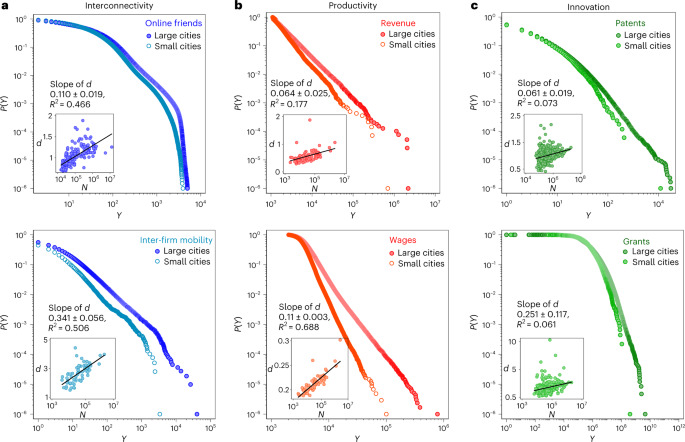
Theories of urban scaling have demonstrated remarkable predictive accuracy at aggregate levels. However, they have overlooked the stark inequalities that exist within cities. Human networking and productivity exhibit heavy-tailed distributions, with some individuals contributing disproportionately to city totals. Here we use micro-level data from Europe and the United States on interconnectivity, productivity and innovation in cities. We find that the tails of within-city distributions and their growth by city size account for 36–80% of previously reported scaling effects, and 56–87% of the variance in scaling between indicators of varying economic complexity. Providing explanatory depth to these findings, we identify a mechanism—city size-dependent cumulative advantage—that constitutes an important channel through which differences in the size of tails emerge. Our findings demonstrate that urban scaling is in large part a story about inequality in cities, implying that the causal processes underlying the heavier tails in larger cities must be considered in explanations of urban scaling. This result also shows that agglomeration effects benefit urban elites the most, with the majority of city dwellers partially excluded from the socio-economic benefits of growing cities.
Brennan Klein, Harrison Hartle, Munik Shrestha, Ana Cecilia Zenteno, David Barros Sierra Cordera, José R. Nicolas-Carlock, Ana I. Bento, Benjamin M. Althouse, Bernardo Gutierrez, Marina Escalera-Zamudio, Arturo Reyes-Sandoval, Oliver G. Pybus, Alessandro Vespignani, Jose Alberto Diaz-Quiñonez, Samuel V. Scarpino, Moritz U.G. Kraemer
During outbreaks of emerging infectious diseases, internationally connected cities often experience large and early outbreaks, while rural regions follow after some delay. This hierarchical structure of disease spread is influenced primarily by the multiscale structure of human mobility. However, during the COVID-19 epidemic, public health responses typically did not take into consideration the explicit spatial structure of human mobility when designing non-pharmaceutical interventions (NPIs). NPIs were applied primarily at national or regional scales. Here we use weekly anonymized and aggregated human mobility data and spatially highly resolved data on COVID-19 cases, deaths and hospitalizations at the municipality level in Mexico to investigate how behavioural changes in response to the pandemic have altered the spatial scales of transmission and interventions during its first wave (March – June 2020). We find that the epidemic dynamics in Mexico were initially driven by SARS-CoV-2 exports from Mexico State and Mexico City, where early outbreaks occurred. The mobility network shifted after the implementation of interventions in late March 2020, and the mobility network communities became more disjointed while epidemics in these communities became increasingly synchronised. Our results provide actionable and dynamic insights into how to use network science and epidemiological modelling to inform the spatial scale at which interventions are most impactful in mitigating the spread of COVID-19 and infectious diseases in general.