
Automating the Search for Artificial Life With Foundation Models

Akarsh Kumar, Chris Lu, Louis Kirsch, Yujin Tang, Kenneth O. Stanley, Phillip Isola, David Ha

Artificial Life (2025) 31 (3): 368–396.

With the recent Nobel Prize awarded for radical advances in protein discovery, foundation models (FMs) for exploring large combinatorial spaces promise to revolutionize many scientific fields. Artificial Life (ALife) has not yet integrated FMs, thus presenting a major opportunity for the field to alleviate the historical burden of relying chiefly on manual design and trial and error to discover the configurations of lifelike simulations. This article presents, for the first time, a successful realization of this opportunity using vision-language FMs. The proposed approach, called automated search for Artificial Life (ASAL), (a) finds simulations that produce target phenomena, (b) discovers simulations that generate temporally open-ended novelty, and (c) illuminates an entire space of interestingly diverse simulations. Because of the generality of FMs, ASAL works effectively across a diverse range of ALife substrates, including Boids, Particle Life, the Game of Life, Lenia, and neural cellular automata. A major result highlighting the potential of this technique is the discovery of previously unseen Lenia and Boids life-forms, as well as cellular automata that are open-ended like Conway’s Game of Life. Additionally, the use of FMs allows for the quantification of previously qualitative phenomena in a human-aligned way. This new paradigm promises to accelerate ALife research beyond what is possible through human ingenuity alone.

Read the full article at: direct.mit.edu
The evolution of zero-sum and positive-sum worldviews

Sergey Gavrilets and Paul Seabright

PNAS 122 (32) e2504339122

Beliefs about whether the world is a zero-sum or a positive-sum environment vary across individuals and cultures, and affect people’s willingness to work, invest, and cooperate with others. We model interaction between individuals who are biased toward believing the environment is zero-sum, and those biased toward believing it is positive-sum. Beliefs spread through natural and cultural selection if they lead individuals to have higher utilities. If individuals are matched randomly, selection leads to the more accurate beliefs driving out the less accurate. Nonrandom matching and conformity biases can favor the survival of inaccurate beliefs. Cultural authorities can profit from creating enclaves of like-minded individuals whose higher bias drives out the more accurate beliefs of others.

Read the full article at: www.pnas.org

Toward a unified taxonomy of information dynamics via Integrated Information Decomposition

Pedro A M Mediano, Fernando E Rosas, Andrea I Luppi, Robin L Carhart-Harris, Daniel Bor , Anil K Seth, and Adam B Barrett

PNAS 122 (39) e2423297122

Complex systems, from the human brain to the global economy, are made of multiple elements that interact dynamically, often giving rise to collective behaviors that are not readily predictable from the “sum of the parts.” To advance our understanding of how this can occur, here we present a mathematical framework to disentangle and quantify different “modes” of information storage, transfer, and integration in complex systems. This framework reveals previously unreported collective behavior phenomena in experimental data across scientific fields, and provides principles to classify and formally relate diverse measures of dynamical complexity and information processing.

Read the full article at: www.pnas.org

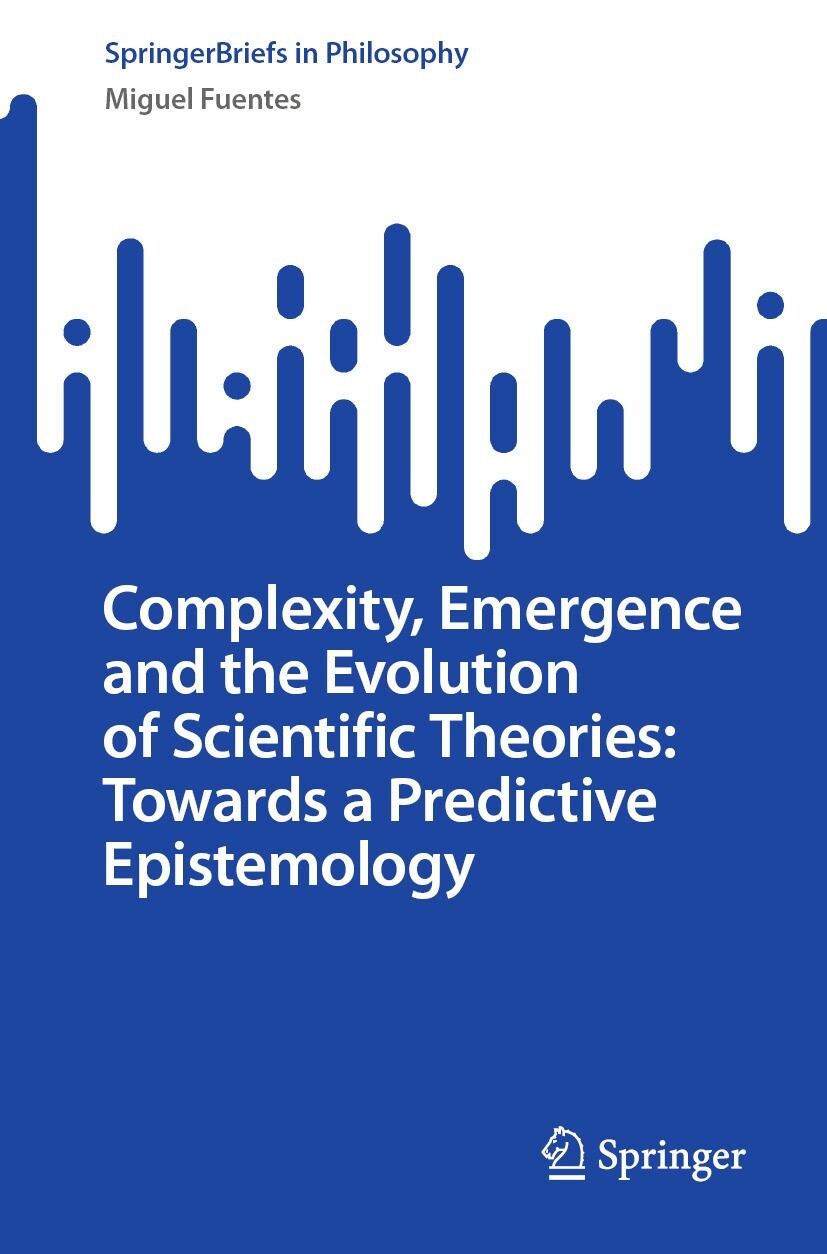
Complexity, Emergence and the Evolution of Scientific Theories: Towards a Predictive Epistemology, by Miguel Fuentes

This book offers a unique perspective on the evolution of scientific theories through the lens of their changing complexity.

To explore this non-trivial connection, the author draws on well-known historical cases from the philosophy of science tradition to test the central theses of the work. At the same time, the book develops a conceptual framework in which the debates on emergence and complexity play a central role.

The opening chapter provides the historical background of emergence, examining both classical and contemporary perspectives, highlighting diverse viewpoints and their contributions to the current discussion.

The second chapter turns to the foundations of complexity science, detailing its key methodologies and emphasizing the role of information in describing and modeling systems.

Building on this foundation, the book introduces a novel quantitative definition of emergent properties, grounded in the concept of parametric model complexity. It discusses how slight variations in control parameters can generate universal features and explores the implications of these dynamics for our understanding of systemic behavior.

Finally, the author shows how this framework illuminates critical aspects of scientific practice, ranging from the criteria guiding theory choice to the relationship between technological innovation and the risk of the appearance of anomalies. By combining historical analysis, conceptual innovation, and formal modeling, the book presents a compelling vision of how complexity and emergence can be predictive indicators of theoretical transformation, recognizing the moments when our current models have reached their limits.

More at: link.springer.com

Could humans and AI become a new evolutionary individual?

Paul B. Rainey and Michael E. Hochberg

PNAS 122 (37) e2509122122

Artificial intelligence (AI)—broadly defined as the capacity of engineered systems to perform tasks that would require intelligence if done by humans—is increasingly embedded in the infrastructure of human life. From personalized recommendation systems to large-scale decision-making frameworks, AI shapes what humans see, choose, believe, and do (1, 2). Much of the current concern about AI centers on its understanding, safety, and alignment with human values (3–5). But alongside these immediate challenges lies a broader, more speculative, and potentially more profound question: could the deepening interdependence between humans and AI give rise to a new kind of evolutionary individual? We argue that as interdependencies grow, humans and AI could come to function not merely as interacting agents, but as an integrated evolutionary individual subject to selection at the collective level.

Read the full article at: www.pnas.org