
DYNAMIC MODELS OF GENTRIFICATION

GIOVANNI MAURO, NICOLA PEDRESCHI, RENAUD LAMBIOTTE, and LUCA PAPPALARDO

Advances in Complex SystemsVol. 28, No. 06, 2540006 (2025)

The phenomenon of gentrification of an urban area is characterized by the displacement of lower-income residents due to rising living costs and an influx of wealthier individuals. This study presents an agent-based model that simulates urban gentrification through the relocation of three income groups — low, middle, and high — driven by living costs. The model incorporates economic and sociological theories to generate realistic neighborhood transition patterns. We introduce a temporal network-based measure to track the outflow of low-income residents and the inflow of middle- and high-income residents over time. Our experiments reveal that high-income residents trigger gentrification and that our network-based measure consistently detects gentrification patterns earlier than traditional count-based methods, potentially serving as an early detection tool in real-world scenarios. Moreover, the analysis highlights how city density promotes gentrification. This framework offers valuable insights for understanding gentrification dynamics and informing urban planning and policy decisions.

Read the full article at: www.worldscientific.com
INFERRING FINANCIAL STOCK RETURNS CORRELATION FROM COMPLEX NETWORK ANALYSIS

IXANDRA ACHITOUV

Advances in Complex SystemsVol. 28, No. 06, 2540005 (2025)

Financial stock returns correlations have been studied in the prism of random matrix theory to distinguish the signal from the “noise”. Eigenvalues of the matrix that are above the rescaled Marchenko–Pastur distribution can be interpreted as collective modes behavior while the modes under are usually considered as noise. In this analysis, we use complex network analysis to simulate the “noise” and the “market” component of the return correlations, by introducing some meaningful correlations in simulated geometric Brownian motion for the stocks. We find that the returns correlation matrix is dominated by stocks with high eigenvector centrality and clustering found in the network. We then use simulated “market” random walks to build an optimal portfolio and find that the overall return performs better than using the historical mean-variance data, up to 50% on short-time scale.

Read the full article at: www.worldscientific.com

Generalizing thermodynamic efficiency of interactions: inferential, information-geometric and computational perspectives

Qianyang Chen, Nihat Ay, Mikhail Prokopenko

Self-organizing systems consume energy to generate internal order. The concept of thermodynamic efficiency, drawing from statistical physics and information theory, has previously been proposed to characterize a change in control parameter by relating the resulting predictability gain to the required amount of work. However, previous studies have taken a system-centric perspective and considered only single control parameters. Here, we generalize thermodynamic efficiency to multi-parameter settings and derive two observer-centric formulations. The first, an inferential form, relates efficiency to fluctuations of macroscopic observables, interpreting thermodynamic efficiency in terms of how well the system parameters can be inferred from observable macroscopic behaviour. The second, an information-geometric form, expresses efficiency in terms of the Fisher information matrix, interpreting it with respect to how difficult it is to navigate the statistical manifold defined by the control protocol. This observer-centric perspective is contrasted with the existing system-centric view, where efficiency is considered an intrinsic property of the system.

Read the full article at: arxiv.org

Evolutionary processes that resolve cooperative dilemmas

Philip LaPorte, Shiyi Wang, Lenz Pracher, Saptarshi Pal, Martin Nowak

In biology, there is often a tension between what is good for the individual and what is good for the population (1–6). Cooperation benefits the community, while defection tempts the individual to garner short term gains. The theory of repeated games specifies that there is a continuum of Nash equilibria which ranges from fully defective to fully cooperative (7,8). The mechanism of direct reciprocity, which relies on repeated interactions, therefore only stipulates that evolution of cooperation is possible, but whether or not cooperation can be established, and for which parameters, depends on the details of the underlying process of mutation and selection (9–18). Many well known evolutionary processes achieve cooperation only in restricted settings. In the case of the donation game (5,6), for example, high benefit to-cost ratios are often needed for selection to favor cooperation (19–22). Here we study a universe of two-player cooperative dilemmas (23), which includes the prisoner’s dilemma (24–27), snowdrift (28–30), stag-hunt (31) and harmony game. Upon those games we apply a universe of evolutionary processes. Among those processes we find a continuous set which has the feature that it achieves maximum payoff for all cooperative dilemmas under direct reciprocity. This set is characterized by a surprisingly simple property which we call parity: competing strategies are evaluated symmetrically.

Read the full article at: www.researchsquare.com

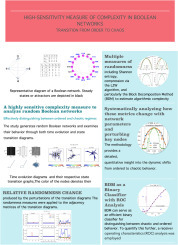
Highly-sensitive measure of complexity captures Boolean networks’ regimes and temporal order more optimally

Manuel de J. Luevano-Robledo, Alejandro Puga-Candelas

Physica D: Nonlinear Phenomena
Volume 482, November 2025, 134844

In this work, several random Boolean networks (RBNs) are generated and analyzed based on two fundamental features: their time evolution diagrams and their transition diagrams. For this purpose, we estimate randomness using three measures, among which Algorithmic Complexity stands out because it can (a) reveal transitions towards the chaotic regime more distinctly, and (b) disclose the algorithmic contribution of certain states to the transition diagrams, including their relationship with the order they occupy in the temporal evolution of the respective RBN. Results from both types of analysis illustrate the potential of Algorithmic Complexity and Perturbation Analysis for Boolean networks, paving the way for possible applications in modeling biological regulatory networks.

Read the full article at: www.sciencedirect.com