CCS 2026: The 2026 Conference on Complex Systems @ Binghamton, NY, USA. October 9 – 16

The 2026 Conference on Complex Systems will be held in Binghamton, New York, USA. Binghamton has a long history of creativity and innovation. The Greater Binghamton area has historically been called “the Valley of Opportunity” and attracted many immigrants (especially from Europe) since the mid-1800s, which has made the region’s rich and diverse culture and demographics. It is the birthplace of IBM (International Business Machines), Link Flight Simulator, McIntosh Laboratory, and a number of other pioneering ventures, fostering a spirit of ingenuity that continues to thrive.

Located at the confluence of the Susquehanna river (one of the oldest rivers in the world) and the Chenango river, the region boasts stunning natural beauty and offers ample opportunities for outdoor recreation, from hiking and biking to fishing and kayaking. In particular, in mid-October when CCS 2026 is held, the Binghamton area will showcase its renowned and breathtaking fall foliage. Furthermore, a vibrant arts and culture scene flourishes here, with numerous galleries, theaters, and music venues providing enriching experiences.

CCS 2026 will be held primarily in person on the main campus at Binghamton University, with an online participation option via Zoom.

Read the full article at: ccs2026.github.io
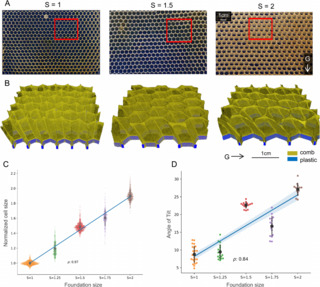
Honeybees adapt to a range of comb cell sizes by merging, tilting, and layering their construction

Honeybees are renowned for their skills in building intricate and adaptive combs that display notable variation in cell size. However, the extent of their adaptability in constructing honeycombs with varied cell sizes has not been thoroughly investigated. We use 3D-printing and X-ray microscopy to quantify honeybees’ capacity in adjusting the comb to different initial conditions. Our findings suggest three distinct comb construction modes in response to foundations with varying sizes of 3D-printed cells. For smaller foundations, bees occasionally merge adjacent cells to compensate for the reduced space. However, for larger cell sizes, the hive uses adaptive strategies such as tilting for foundations with cells up to twice the reference size and layering for cells that are three times larger than the reference cell. Our findings shed light on honeybees adaptive comb construction abilities, significant for the biology of self-organized collective behavior, as well as for bio-inspired engineered systems.

Gharooni-Fard G, Kavaraganahalli Prasanna C, Peleg O, López Jiménez F (2025) Honeybees adapt to a range of comb cell sizes by merging, tilting, and layering their construction. PLoS Biol 23(8): e3003253.

Read the full article at: journals.plos.org

Integrated information and predictive processing theories of consciousness: An adversarial collaborative review

Andrew W. Corcoran, Andrew M. Haun, Reinder Dorman, Giulio Tononi, Karl J. Friston, Cyriel M. A. Pennartz, TWCF: INTREPID Consortium

As neuroscientific theories of consciousness continue to proliferate, the need to assess their similarities and differences — as well as their predictive and explanatory power — becomes ever more pressing. Recently, a number of structured adversarial collaborations have been devised to test the competing predictions of several candidate theories of consciousness. In this review, we compare and contrast three theories being investigated in one such adversarial collaboration: Integrated Information Theory, Neurorepresentationalism, and Active Inference. We begin by presenting the core claims of each theory, before comparing them in terms of (1) the phenomena they seek to explain, (2) the sorts of explanations they avail, and (3) the methodological strategies they endorse. We then consider some of the inherent challenges of theory testing, and how adversarial collaboration addresses some of these difficulties. More specifically, we outline the key hypotheses that will be tested in this adversarial collaboration, and exemplify how contrasting empirical predictions may pertain to core and auxiliary components of each theory. Finally, we discuss how the data harvested across disparate experiments (and their replicates) may be formally integrated to provide a quantitative measure of the evidential support accrued under each theory. We suggest this approach to theory comparison may afford a useful metric for tracking the amount of scientific progress being made in consciousness research.

Read the full article at: arxiv.org

4th Meeting of the Spanish Society of Complex Systems January 21-23, 2026, Doñana Biological Station and University of Seville.

The Spanish Society of Complex Systems (CS³ Spain) was founded in 2022, during the International Conference on Complex Systems held in Palma de Mallorca, with the aim of strengthening the community of complex systems researchers in our country.

Since then, the Spanish Chapter has held three meetings: in Santander (2023), in Barcelona (2024) and in Madrid (2025), consolidating itself as a reference space for the exchange of ideas and interdisciplinary collaboration.

The 4th Meeting of the Spanish Society of Complex Systems will take place in Seville, from January 21 to 23, 2026, at the emblematic Uruguay Pavilion, headquarters of the University of Seville.

More at: cs3.es