Rethinking cognition: From animal to minimal

Lucia Regolin and Giorgio Vallortigara

Biochemical and Biophysical Research Communications
Volume 564

In its current use, cognition refers to all activities and processes dealing with the acquisition, storage, retrieval, and processing of information, and this seems to imply the involvement of a relatively complex nervous system. The term “relatively complex” usually refers to a direct comparison with the human or primate brain. And most research on comparative cognition and its neural bases has been restricted to a limited range of species within the vertebrate taxonomic groups. In the last 20 years, however, comparative research has been accumulating a huge bulk of scientific evidence for a wide range of processes in a variety of distantly related species, that seem to imply cognitive phenomena. Intriguing evidence of sophisticated behaviour has come from models which are extremely distant from primates, sometimes organisms with miniature brains. Great attention has attracted the (unexpected by many) evidence of cognitive behaviour in invertebrates and even in organisms classified outside of the Animal Kingdom. In 1980s Humberto Maturana suggested that: “Living systems are cognitive systems, and living as a process is a process of cognition”, extending this statement to all organisms “with or without a nervous system” [1]. This was of course anticipated by the famous statement by Konrad Lorenz according to whom “Life itself is a process of acquiring knowledge” [2].

Read the full article at: www.sciencedirect.com

See Special Issue: Rethinking Cognition: From Animal to Minimal
Association between COVID-19 outcomes and mask mandates, adherence, and attitudes

Dhaval Adjodah,Karthik Dinakar,Matteo Chinazzi,Samuel P. Fraiberger,Alex Pentland,Samantha Bates,Kyle Staller,Alessandro Vespignani,Deepak L. Bhatt

PLoS ONE 16(6): e0252315.

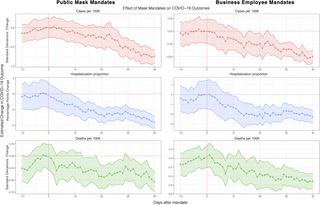
We extend previous studies on the impact of masks on COVID-19 outcomes by investigating an unprecedented breadth and depth of health outcomes, geographical resolutions, types of mask mandates, early versus later waves and controlling for other government interventions, mobility testing rate and weather. We show that mask mandates are associated with a statistically significant decrease in new cases (-3.55 per 100K), deaths (-0.13 per 100K), and the proportion of hospital admissions (-2.38 percentage points) up to 40 days after the introduction of mask mandates both at the state and county level. These effects are large, corresponding to 14% of the highest recorded number of cases, 13% of deaths, and 7% of admission proportion. We also find that mask mandates are linked to a 23.4 percentage point increase in mask adherence in four diverse states. Given the recent lifting of mandates, we estimate that the ending of mask mandates in these states is associated with a decrease of -3.19 percentage points in mask adherence and 12 per 100K (13% of the highest recorded number) of daily new cases with no significant effect on hospitalizations and deaths. Lastly, using a large novel survey dataset of 847 thousand responses in 69 countries, we introduce the novel results that community mask adherence and community attitudes towards masks are associated with a reduction in COVID-19 cases and deaths. Our results have policy implications for reinforcing the need to maintain and encourage mask-wearing by the public, especially in light of some states starting to remove their mask mandates.

Read the full article at: journals.plos.org

Socio-Economic Impact of the Covid-19 Pandemic in the U.S.

Jonathan Barlow and Irena Vodenska

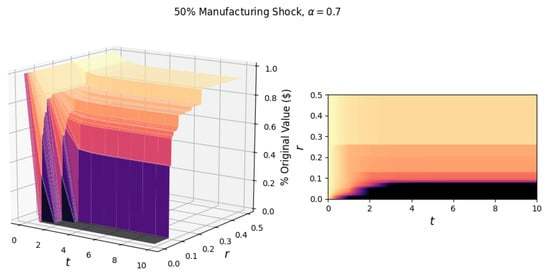
This paper proposes a dynamic cascade model to investigate the systemic risk posed by sector-level industries within the U.S. inter-industry network. We then use this model to study the effect of the disruptions presented by Covid-19 on the U.S. economy. We construct a weighted digraph G = (V,E,W) using the industry-by-industry total requirements table for 2018, provided by the Bureau of Economic Analysis (BEA). We impose an initial shock that disrupts the production capacity of one or more industries, and we calculate the propagation of production shortages with a modified Cobb–Douglas production function. For the Covid-19 case, we model the initial shock based on the loss of labor between March and April 2020 as reported by the Bureau of Labor Statistics (BLS). The industries within the network are assigned a resilience that determines the ability of an industry to absorb input losses, such that if the rate of input loss exceeds the resilience, the industry fails, and its outputs go to zero. We observed a critical resilience, such that, below this critical value, the network experienced a catastrophic cascade resulting in total network collapse. Lastly, we model the economic recovery from June 2020 through March 2021 using BLS data.

Read the full article at: www.mdpi.com

Dynamics of Disruption in Science and Technology

Michael Park, Erin Leahey, Russell Funk

Although the number of new scientific discoveries and technological
inventions has increased dramatically over the past century, there have also
been concerns of a slowdown in the progress of science and technology. We
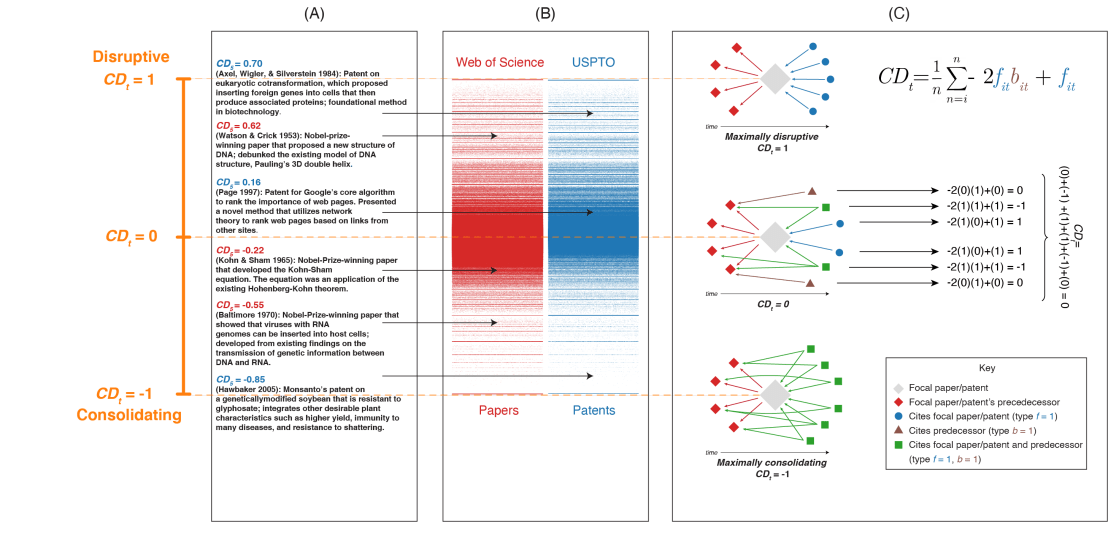
analyze 25 million papers and 4 million patents across 6 decades and find that
science and technology are becoming less disruptive of existing knowledge, a
pattern that holds nearly universally across fields. We link this decline in
disruptiveness to a narrowing in the utilization of existing knowledge.
Diminishing quality of published science and changes in citation practices are
unlikely to be responsible for this trend, suggesting that this pattern
represents a fundamental shift in science and technology.

Read the full article at: arxiv.org