The Impossibility of Automating Ambiguity

Abeba Birhane

Artificial Life

On the one hand, complexity science and enactive and embodied cognitive science approaches emphasize that people, as complex adaptive systems, are ambiguous, indeterminable, and inherently unpredictable. On the other, Machine Learning (ML) systems that claim to predict human behaviour are becoming ubiquitous in all spheres of social life. I contend that ubiquitous Artificial Intelligence (AI) and ML systems are close descendants of the Cartesian and Newtonian worldview in so far as they are tools that fundamentally sort, categorize, and classify the world, and forecast the future. Through the practice of clustering, sorting, and predicting human behaviour and action, these systems impose order, equilibrium, and stability to the active, fluid, messy, and unpredictable nature of human behaviour and the social world at large. Grounded in complexity science and enactive and embodied cognitive science approaches, this article emphasizes why people, embedded in social systems, are indeterminable and unpredictable. When ML systems “pick up” patterns and clusters, this often amounts to identifying historically and socially held norms, conventions, and stereotypes. Machine prediction of social behaviour, I argue, is not only erroneous but also presents real harm to those at the margins of society.

Read the full article at: direct.mit.edu
Bad machines corrupt good morals

Nils Köbis, Jean-François Bonnefon & Iyad Rahwan 
Nature Human Behaviour (2021)

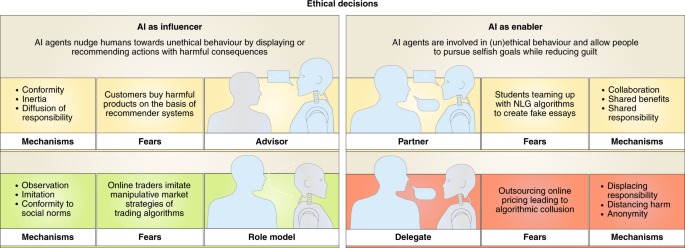
As machines powered by artificial intelligence (AI) influence humans’ behaviour in ways that are both like and unlike the ways humans influence each other, worry emerges about the corrupting power of AI agents. To estimate the empirical validity of these fears, we review the available evidence from behavioural science, human–computer interaction and AI research. We propose four main social roles through which both humans and machines can influence ethical behaviour. These are: role model, advisor, partner and delegate. When AI agents become influencers (role models or advisors), their corrupting power may not exceed the corrupting power of humans (yet). However, AI agents acting as enablers of unethical behaviour (partners or delegates) have many characteristics that may let people reap unethical benefits while feeling good about themselves, a potentially perilous interaction. On the basis of these insights, we outline a research agenda to gain behavioural insights for better AI oversight.

Read the full article at: www.nature.com

Evolution of Autopoiesis and Multicellularity in the Game of Life

Peter D. Turney

Artificial Life

Recently we introduced a model of symbiosis, Model-S, based on the evolution of seed patterns in Conway’s Game of Life. In the model, the fitness of a seed pattern is measured by one-on-one competitions in the Immigration Game, a two-player variation of the Game of Life. Our previous article showed that Model-S can serve as a highly abstract, simplified model of biological life: (1) The initial seed pattern is analogous to a genome. (2) The changes as the game runs are analogous to the development of the phenome. (3) Tournament selection in Model-S is analogous to natural selection in biology. (4) The Immigration Game in Model-S is analogous to competition in biology. (5) The first three layers in Model-S are analogous to biological reproduction. (6) The fusion of seed patterns in Model-S is analogous to symbiosis. The current article takes this analogy two steps further: (7) Autopoietic structures in the Game of Life (still lifes, oscillators, and spaceships—collectively known as ashes) are analogous to cells in biology. (8) The seed patterns in the Game of Life give rise to multiple, diverse, cooperating autopoietic structures, analogous to multicellular biological life. We use the apgsearch software (Ash Pattern Generator Search), developed by Adam Goucher for the study of ashes, to analyze autopoiesis and multicellularity in Model-S. We find that the fitness of evolved seed patterns in Model-S is highly correlated with the diversity and quantity of multicellular autopoietic structures.

Read the full article at: direct.mit.edu
Revealing Consensus and Dissensus between Network Partitions

Tiago P. Peixoto
Phys. Rev. X 11, 021003

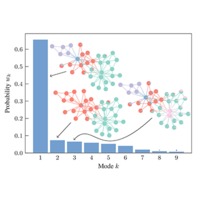
Community detection methods attempt to divide a network into groups of nodes that share similar properties, thus revealing its large-scale structure. A major challenge when employing such methods is that they are often degenerate, typically yielding a complex landscape of competing answers. As an attempt to extract understanding from a population of alternative solutions, many methods exist to establish a consensus among them in the form of a single partition “point estimate” that summarizes the whole distribution. Here, we show that it is, in general, not possible to obtain a consistent answer from such point estimates when the underlying distribution is too heterogeneous. As an alternative, we provide a comprehensive set of methods designed to characterize and summarize complex populations of partitions in a manner that captures not only the existing consensus but also the dissensus between elements of the population. Our approach is able to model mixed populations of partitions, where multiple consensuses can coexist, representing different competing hypotheses for the network structure. We also show how our methods can be used to compare pairs of partitions, how they can be generalized to hierarchical divisions, and how they can be used to perform statistical model selection between competing hypotheses.

Read the full article at: link.aps.org

The universal visitation law of human mobility

Markus Schläpfer, Lei Dong, Kevin O’Keeffe, Paolo Santi, Michael Szell, Hadrien Salat, Samuel Anklesaria, Mohammad Vazifeh, Carlo Ratti & Geoffrey B. West
Nature volume 593, pages 522–527 (2021)

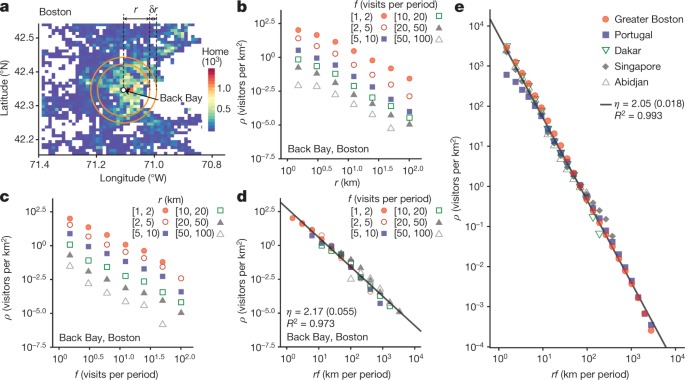
Human mobility impacts many aspects of a city, from its spatial structure to its response to an epidemic. It is also ultimately key to social interactions, innovation and productivity. However, our quantitative understanding of the aggregate movements of individuals remains incomplete. Existing models—such as the gravity law or the radiation model—concentrate on the purely spatial dependence of mobility flows and do not capture the varying frequencies of recurrent visits to the same locations. Here we reveal a simple and robust scaling law that captures the temporal and spatial spectrum of population movement on the basis of large-scale mobility data from diverse cities around the globe. According to this law, the number of visitors to any location decreases as the inverse square of the product of their visiting frequency and travel distance. We further show that the spatio-temporal flows to different locations give rise to prominent spatial clusters with an area distribution that follows Zipf’s law. Finally, we build an individual mobility model based on exploration and preferential return to provide a mechanistic explanation for the discovered scaling law and the emerging spatial structure. Our findings corroborate long-standing conjectures in human geography (such as central place theory and Weber’s theory of emergent optimality) and allow for predictions of recurrent flows, providing a basis for applications in urban planning, traffic engineering and the mitigation of epidemic diseases.

Read the full article at: www.nature.com