When less is more: Robot swarms adapt better to changes with constrained communication

Mohamed S. Talamali, Arindam Saha, James A. R. Marshall, and Andreagiovanni Reina
Science Robotics 6(56): eabf1416
https://doi.org/10.1126/scirobotics.abf1416 
video: https://bcove.video/3zwyQpA 

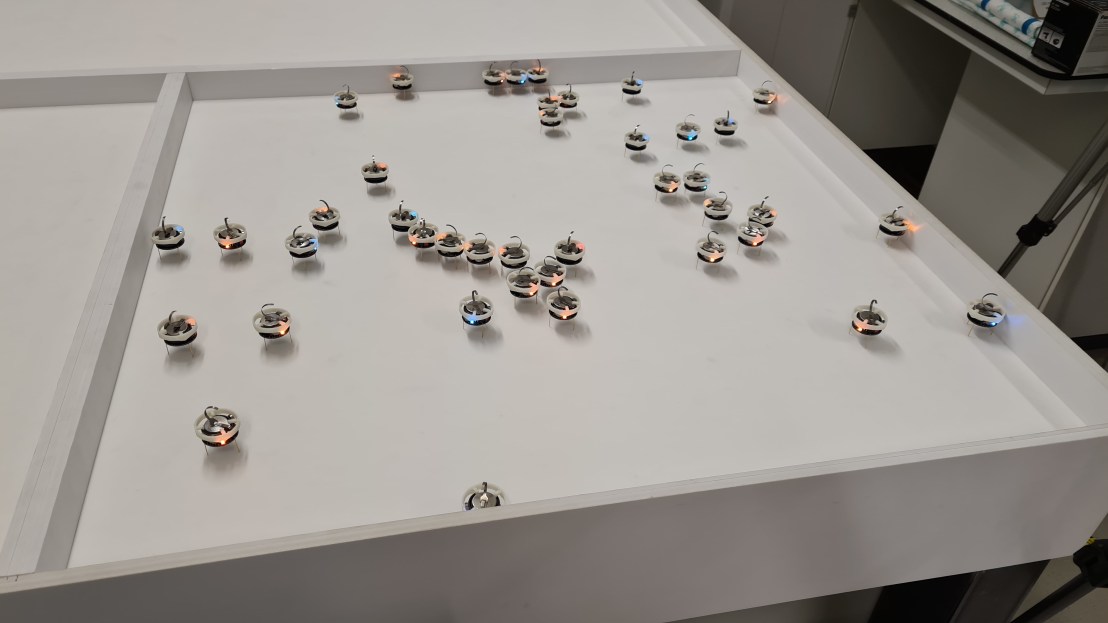
You found a new better bar, with nicer drinks and healthier snacks, but you do not know how to convince your friends to deviate from their established favourite bar and take them to the new better place. Next time, you should consider convincing your friends one by one, rather than reaching out in the group chat. Recent research published today in Science Robotics, suggests that this strategy will increase your probability of convincing the entire group to choose the better bar.
The study has found that a population of naive individuals, when globally connected, can be unable to discard outdated beliefs and adopt better available alternatives. Instead, when the social network is sparse and individuals only share information locally, the population can effectively adapt to changes and reach an agreement in favour of the best option.
Researchers investigated how a swarm of autonomous robots could adapt to environmental changes and found the counterintuitive result that reduced social information would improve the spreading of localised information, and, in turn, allows an informed minority to effectively change the opinion of the entire group. This finding is opposed to the widely accepted and intuitive belief in network science that more connections lead to more effective information exchange. While information spreading speed may indeed increase, the study showed that adaptation—the ability to modify the group’s belief in light of new information—is impaired.

Read the full article at: robotics.sciencemag.org

Atlas of Forecasts: Modeling and Mapping Desirable Futures

Forecasting the future with advanced data models and visualizations.

To envision and create the futures we want, society needs an appropriate understanding of the likely impact of alternative actions. Data models and visualizations offer a way to understand and intelligently manage complex, interlinked systems in science and technology, education, and policymaking. Atlas of Forecasts, from the creator of Atlas of Science and Atlas of Knowledge, shows how we can use data to predict, communicate, and ultimately attain desirable futures.

Using advanced data visualizations to introduce different types of computational models, Atlas of Forecasts demonstrates how models can inform effective decision-making in education, science, technology, and policymaking. The models and maps presented aim to help anyone understand key processes and outcomes of complex systems dynamics, including which human skills are needed in an artificial intelligence–empowered economy; what progress in science and technology is likely to be made; and how policymakers can future-proof regions or nations. This Atlas offers a driver’s seat-perspective for a test-drive of the future.

More at: mitpress.mit.edu

Self-organized multistability in the forest fire model

Diego Rybski, Van Butsic, and Jan W. Kantelhardt

Phys. Rev. E 104, L012201 – Published 29 July 2021

The forest fire model in statistical physics represents a paradigm for systems close to but not completely at criticality. For large tree growth probabilities p we identify periodic attractors, where the tree density ρ oscillates between discrete values. For lower p this self-organized multistability persists with incrementing numbers of states. Even at low p the system remains quasiperiodic with a frequency ≈p on the way to chaos. In addition, the power-spectrum shows 1/f^2 scaling (Brownian noise) at the low frequencies f, which turns into white noise for very long simulation times.

Read the full article at: link.aps.org

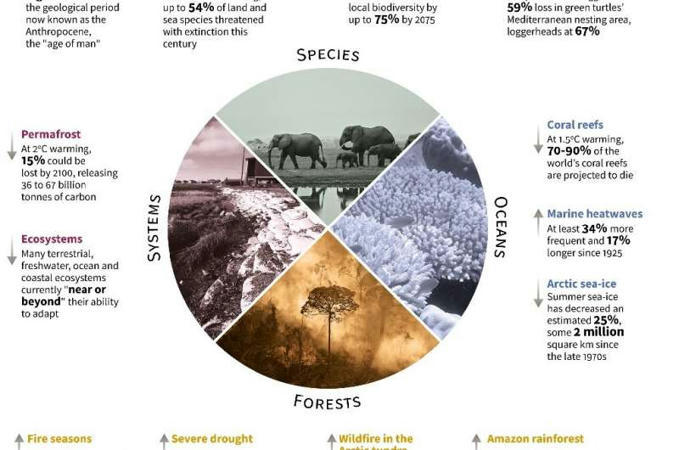
Global Disaster Coming? Earth’s ‘Vital Signs’ are Worsening Rapidly as Humanity’s Impact Deepens

The global economy’s business-as-usual approach to climate change has seen Earth’s “vital signs” deteriorate to record levels, an influential group of scientists said Wednesday, warning that several climate tipping points were now imminent. The researchers, part of a group of more than 14,000 scientists who have signed on to an initiative declaring a worldwide climate emergency, said that governments had consistently failed to address the root cause of climate change: “the overexploitation of the Earth”.

Read the full article at: phys.org

Modelling and measuring open-endedness

Susan Stepney

Generating open-ended (OE) systems is a major and as yet unachieved goal of ALife research. Here I discuss aspects of defining, modelling, and measuring OE. I apply a simple model of OE to itself, thereby expanding the concept, to demonstrate how truly open and vast open-endedness is.

Read the full article at: workshops.alife.org